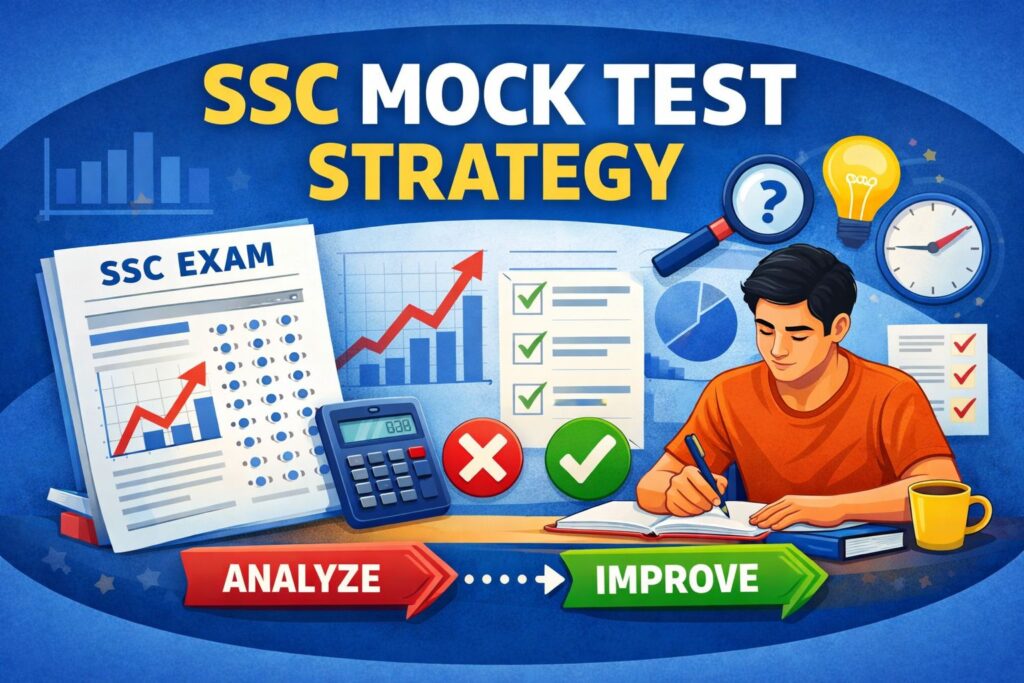
Mock tests are not just practice papers for SSC exams—they are the biggest score-boosting tool when used correctly. This guide explains how many mock tests you actually need and how to analyze them smartly to avoid common mistakes and follow a result-oriented SSC study strategy.
Why Mock Tests Are Non-Negotiable for SSC Exams
Many SSC aspirants believe that completing books and watching lectures is enough to clear the exam. In reality, this approach creates a false sense of preparation. SSC is not just about knowing concepts—it is about applying them accurately under time pressure, and that skill can only be developed through mock tests.
Mock tests prepare you for the real exam environment. They train your brain to handle pressure, distractions, negative marking, and strict time limits. Without regular mocks, even well-prepared candidates often fail to convert knowledge into marks.
Another major benefit of mock tests is self-diagnosis. They clearly show:
- Which topics are weak
- Where you are losing time
- Which questions you should avoid
- Whether your accuracy is exam-level or not
Books tell you what to study, but mock tests tell you what you are doing wrong.
Mock tests also help in building exam temperament. SSC exams demand speed, smart question selection, and emotional control. Candidates who never practiced mocks often panic in the real exam, attempt unnecessary questions, or mismanage time—leading to avoidable mistakes.
Most importantly, mock tests bring direction to preparation. Instead of studying randomly, you start focusing only on areas that actually improve your score. This is why toppers treat mock tests as a core part of preparation, not as an optional activity.
In short, if book study builds knowledge, mock tests convert that knowledge into marks—and without marks, SSC selection is impossible.
Choosing the Wrong SSC Books Can Ruin Your Preparation!
Don’t waste months studying from outdated or ineffective material. Check this expert-recommended list of SSC books before you start your preparation journey.
View Best Books for SSC ExamsHow Many Mock Tests Are Enough for SSC Preparation?
One of the most common questions among SSC aspirants is, “How many mock tests should I give?” The honest answer is there is no fixed magic number. The right number of mock tests depends on your preparation stage, not on what others are doing.
Giving too few mock tests keeps you underprepared, while giving too many without analysis leads to burnout and confusion. The goal is balanced, stage-wise testing.
2.1 Stage-Wise Mock Test Count
Beginner Stage (Early Preparation)
At this stage, your focus should be on understanding concepts and identifying weak areas.
- Full-length mocks: 1 mock every 7–10 days
- Subject-wise mocks: 2–3 per week
The purpose here is not scoring high but understanding the exam pattern and your current level.
Intermediate Stage (Concepts Mostly Covered)
Now your preparation becomes more exam-oriented.
- Full-length mocks: 1–2 per week
- Subject-wise mocks (weak areas): 1–2 per week
This stage is about improving accuracy, speed, and question selection.
Final Stage (Last 2–3 Months Before Exam)
This is where mock tests become a daily habit—but in a controlled way.
- Full-length mocks: 2–3 per week
- Light revision or sectional practice on other days
Avoid giving a full mock every day unless you can properly analyze it.
2.2 Subject-Wise Mocks vs Full-Length Mocks
Both types of mock tests serve different purposes and must be used smartly.
Subject-wise mocks help you:
- Strengthen weak topics
- Improve speed in individual sections
- Build confidence gradually
Full-length mocks help you:
- Practice time management across all sections
- Decide section order
- Improve overall exam strategy
The ideal approach is to start with subject-wise mocks and slowly shift focus towards full-length mocks as the exam approaches.
Many aspirants make the mistake of attempting only full mocks from the beginning, which leads to repeated mistakes and low confidence. A balanced mix is the smart SSC study strategy that actually improves scores.
Ideal Mock Test Frequency (Weekly Plan)
Giving mock tests is important, but giving them at the right frequency is what actually improves performance. Many SSC aspirants either give too few mocks or overdo it by attempting mocks every day without proper recovery or analysis.
The ideal mock test frequency depends on your daily schedule and preparation time.
For Full-Time SSC Aspirants
If you are preparing full-time and can study 6–8 hours a day:
- 1–2 full-length mocks per week are enough for steady improvement
- Keep 2–3 days reserved only for analysis and revision
- Use non-mock days for strengthening weak topics identified from previous mocks
This approach keeps your preparation focused and prevents burnout.
For Working Professionals or College Students
If you have limited time due to work or studies:
- 1 full-length mock per week is sufficient
- Take the mock on a fixed day (weekend or free day)
- Spend the next 2–3 days analyzing mistakes and revising weak areas
Consistency matters more than frequency. Even one well-analyzed mock per week can significantly improve your score.
Why Daily Mock Tests Are Not Always a Good Idea
Many aspirants believe that giving daily mock tests is the fastest way to improve. In reality, this often leads to:
- Mental fatigue
- Repeated mistakes
- No time for proper analysis
- Falling confidence due to fluctuating scores
Mock tests are meant to guide your study, not replace it. Without analysis, daily mocks become one of the most common SSC preparation mistakes.
A smart weekly plan always follows this cycle:
Mock → Analysis → Improvement → Next Mock
This cycle ensures continuous growth instead of random effort.
When Should You Start Taking Mock Tests?
A common myth in SSC preparation is that mock tests should be taken only in the last two or three months before the exam. This belief is one of the biggest reasons why many aspirants struggle despite studying for a long time.
The truth is, mock tests should start much earlier, but in the right way.
You should begin taking mock tests as soon as you understand basic concepts of all major subjects. You do not need to complete the entire syllabus before starting mocks. Even early-stage mocks provide valuable feedback about your preparation level.
Why Starting Mocks Early Is Important
Early mock tests help you:
- Understand the real SSC exam pattern
- Identify weak subjects and topics early
- Avoid wasting months on low-return areas
- Build confidence gradually instead of suddenly
When you delay mock tests, you risk preparing in the wrong direction. Many aspirants realize their mistakes only after giving their first mock very late, when correction becomes difficult.
The Right Way to Start Early Mocks
In the beginning:
- Do not focus on score or rank
- Treat mocks as a diagnostic tool
- Analyze mistakes calmly and honestly
Low scores in early mocks are normal and useful. They show you what needs improvement and help you design a more effective preparation plan.
A well-timed mock test strategy ensures that by the time the exam arrives, you are already comfortable with pressure, time limits, and question patterns. This is what separates confident candidates from nervous ones in the exam hall.
How to Attempt an SSC Mock Test Correctly
Giving a mock test without the right approach reduces its value. To get real improvement, you must treat every mock test like the actual SSC exam, not like a casual practice session.
Before the Mock Test
Before starting the mock:
- Choose a quiet environment with no distractions
- Set a fixed time similar to your actual exam slot
- Keep a calm and focused mindset
Avoid giving mocks when you are tired or distracted, as it gives misleading results.
During the Mock Test
While attempting the mock, follow a clear strategy:
- Do not try to attempt every question
- Focus on accuracy first, then speed
- Skip time-consuming or confusing questions
- Stick to your planned section order
Do not change your strategy in the middle just because a section feels difficult. Panic leads to poor decision-making and unnecessary mistakes.
Time Management During the Mock
Time management is crucial:
- Allocate time to each section in advance
- Move on if a question takes too long
- Keep buffer time for review if possible
Successful candidates are not those who attempt the most questions, but those who attempt the right questions.
After Submitting the Mock
Once the mock is submitted:
- Do not immediately check rank or compare scores
- Avoid emotional reactions to low or high marks
- Take a short break before starting analysis
The real benefit of a mock test begins after submission, not during the test.
Mock Test Analysis – The Real Game Changer
Many SSC aspirants give a large number of mock tests but still fail to see improvement in their scores. The reason is simple: they focus on attempting mocks, not analyzing them.
A mock test without analysis is just another practice paper. It may show your score, but it does not improve it.
Why Analysis Matters More Than the Number of Mocks
Mock test analysis helps you understand:
- Why you lost marks
- Whether mistakes were due to concept gaps or poor decisions
- How much time you wasted on low-value questions
Without analysis, aspirants keep repeating the same mistakes in every mock. This creates frustration and the false belief that “mock tests are not helping.”
Why Most Aspirants Fail to Improve Despite Many Mocks
The most common reasons are:
- Only checking the final score and rank
- Ignoring wrong and unattempted questions
- Not revising mistakes after analysis
- Giving the next mock without fixing previous errors
This approach leads to stagnation. Scores remain stuck within the same range, no matter how many mocks are attempted.
The Right Mindset for Mock Test Analysis
Analysis should be treated as a learning session, not a judgment of your ability. Every wrong question is an opportunity to improve, and every mock test provides data that can guide your preparation.
Candidates who clear SSC exams are not those who give the most mocks, but those who learn the most from each mock. This mindset shift alone can dramatically change your results.
Step-by-Step SSC Mock Test Analysis Method
Proper mock test analysis follows a clear, step-by-step process. Skipping any step reduces the effectiveness of the entire exercise. This method is simple, practical, and suitable for all SSC exams.
1. Analyze Accuracy First
Start by checking how many questions you attempted and how many were correct.
- Calculate your accuracy percentage
- Identify careless mistakes
- Separate conceptual errors from silly errors
For SSC exams, maintaining high accuracy is more important than attempting a large number of questions. Repeated careless mistakes indicate a lack of focus or rushing during the exam.
2. Analyze Time Management
Next, analyze how you used your time:
- Time spent on each section
- Questions that consumed too much time
- Sections where you felt rushed
Identify time traps—questions that look easy but take longer than expected. Learning to skip such questions is a key skill in SSC exams.
3. Analyze Question Types and Topics
Now focus on the type of questions:
- Topics where mistakes are repeated
- Questions you skipped but could have solved
- High-scoring topics that deserve more attention
This step helps you identify high-return areas and avoid wasting time on low-impact topics.
4. Analyze Unattempted Questions
Unattempted questions also reveal important insights:
- Were they skipped due to lack of time?
- Were they skipped due to weak concepts?
- Were they unnecessarily avoided due to fear?
Understanding why you left questions improves future decision-making.
5. Convert Analysis into Action
Analysis is useless unless it leads to improvement:
- Revise weak concepts immediately
- Practice similar questions
- Apply corrections in the next mock
This cycle—attempt, analyze, improve, repeat—is the foundation of a smart SSC study strategy.
Creating a Personal Error Notebook from Mock Tests
One of the most effective ways to improve SSC scores is maintaining a personal error notebook. This notebook acts as a mirror of your weaknesses and helps ensure that the same mistakes are not repeated again.
What Is an Error Notebook?
An error notebook is a simple record of:
- Questions you got wrong
- Topics where mistakes are frequent
- Concepts that confuse you during mocks
It can be digital or handwritten—the format does not matter. What matters is regular updating and revision.
What to Write in the Error Notebook
For each mistake, note:
- The topic and question type
- Why the mistake happened (conceptual, calculation, confusion, time pressure)
- The correct method or shortcut
- A reminder to avoid the same error
Avoid copying full questions. Focus on learning points, not repetition.
How Often Should You Update and Revise It?
- Update the notebook after every mock test
- Revise it before attempting the next mock
- Do a quick revision before the actual exam
This habit ensures continuous improvement and helps you avoid repeating common SSC preparation mistakes.
Why an Error Notebook Works So Well
Most aspirants rely on memory, which fades quickly under exam pressure. An error notebook creates a permanent correction system. Over time, you will notice that:
- Repeated mistakes disappear
- Accuracy improves naturally
- Confidence increases with every mock
This simple tool can create a visible jump in your scores within a few weeks.
How to Improve Score After Every Mock Test
Improvement after mock tests does not happen automatically. It requires intentional correction and smart follow-up actions. Each mock test should leave you better prepared than before.
Focus on One Improvement at a Time
Do not try to fix everything at once. After each mock:
- Choose 2–3 major issues
- Work on them before the next mock
- Ignore minor flaws temporarily
This focused approach leads to steady and visible progress.
Strengthen Weak Areas Identified in Analysis
Use mock analysis to decide what to study next:
- Revise weak concepts immediately
- Practice similar questions
- Avoid over-studying strong topics
Let your mock results guide your daily study plan.
Improve Question Selection
Many marks are lost due to poor question selection, not lack of knowledge.
- Avoid questions that consume excessive time
- Prioritize high-accuracy questions
- Skip confusing questions early
Better selection often improves score without increasing attempts.
Refine Time Management Gradually
Do not change your time strategy after every mock.
- Test small adjustments
- Observe results over 2–3 mocks
- Lock a strategy once it works
Stability in approach builds confidence and consistency.
Track Progress Objectively
Maintain a simple record of:
- Scores
- Accuracy
- Section-wise performance
This helps you see real progress instead of relying on emotions after each mock.
Common Mock Test Mistakes SSC Aspirants Make
Mock tests are meant to improve performance, but when used incorrectly, they can slow down progress. Many aspirants unknowingly repeat the same errors, which prevents score improvement despite hard work.
One of the biggest mistakes is giving too many mock tests without proper analysis. Attempting multiple mocks back-to-back may feel productive, but without learning from mistakes, it adds little value. This habit often leads to frustration and burnout.
Another common mistake is obsessing over scores and ranks. Mock tests are practice tools, not final results. Comparing your mock score with others can damage confidence and distract you from real improvement.
Many aspirants also make the mistake of copying strategies blindly. A strategy that works for one candidate may not suit another. Your mock test analysis should guide your strategy, not online trends or peer pressure.
Ignoring repeated errors is another serious issue. When the same type of mistake appears in multiple mocks and is not corrected, it becomes a permanent weakness. This is one of the most common SSC preparation mistakes that prevents aspirants from breaking their score plateau.
Finally, changing strategy after every mock creates confusion. Constant experimentation without enough data leads to instability and poor performance. Improvement requires patience, consistency, and disciplined analysis.
Avoiding these mistakes can significantly improve your results without increasing study hours.
Smart SSC Study Strategy Using Mock Tests
Mock tests should not be treated as isolated events. When used correctly, they become the foundation of a smart SSC study strategy that continuously improves performance.
The Mock-Based Study Cycle
A smart preparation cycle looks like this:
Mock Test → Detailed Analysis → Targeted Study → Revision → Next Mock
This cycle ensures that every study session is guided by real performance data instead of guesswork.
How Mock Tests Guide Daily Study
Mock test analysis tells you:
- Which topics need immediate revision
- Which subjects require more practice
- Where time management needs improvement
Instead of studying everything equally, you focus only on areas that actually increase your score.
Using Mocks to Plan Weekly Study
At the end of each mock:
- List weak topics
- Allocate study hours accordingly
- Reduce time spent on already strong areas
This prevents over-preparation and keeps your effort balanced.
Smart Revision Through Mock Data
Mock tests highlight the topics that cause repeated errors. Revising these topics regularly ensures that:
- Weaknesses turn into strengths
- Accuracy improves naturally
- Confidence increases before the exam
This data-driven approach is far more effective than random revision.
When mock tests and study plans work together, preparation becomes structured, efficient, and stress-free. This is how serious aspirants move ahead while others remain stuck despite hard work.
How Mock Test Strategy Changes for Tier-1 vs Tier-2
SSC exams have multiple tiers, and each tier demands a slightly different mock test approach. Using the same strategy for all tiers can limit your score potential.
Mock Test Strategy for Tier-1
Tier-1 is primarily about speed, accuracy, and smart selection.
- Focus on increasing attempt efficiency
- Practice skipping low-return questions
- Improve sectional balance
- Maintain high accuracy to avoid negative marking
Mock tests at this level help you decide:
- Section order
- Time allocation per section
- Safe attempt range
Tier-1 mocks should train you to perform confidently under strict time pressure.
Mock Test Strategy for Tier-2
Tier-2 demands deeper accuracy and stronger concepts.
- Focus on reducing silly mistakes
- Practice longer and calculation-heavy questions
- Strengthen conceptual clarity
- Analyze mistakes in detail
Here, mock tests help refine precision rather than speed alone. Even small errors can have a big impact on final results, so careful analysis becomes more important.
Transitioning Between Tiers
After clearing Tier-1, shift your mock strategy:
- Reduce guesswork
- Increase focus on accuracy
- Spend more time on analysis
Understanding this difference prevents overconfidence and ensures continuous improvement across stages.
FAQs on SSC Mock Test Strategy
Q1. How many mock tests are too many for SSC?
There is no fixed number, but giving mock tests without proper analysis is too many. If you are not revising mistakes and scores are not improving, reduce mock frequency and increase analysis time.
Q2. Is giving daily mock tests good for SSC preparation?
Daily mock tests are not recommended for most aspirants. Without sufficient analysis and revision, daily mocks often lead to fatigue and repeated mistakes rather than improvement.
Q3. What should I do if my mock test scores are not improving?
Check whether you are analyzing your mocks properly. Focus on accuracy, revise weak topics, improve question selection, and track repeated errors instead of increasing the number of mock tests.
Q4. Can mock tests alone help clear SSC exams?
No. Mock tests are a powerful tool, but they cannot replace concept building and practice. They should be used alongside proper study and revision.
Q5. When should I stop giving mock tests before the exam?
Do not stop mock tests completely. Reduce frequency in the final days and focus on light revision, error notebook review, and confidence building.
Choosing the Wrong SSC Books Can Ruin Your Preparation!
Don’t waste months studying from outdated or ineffective material. Check this expert-recommended list of SSC books before you start your preparation journey.
View Best Books for SSC ExamsFinal Advice – Use Mocks as a Tool, Not a Test
Mock tests are one of the most powerful resources in SSC preparation, but only when used with the right mindset. They are not meant to judge your ability or predict your final result. Their real purpose is to show you where to improve.
Instead of chasing high scores or ranks in every mock, focus on learning from mistakes and making small improvements consistently. A single well-analyzed mock test is far more valuable than multiple mocks attempted without reflection.
Remember, SSC selection is not about how many hours you study or how many mock tests you give. It is about how smartly you convert effort into marks. When mock tests guide your study plan, revision becomes focused, confidence grows naturally, and performance stabilizes.
Stay patient, trust the process, and keep refining your strategy. Used correctly, mock tests can turn average preparation into a high-scoring, exam-ready performance.