
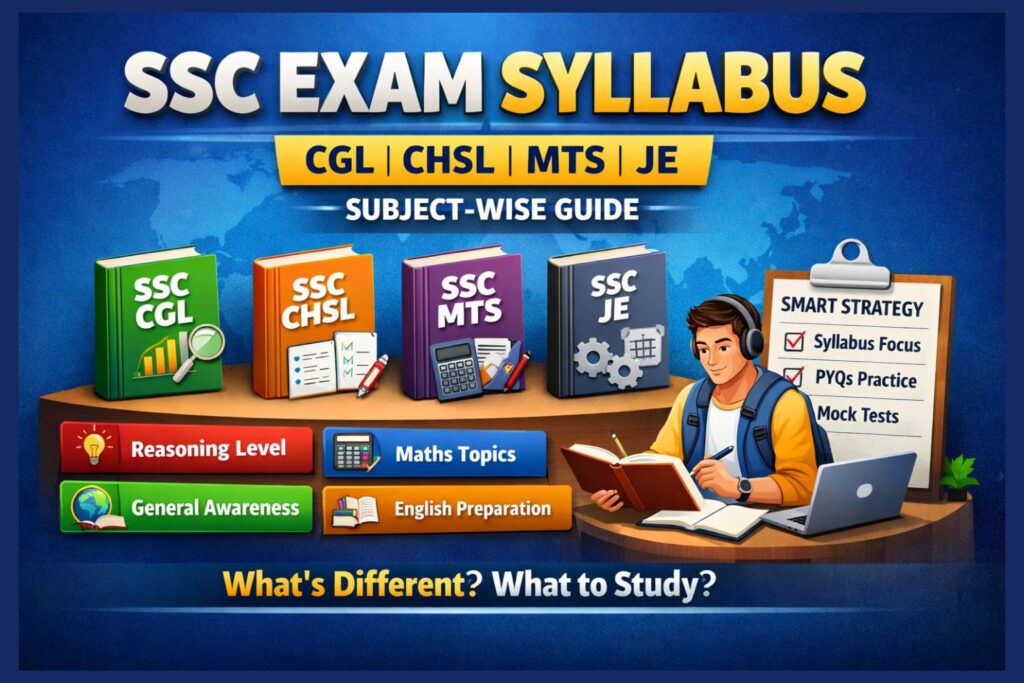
Most SSC aspirants fail not because of lack of hard work, but because they prepare without fully understanding the syllabus and exam pattern.
If you clearly know what to study and what to skip, your preparation becomes faster, smarter, and more focused.
This guide explains the SSC CGL, CHSL, MTS, and JE syllabus in a simple, subject-wise manner.
Overview of SSC Exams
What is SSC?
The Staff Selection Commission (SSC) is a central government organization responsible for recruiting candidates for various Group B and Group C posts in ministries, departments, and offices of the Government of India.
Every year, SSC conducts multiple competitive exams for candidates from different educational backgrounds—10th pass, 12th pass, diploma holders, and graduates.
Why Understanding the SSC Syllabus Is Important
Many beginners make the mistake of buying multiple books before even reading the syllabus.
In SSC exams, questions are strictly syllabus-based, and repeated topics appear every year.
A clear syllabus understanding helps you:
- Avoid unnecessary topics
- Focus on high-weightage areas
- Choose the right study material
- Plan preparation according to exam level
SSC Exams Covered in This Guide
This post explains the syllabus and exam pattern of the following major SSC exams:
1. SSC CGL (Combined Graduate Level)
- For graduates
- Recruits candidates for posts like Assistant Section Officer, Inspector, Auditor, Accountant, etc.
- Considered the most competitive SSC exam
2. SSC CHSL (Combined Higher Secondary Level)
- For 12th pass candidates
- Posts include Lower Division Clerk (LDC), Junior Secretariat Assistant (JSA), and Data Entry Operator (DEO)
- Popular among beginners
3. SSC MTS (Multi-Tasking Staff)
- For 10th pass candidates
- Includes posts like MTS and Havaldar
- Entry-level government job with simpler syllabus
4. SSC JE (Junior Engineer)
- For engineering diploma or degree holders
- Special focus on technical subjects (Civil, Mechanical, Electrical)
- Limited vacancies but high respect and technical role
One Important Thing to Remember
Although these SSC exams look similar, their syllabus depth, difficulty level, and exam pattern are different.
Preparing all exams with the same strategy is a common mistake—which we will help you avoid in this guide.
Choosing the Wrong SSC Books Can Ruin Your Preparation!
Don’t waste months studying from outdated or ineffective material. Check this expert-recommended list of SSC books before you start your preparation journey.
View Best Books for SSC ExamsSSC Exam Pattern Explained (Tier-Wise Structure)
Before starting syllabus topic-by-topic, it is very important to understand how SSC exams are conducted.
The exam pattern tells you how many stages are there, what type of questions are asked, and where marks really matter.
Many aspirants study hard but fail because they prepare without aligning their study with the actual exam pattern.
1. Common Features Across Most SSC Exams
Although SSC conducts different exams, many features are common across them:
- Mode of Exam:
Most SSC exams are conducted in online (CBT – Computer Based Test) mode. - Question Type:
- Objective (MCQs) in early stages
- Descriptive or Skill Test in later stages (for some exams)
- Negative Marking:
- Generally 0.25 or 0.50 marks deducted for each wrong answer
- Not applicable in some qualifying sections (explained exam-wise later)
- Normalization of Marks:
Since exams are conducted in multiple shifts, SSC uses a normalization method to ensure fairness across shifts.
2. Tier / Stage System in SSC Exams
SSC exams are usually conducted in multiple stages, also called Tiers or Papers.
Each tier has a specific purpose.
Let’s understand this concept clearly.
Tier-I (Screening / Preliminary Stage)
- Objective type (MCQs)
- Tests basic understanding of:
- Reasoning
- Maths
- English
- General Awareness
- Conducted online
- Very important for cut-off
- Speed + accuracy matter most
👉 Present in: SSC CGL, CHSL, MTS
Tier-II (Main Examination)
- Higher difficulty level
- Focuses on:
- Advanced Maths
- English Language
- Subject-specific knowledge
- Marks usually count for final merit
👉 Present in: SSC CGL, CHSL, JE
Descriptive / Skill Test / Typing Test
Some SSC exams also include a skill-based or descriptive stage to check real-world abilities.
Examples:
- Essay & Letter writing
- Typing speed
- Data entry speed
👉 Mainly for:
- SSC CHSL
- SSC CGL
- SSC MTS (Havaldar post)
3. Exam-Wise Pattern Summary (Quick Understanding)
- SSC CGL:
Tier-I → Tier-II → Skill Test (where applicable) - SSC CHSL:
Tier-I → Tier-II (Descriptive) → Skill / Typing Test - SSC MTS:
Paper-I (Session-I + Session-II) → PET (Havaldar only) - SSC JE:
Paper-I (Objective) → Paper-II (Technical)
👉 This means not all SSC exams stop at MCQs. Ignoring later stages is a serious mistake.
Why Exam Pattern Matters Before Syllabus
Understanding the exam pattern helps you:
- Decide how deep to study each subject
- Know which stage is qualifying and which is scoring
- Avoid wasting time on low-importance areas
- Prepare with a clear end-goal
Only after this clarity should you move to subject-wise syllabus, which we’ll start next.
SSC CGL Syllabus (Subject-Wise Detailed)
SSC CGL is considered the most competitive SSC exam, so its syllabus is also the most detailed and structured.
If you understand SSC CGL syllabus properly, preparing for other SSC exams becomes much easier.
SSC CGL is conducted in two main tiers, followed by a skill test where applicable.
1. SSC CGL Tier-I Syllabus (Preliminary Stage)
Tier-I is an objective, screening-level exam, but do not underestimate it.
Your Tier-I score decides whether you move forward or not.
Subjects in SSC CGL Tier-I
There are four sections, each equally important:
1. General Intelligence & Reasoning
This section tests your logical thinking and problem-solving ability, not memorization.
Important Topics:
- Analogy
- Classification
- Series (Number, Alphabet)
- Coding–Decoding
- Blood Relations
- Direction Sense
- Venn Diagrams
- Syllogism
- Non-verbal Reasoning (Figures, Patterns)
- Mirror & Water Image
- Paper Folding & Cutting
👉 Level: Easy to Moderate
👉 Practice-based, not theory-heavy
2. General Awareness (GA)
This is a knowledge-based section and can be scoring if prepared smartly.
Important Topics:
- History (Ancient, Medieval, Modern)
- Geography (India & World – basics)
- Indian Polity & Constitution
- Indian Economy (basic concepts)
- General Science (Physics, Chemistry, Biology – school level)
- Current Affairs (last 6–12 months)
- Static GK (Days, Books, Awards, Important Facts)
👉 Concept clarity + revision is the key here
3. Quantitative Aptitude (Maths)
This section decides the rank difference between average and top candidates.
Important Topics:
- Number System
- Simplification
- Percentage
- Profit & Loss
- Ratio & Proportion
- Average
- Time & Work
- Time, Speed & Distance
- Simple & Compound Interest
- Mensuration (2D & 3D)
- Algebra (basic)
- Geometry
- Trigonometry
- Data Interpretation (Tables, Graphs)
👉 Speed + accuracy matter more than long calculations
4. English Comprehension
This section tests your understanding of English, not just grammar rules.
Important Topics:
- Reading Comprehension
- Vocabulary (Synonyms, Antonyms, One-word Substitution)
- Fill in the Blanks
- Error Spotting
- Sentence Improvement
- Active & Passive Voice
- Direct & Indirect Speech
- Cloze Test
👉 Daily reading and practice are very helpful
2. SSC CGL Tier-II Syllabus (Main Examination)
Tier-II is the most important stage of SSC CGL because final merit is based on Tier-II marks.
It tests depth of knowledge, not just basics.
Paper-I: Mathematical Abilities
This is an advanced version of Tier-I maths.
Key Areas:
- Arithmetic (advanced level)
- Algebra
- Geometry
- Trigonometry
- Mensuration
- Data Interpretation
👉 Accuracy is more important than attempts here
Paper-I: Reasoning & General Intelligence
- Verbal Reasoning
- Non-Verbal Reasoning
- Logical & Analytical Reasoning
👉 Slightly tougher than Tier-I
Paper-I: English Language & Comprehension
Focus Areas:
- Advanced grammar
- Vocabulary usage
- Comprehension skills
- Sentence structure
👉 This paper separates good scorers from average ones
Paper-I: General Awareness
Includes:
- Current Affairs
- Static GK
- Science
- Economy
- Polity
👉 Static + current balance is required
Paper-I: Computer Knowledge
Basic Topics:
- Computer fundamentals
- Hardware & Software
- Operating System
- MS Office basics
- Internet & Networking
- Cyber Security basics
👉 Conceptual, not technical
DEST (Data Entry Speed Test)
- Qualifying in nature
- Checks typing/data entry speed
- Mandatory for some posts
👉 Practice is enough, no theory required
Important SSC CGL Preparation Tip
SSC CGL syllabus is fixed, but questions are twisted every year.
So instead of studying everything deeply, focus on:
- Repeated topics
- PYQ-based preparation
- Limited but recommended SSC books
We’ll discuss book strategy later in this guide.
SSC CHSL Syllabus (Tier-Wise Breakdown)
SSC CHSL is one of the most popular SSC exams among 12th pass candidates.
Its syllabus is simpler than SSC CGL, but competition is still high because of large number of applicants.
SSC CHSL is conducted in three stages:
- Tier-I (Objective)
- Tier-II (Descriptive)
- Skill Test / Typing Test
1. SSC CHSL Tier-I Syllabus (Objective Stage)
Tier-I is a computer-based MCQ exam.
The syllabus looks similar to SSC CGL Tier-I, but difficulty level is lower.
Subjects in SSC CHSL Tier-I
1. General Intelligence & Reasoning
Focus is on basic logical ability.
Important Topics:
- Analogy
- Classification
- Number & Alphabet Series
- Coding–Decoding
- Blood Relations
- Direction Test
- Venn Diagrams
- Syllogism
- Non-verbal Reasoning
- Mirror & Water Images
👉 Level: Easy to Moderate
2. General Awareness
Questions are usually direct and factual.
Important Topics:
- Indian History
- Indian Geography
- Indian Polity
- Indian Economy (basic)
- General Science
- Current Affairs
- Static GK
👉 NCERT-based questions are common
3. Quantitative Aptitude
Maths is calculation-oriented but basic.
Important Topics:
- Number System
- Simplification
- Percentage
- Ratio & Proportion
- Average
- Profit & Loss
- Time & Work
- Time & Distance
- Mensuration (basic)
- Data Interpretation
👉 Speed practice is essential
4. English Language
This section is very scoring if basics are clear.
Important Topics:
- Reading Comprehension
- Cloze Test
- Error Spotting
- Fill in the Blanks
- Synonyms & Antonyms
- One-word Substitution
- Sentence Improvement
- Active & Passive Voice
- Direct & Indirect Speech
2. SSC CHSL Tier-II Syllabus (Descriptive Paper)
Tier-II tests writing skills, not MCQs.
✍️ Paper Pattern:
- Essay Writing
- Letter / Application Writing
- Language: English or Hindi
- Conducted online
👉 This paper is qualifying in nature, but compulsory.
3. Skill Test / Typing Test (Post-Wise)
This stage checks practical ability.
⌨️ Typing Test:
- For LDC / JSA posts
- Typing speed:
- English: 35 words per minute
- Hindi: 30 words per minute
💻 Skill Test:
- For DEO posts
- Data entry on computer
👉 Qualifying only, but mandatory
Important SSC CHSL Preparation Tip
Many candidates clear Tier-I but fail in typing or descriptive paper.
So CHSL preparation should include:
- MCQ practice
- Basic writing practice
- Regular typing practice
Understanding the syllabus early helps avoid last-minute panic.
SSC MTS Syllabus (New Pattern Explained)
SSC MTS is designed for 10th pass candidates, but many aspirants still get confused because of its new session-based pattern.
If you clearly understand this syllabus, SSC MTS becomes one of the easiest SSC exams to crack.
SSC MTS selection process includes:
- Paper-I (Session-I + Session-II)
- Physical Efficiency Test (PET) – only for Havaldar post
1. SSC MTS Paper-I Syllabus (CBT)
Paper-I is conducted in two sessions on the same day.
Both sessions are compulsory.
Session-I (No Negative Marking)
This session checks basic understanding, so accuracy matters more than speed.
Subjects & Topics:
Numerical and Mathematical Ability
- Integers & Whole Numbers
- LCM & HCF
- Decimals & Fractions
- Percentage
- Ratio & Proportion
- Average
- Simple Interest
- Profit & Loss
- Time & Work
- Time & Distance
- Basic Mensuration
- Simple Data Interpretation
Reasoning Ability and Problem Solving
- Analogy
- Classification
- Series
- Coding–Decoding
- Direction Sense
- Blood Relations
- Venn Diagram
- Syllogism
- Non-verbal Reasoning
👉 No negative marking means you should attempt all questions carefully.
Session-II (With Negative Marking)
This session is more important and decides the cut-off.
Subjects & Topics:
General Awareness
- Indian History
- Indian Geography
- Indian Polity
- Indian Economy (basic)
- General Science
- Current Affairs
- Static GK
English Language & Comprehension
- Reading Comprehension
- Vocabulary
- Fill in the Blanks
- Error Spotting
- Sentence Correction
- Basic Grammar
👉 Negative marking applies here, so accuracy is critical.
2. Physical Efficiency Test (PET) – Havaldar Post Only
Candidates applying for the Havaldar post must clear PET.
🏃 PET Includes:
- Walking or Running (as per official standards)
- Qualifying in nature
- No marks added to merit
👉 MTS (Non-Havaldar) candidates do not appear for PET.
Important SSC MTS Preparation Tip
Many aspirants focus only on Session-II and ignore Session-I.
This is a mistake.
To clear SSC MTS:
- Prepare both sessions equally
- Focus on basics
- Practice speed without panic
- Don’t underestimate GA
SSC MTS syllabus is simple, but cut-offs go high due to large competition.
SSC JE Syllabus (Technical + Non-Technical)
SSC JE is completely different from CGL, CHSL, and MTS.
This exam is not for general studies-focused preparation, but for candidates with an engineering background.
SSC JE is conducted in two papers:
- Paper-I (Objective)
- Paper-II (Conventional / Descriptive – Technical)
1. SSC JE Paper-I Syllabus (Objective)
Paper-I is a computer-based MCQ exam.
It has both non-technical and technical sections.
Part A: General Intelligence & Reasoning
This section is similar to other SSC exams but shorter in scope.
Important Topics:
- Analogy
- Classification
- Coding–Decoding
- Series
- Direction Sense
- Blood Relations
- Syllogism
- Non-verbal Reasoning
- Logical Problems
👉 Level: Easy to Moderate
👉 Scoring if practiced properly
Part B: General Awareness
Questions are basic and factual.
Important Topics:
- Current Affairs
- Indian History & Geography
- Indian Polity
- Indian Economy
- General Science
- Static GK
👉 Focus is on basic awareness, not deep theory
Part C: Engineering Subject (Core Section)
This is the most important part of SSC JE.
Candidates must choose one discipline only:
- Civil Engineering
- Mechanical Engineering
- Electrical Engineering
Questions are technical and concept-based.
🔧 Civil Engineering (Key Areas)
- Building Materials
- Strength of Materials
- Structural Analysis
- RCC
- Steel Structures
- Geotechnical Engineering
- Environmental Engineering
- Fluid Mechanics
- Irrigation Engineering
- Surveying
⚙️ Mechanical Engineering (Key Areas)
- Engineering Mechanics
- Strength of Materials
- Theory of Machines
- Machine Design
- Thermodynamics
- Heat Transfer
- Fluid Mechanics
- Production Engineering
- Industrial Engineering
⚡ Electrical Engineering (Key Areas)
- Basic Electrical Engineering
- Circuit Theory
- Electrical Machines
- Power Systems
- Control Systems
- Measurement & Instrumentation
- Analog & Digital Electronics
👉 Technical syllabus depth is diploma + degree level
2. SSC JE Paper-II Syllabus (Descriptive – Technical)
Paper-II is a conventional (written) exam.
Key Features:
- Questions from core engineering subjects
- Same discipline as Paper-I
- Tests:
- Concept clarity
- Numerical problem-solving
- Presentation of answers
👉 No General Awareness or Reasoning here
👉 Pure technical knowledge
Important SSC JE Preparation Tip
SSC JE cannot be prepared like other SSC exams.
To succeed:
- Focus mainly on engineering subjects
- Use standard technical books
- Practice numerical problems regularly
- Do not ignore Paper-II writing practice
SSC JE has fewer vacancies, but competition is serious because candidates are technically strong.
Subject-Wise Comparison (CGL vs CHSL vs MTS vs JE)
Many aspirants ask, “All SSC exams have the same syllabus, right?”
The answer is NO.
Subjects may look similar, but difficulty level, depth, and purpose are very different.
Let’s compare them clearly.
Common Subjects Across SSC Exams
Most SSC exams include:
- Reasoning
- Quantitative Aptitude
- General Awareness
- English Language
But the level of questions changes significantly.
Difficulty-Level Comparison (Simple Explanation)
🧠 Reasoning
- SSC MTS: Very basic logic
- SSC CHSL: Easy to moderate
- SSC CGL: Moderate to tricky
- SSC JE: Basic (not main focus)
➗ Quantitative Aptitude (Maths)
- SSC MTS: Basic arithmetic
- SSC CHSL: Arithmetic + speed
- SSC CGL: Advanced arithmetic + algebra, geometry, trigonometry
- SSC JE: Very basic (technical section is main)
🌍 General Awareness
- SSC MTS: Static GK + basic current affairs
- SSC CHSL: NCERT-level GA
- SSC CGL: Wide coverage + deeper questions
- SSC JE: Basic awareness only
📘 English Language
- SSC MTS: Simple grammar & vocabulary
- SSC CHSL: Standard grammar + comprehension
- SSC CGL: Advanced grammar & comprehension
- SSC JE: Not included
🛠️ Technical Subjects
- SSC MTS: ❌ Not included
- SSC CHSL: ❌ Not included
- SSC CGL: ❌ Not included
- SSC JE: ✅ Core engineering subjects (main focus)
Which SSC Exam Should You Choose?
Choose your exam based on qualification and strength, not on popularity.
- 10th pass: SSC MTS
- 12th pass: SSC CHSL
- Graduate: SSC CGL
- Engineering background: SSC JE
👉 Trying to prepare for all exams without clarity leads to confusion and burnout.
Can You Prepare Multiple SSC Exams Together?
Yes—but only if:
- Syllabus overlaps
- Your base is strong
- You follow syllabus-first strategy
Example:
- CGL + CHSL → Possible
- CHSL + MTS → Easy
- CGL + JE → Not recommended
How to Study According to the SSC Syllabus (Smart Strategy)
Most candidates focus on how much to study, but successful SSC preparation depends on what to study and what to ignore.
SSC exams are strictly syllabus-driven.
If your preparation follows the syllabus line by line, unnecessary effort automatically disappears.
Step 1: Read the Syllabus Before Choosing Any Book
A common mistake is starting with books or coaching recommendations.
The correct order is:
- Read the official SSC syllabus carefully
- Identify repeated and high-weightage topics
- Then select recommended SSC books
This approach prevents over-study and keeps preparation focused.
Step 2: Identify High-Weightage Topics
Not every topic contributes equally to the final score.
Examples of consistently important areas:
- Mathematics: Percentage, Ratio & Proportion, Profit & Loss, Time & Work
- Reasoning: Series, Analogy, Coding–Decoding
- English: Error Spotting, Fill in the Blanks, Reading Comprehension
- General Awareness: Polity, General Science, Static GK
These topics appear year after year across SSC exams.
Step 3: Previous Year Questions Are Non-Negotiable
SSC follows a pattern-based approach.
If a topic has appeared repeatedly in previous years, it will appear again in some form.
Therefore:
- Study the topic
- Practice previous year questions
- Analyze how questions are framed
One well-understood PYQ often improves performance in multiple future questions.
Step 4: Adjust Depth According to the Exam
The same subject should not be studied at the same level for every exam.
- SSC MTS / CHSL: Focus on fundamentals and speed
- SSC CGL: Focus on accuracy and deeper concepts
- SSC JE: Focus mainly on technical subjects
Understanding the required depth saves time and effort.
Step 5: Limit Resources and Increase Revision
Using too many books often leads to confusion and poor revision.
A better strategy is:
- One standard book per subject
- Regular revision
- Weekly mock test analysis
This is where carefully chosen recommended SSC books actually help.
Key Takeaway
SSC selection is driven by:
- Consistency
- Smart topic selection
- Repeated revision
A clear understanding of the syllabus already puts you ahead of most competitors.
Common Syllabus Myths and Preparation Mistakes
Many SSC aspirants fail not because they lack effort, but because they follow the wrong assumptions and habits during preparation.
These mistakes look small in the beginning but silently reduce selection chances.
Myth 1: “All SSC Exams Have the Same Syllabus”
This is one of the most common misunderstandings.
While subjects may appear similar, the difficulty level, depth, and expectations are different for each exam.
For example:
- SSC CGL Mathematics is more advanced than SSC CHSL
- SSC CHSL is more complex than SSC MTS
- SSC JE focuses mainly on technical subjects
Using the same strategy for all exams leads to ineffective preparation.
Myth 2: “Studying More Books Improves Selection Chances”
Quality matters more than quantity.
Using too many books results in:
- Poor revision
- Confusion between concepts
- Lack of confidence
For SSC exams:
One reliable book per subject combined with regular revision is more effective than multiple resources.
Myth 3: “Clearing Tier-I Means Selection Is Almost Certain”
Tier-I only allows entry into the next stage.
Final selection depends on:
- Tier-II performance (CGL and CHSL)
- Skill or typing tests
- Technical papers in SSC JE
Reducing preparation intensity after Tier-I is a critical mistake.
Myth 4: “Skill Tests and Typing Tests Are Easy”
Skill-based stages are qualifying but compulsory.
Every year, many candidates are eliminated due to:
- Inadequate typing speed
- Poor descriptive writing
Ignoring these stages until the last moment often leads to failure.
Myth 5: “General Awareness Can Be Covered at the End”
General Awareness has a wide syllabus and relies heavily on revision.
Covering it only in the final weeks is risky.
A better approach is:
- Regular short study sessions
- Continuous revision
This builds long-term retention.
A Common but Costly Habit
Many candidates:
- Read the syllabus but do not follow it strictly
- Practice questions without analyzing mistakes
- Attempt mock tests without reviewing them
In SSC exams, analysis matters more than the number of attempts.
Final Advice
If you:
- Respect the syllabus
- Correct mistakes early
- Focus on improvement rather than shortcuts
Then SSC exams become predictable and manageable.
Consistency combined with a syllabus-based approach is the strongest preparation strategy.
FAQs (Exam-Oriented & SEO Friendly)
Q1. Is the SSC CGL syllabus the same as SSC CHSL?
No.
Although subjects look similar, SSC CGL syllabus is deeper and more analytical, especially in Maths, English, and Reasoning. SSC CHSL focuses more on basics and speed.
Q2. Which SSC exam has the toughest syllabus?
Among these exams:
- SSC JE is toughest technically
- SSC CGL is toughest among non-technical exams
Difficulty depends on your background and subject strength.
Q3. Can I prepare for multiple SSC exams together?
Yes, but only if the syllabus overlaps.
Good combinations:
- SSC CGL + CHSL
- SSC CHSL + MTS
Not recommended:
- SSC CGL + SSC JE (different preparation approach)
Q4. Is syllabus-based preparation enough for SSC exams?
Yes, if done properly.
SSC questions are strictly syllabus-oriented, but you must also:
- Practice previous year questions
- Revise repeatedly
- Analyze mock tests
Q5. When should I start using books for SSC preparation?
Only after understanding the syllabus clearly.
First:
- Read syllabus
- Identify important topics
Then move to recommended SSC books for structured preparation.
Choosing the Wrong SSC Books Can Ruin Your Preparation!
Don’t waste months studying from outdated or ineffective material. Check this expert-recommended list of SSC books before you start your preparation journey.
View Best Books for SSC ExamsConclusion: Final Smart Advice
SSC exams do not require extraordinary intelligence or unlimited resources.
They require clarity, discipline, and consistency.
If you:
- Understand the syllabus properly
- Study only relevant topics
- Avoid unnecessary materials
- Revise what you study
then cracking SSC CGL, CHSL, MTS, or JE becomes completely achievable.
Before solving your next question or buying your next book, ask yourself one thing:
“Is this topic part of the SSC syllabus?”
If the answer is yes, study it well.
If not, skip it without regret.