
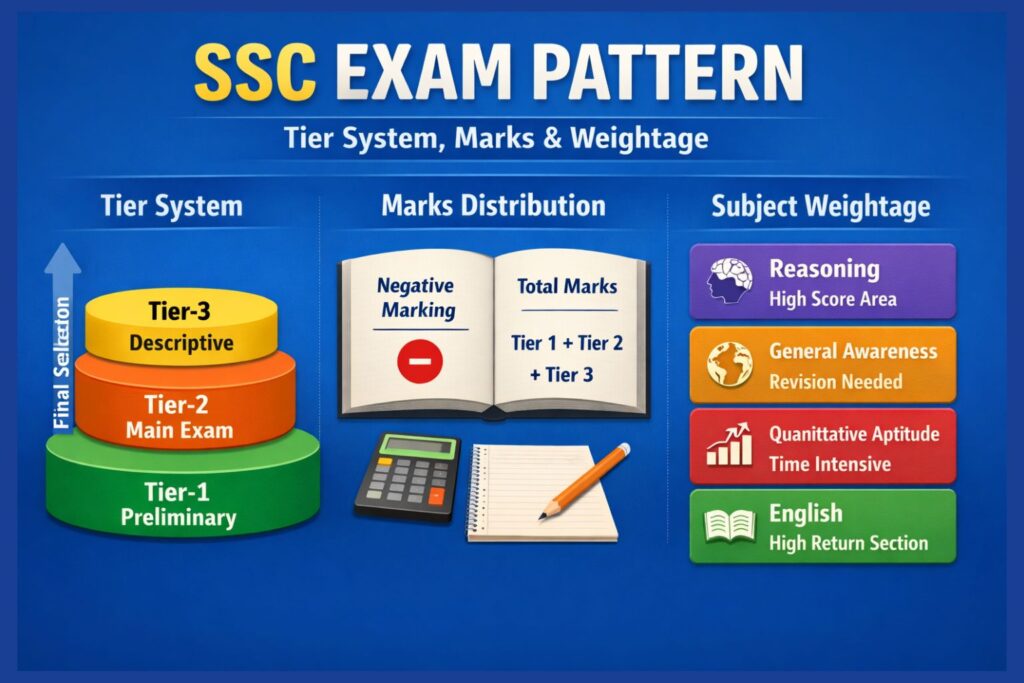
Understanding the SSC exam pattern is the first real step toward smart and focused preparation. Many candidates study hard but still struggle because they are not clear about the tier system, marks distribution, and section-wise weightage. This guide explains the SSC exam pattern in a simple and practical way, so you know exactly what to expect before entering the exam hall.
A clear understanding of the pattern helps you plan your study time better, avoid common mistakes, and prepare with confidence instead of guesswork.
What is SSC and Why Exam Pattern Matters
The Staff Selection Commission (SSC) is a central government body that conducts recruitment exams for various posts in ministries, departments, and government offices across India. Every year, lakhs of candidates appear in SSC exams with the same goal—securing a stable government job.
However, success in SSC exams does not depend only on hard work. It depends on how well you understand the exam structure. The SSC exam pattern clearly defines how many stages are involved, what type of questions are asked, how marks are distributed, and where negative marking applies. Without this clarity, preparation often becomes directionless.
When you understand the exam pattern properly, you know which subjects need more attention, how much time to give each section, and how to attempt the paper smartly. This is why most successful candidates study the exam pattern first and then plan their preparation accordingly.
Choosing the Wrong SSC Books Can Ruin Your Preparation!
Don’t waste months studying from outdated or ineffective material. Check this expert-recommended list of SSC books before you start your preparation journey.
View Best Books for SSC ExamsSSC Exams Covered Under This Pattern
The Staff Selection Commission conducts multiple exams, but the basic structure of the exam pattern remains similar across most of them. Understanding this common pattern helps you prepare for more than one SSC exam at the same time.
The SSC exams that broadly follow this pattern include:
- SSC CGL (Combined Graduate Level): Conducted for graduate-level posts in central government departments and offices.
- SSC CHSL (Combined Higher Secondary Level): For candidates who have passed 10+2, mainly clerical and assistant-level posts.
- SSC MTS (Multi-Tasking Staff): For matriculation-level posts involving basic office and field duties.
- SSC GD (General Duty Constable): Recruitment for paramilitary forces, combining written exams with physical tests.
- SSC CPO (Central Police Organization): For Sub-Inspector posts in Delhi Police and CAPFs.
While the number of tiers and difficulty level may vary slightly, the core idea of objective exams, subject-wise sections, and qualifying criteria remains the same. This is why mastering the SSC exam pattern gives you an advantage across multiple exams instead of preparing blindly for each one.
SSC Tier System – Complete Overview
The SSC follows a tier-based examination system to assess candidates at different levels. Each tier is designed to test specific skills, and clearing one tier is mandatory to move to the next. Understanding how this system works helps you avoid confusion and prepare with a clear roadmap.
The tier system usually includes objective tests, descriptive papers, and skill or physical tests, depending on the exam. Early tiers mainly focus on speed, accuracy, and basic concepts, while later tiers test depth of knowledge, writing ability, or practical skills.
In most SSC exams, Tier-1 acts as the screening stage, filtering candidates based on overall performance. Tier-2 plays a more decisive role in ranking and final selection. Some exams also include additional stages like descriptive papers, skill tests, or physical efficiency tests to ensure candidates are suitable for the job requirements.
Knowing the purpose of each tier helps you plan your preparation wisely. Instead of treating all stages the same, you can focus on what really matters at each level and avoid wasting time on unnecessary areas.
Tier-1 Exam Pattern (Most Important Stage)
Tier-1 is the most crucial stage of the SSC exam because it is compulsory for all major SSC exams and acts as the first filtering round. Your performance here decides whether you move forward in the selection process.
Tier-1 is a computer-based objective test designed to check your basic understanding, speed, and accuracy across multiple subjects.
Basic Structure of Tier-1:
- Mode of Exam: Online (Computer Based Test)
- Type of Questions: Multiple Choice Questions (MCQs)
- Total Sections: 4
- Total Questions: 100
- Total Marks: 200
- Time Duration: 60 minutes
Each section carries equal importance, which means ignoring even one subject can seriously affect your overall score.
Section-wise Breakup:
General Intelligence & Reasoning
- Questions test logical thinking, patterns, and problem-solving ability
- Topics include analogy, series, coding-decoding, syllogism, and visual reasoning
General Awareness
- Covers current events and static knowledge
- Includes history, geography, polity, economy, science, and current affairs
Quantitative Aptitude
- Focuses on basic mathematical concepts
- Topics include arithmetic, algebra, geometry, mensuration, and data interpretation
English Comprehension
- Tests understanding of English language
- Includes grammar, vocabulary, reading comprehension, and sentence correction
Tier-1 does not test advanced concepts, but it demands strong basics and fast execution. This is why consistent practice and clarity of concepts are more important than studying complex topics at this stage.
Tier-1 Marks Weightage & Scoring Rules
In Tier-1, all four sections carry equal weightage, which means no single subject can be ignored. Each section has 25 questions, and every question carries 2 marks, making the total 200 marks.
Because the weightage is evenly distributed, balanced preparation becomes essential. Scoring very high in one section cannot fully compensate for weak performance in another. Successful candidates aim for consistent scores across all sections rather than depending on a single strong area.
SSC also follows a normalization process in Tier-1. Since the exam is conducted in multiple shifts, normalization ensures fairness by adjusting scores based on the difficulty level of different shifts. This means your final score is not just raw marks but a normalized score calculated by SSC.
Another important point is that Tier-1 is not just about attempting more questions. Accuracy plays a major role in maintaining a good score. A high number of incorrect attempts can quickly reduce your total due to negative marking, which makes smart question selection extremely important.
Understanding the marking and weightage system helps you plan your attempts wisely and focus on safe, high-return questions during the exam.
Negative Marking Explained Clearly
Negative marking is one of the most important aspects of the SSC exam pattern, and ignoring it can seriously damage your final score. In Tier-1, 0.50 marks are deducted for every wrong answer.
This means that for each incorrect attempt, one-fourth of the marks allotted to that question are subtracted. While the deduction may look small, repeated mistakes can quickly reduce an otherwise good score.
Because of negative marking, random guessing is risky. Attempting too many doubtful questions often leads to more loss than gain. This is why experienced candidates follow a selective approach—attempting questions they are confident about and skipping those that are unclear or time-consuming.
A smart strategy is to first attempt easy and familiar questions, then move to moderate ones if time allows. Questions that require lengthy calculations or feel confusing should be avoided unless you are sure of the answer. Managing negative marking effectively is not about fear, but about making informed and confident choices during the exam.
Tier-2 Exam Pattern (For Exams That Have It)
Tier-2 is the most decisive stage in SSC exams where it is applicable, especially for exams like CGL and CPO. Unlike Tier-1, which mainly filters candidates, Tier-2 plays a major role in final ranking and selection.
Tier-2 is also a computer-based exam, but the level of questions is higher and more subject-focused. The papers are designed to test in-depth understanding, accuracy, and exam discipline rather than just speed.
Key Characteristics of Tier-2:
- Mode of Exam: Online (CBT)
- Type of Questions: Objective
- Difficulty Level: Moderate to High
- Importance: High impact on final merit list
Tier-2 usually consists of multiple papers, and each paper is conducted separately. Common papers include:
- Quantitative Abilities
- English Language & Comprehension
- Statistics (for specific posts)
- General Studies (Finance & Economics) for selected posts
Unlike Tier-1, marks scored in Tier-2 are taken very seriously by the Staff Selection Commission while preparing the final merit list. Even a small difference in marks can result in a large rank gap.
Because of this, Tier-2 preparation requires:
- Strong conceptual clarity
- Regular practice of standard-level questions
- Focus on accuracy over blind attempts
Candidates who treat Tier-2 casually often lose their selection despite clearing Tier-1 comfortably. This stage demands disciplined preparation and a clear understanding of the exam pattern.
Tier-3 / Skill Test / Physical Test (If Applicable)
After clearing the written stages, some SSC exams include additional qualifying rounds to assess practical skills or physical fitness. These stages are not about speed or MCQs but about job-specific abilities.
Tier-3 (Descriptive Paper)
Tier-3 is a pen-and-paper descriptive test conducted for exams like SSC CGL and CHSL. It evaluates your ability to express ideas clearly in written form.
- Mode: Offline
- Type: Essay, Letter, or Application writing
- Purpose: To test writing skills and basic clarity of thought
Marks scored in Tier-3 are important and are included in the final merit calculation, so it should never be taken lightly.
Skill Test / Typing Test
For certain posts, especially clerical roles, candidates must clear a skill or typing test.
- Typing speed is tested in English or Hindi
- This stage is generally qualifying in nature
- Accuracy matters more than speed
Physical Efficiency / Physical Standard Test
In exams like GD and CPO, physical tests are mandatory.
- Includes running, height, chest, and endurance tests
- Only qualifying, but compulsory
- Failure here means disqualification, regardless of written scores
These stages ensure that candidates are practically fit for the job role. Clearing the written exam alone is not enough if the final stage requirements are ignored.
Subject-Wise Weightage Analysis
Understanding subject-wise weightage helps you decide where to invest more time and effort. Since SSC exams are competitive, smart allocation of study hours often makes the difference between selection and rejection.
General Intelligence & Reasoning
This section is usually considered high-scoring because questions are logic-based and repetitive in nature. With regular practice, accuracy improves quickly. Most questions can be solved in less time once patterns are familiar.
General Awareness
General Awareness has a wide syllabus but fixed questions. It does not require calculations, which saves time in the exam. However, it demands consistent revision. Static GK and current affairs together decide performance in this section.
Quantitative Aptitude
This section carries equal marks but often consumes the maximum time. Calculation speed and concept clarity are crucial. Candidates who practice shortcut methods and basic formulas regularly tend to score well here.
English Comprehension
English is another high-return section. Grammar rules, vocabulary, and reading comprehension follow predictable patterns. With focused practice, this section can be a strong scoring area even for average students.
A balanced approach works best. Ignoring any one subject can pull down your overall score, even if other sections are strong.
How Exam Pattern Should Shape Your Preparation
Once you clearly understand the SSC exam pattern, your preparation automatically becomes more focused and effective. Instead of studying everything randomly, you start preparing with a clear purpose for each tier and section.
The first step is to align your study plan with the tier system. Tier-1 requires speed and accuracy, so daily practice of MCQs, time-bound tests, and revision of basics should be your priority. Tier-2 demands deeper understanding, so concept clarity and standard-level questions become more important at that stage.
Section-wise time allocation is another key factor. Subjects like Quantitative Aptitude and Reasoning need regular practice, while General Awareness requires consistent revision. English improves gradually with daily reading and grammar practice, so it should be included in your routine without long gaps.
One of the most effective ways to understand the real exam pattern is by solving previous year papers for SSC. They help you identify frequently asked topics, difficulty level, and the actual balance between speed and accuracy. Candidates who regularly analyze past papers usually perform better because they know exactly what to expect in the exam.
When your preparation follows the exam pattern, revision becomes easier, confidence improves, and unnecessary stress is automatically reduced.
Mock Tests & Exam Pattern Alignment
Mock tests play a critical role in SSC preparation, but their real value comes only when they follow the exact exam pattern. Practicing random questions without time limits does not prepare you for the pressure of the actual exam.
Mock tests help you understand how to manage 100 questions within 60 minutes, how much time to give each section, and how negative marking affects your score. They also reveal your weak areas early, giving you enough time to improve before the exam.
An ideal approach is to start with section-wise mocks and gradually move to full-length tests. Initially, focus more on accuracy than attempts. Once accuracy stabilizes, you can work on increasing speed without compromising correctness.
After every mock test, analysis is more important than the test itself. Reviewing wrong answers, understanding mistakes, and noting weak topics help you avoid repeating the same errors. This process gradually builds a reliable SSC mock test strategy that aligns perfectly with the real exam pattern.
Regular mock testing, combined with honest analysis, trains your mind to perform calmly and confidently in the actual SSC exam.
Common Mistakes Students Make About SSC Exam Pattern
Many candidates prepare seriously for SSC exams but still fail to get the desired result because they misunderstand the exam pattern. These mistakes are common but completely avoidable with the right awareness.
One frequent mistake is treating all tiers the same. Tier-1 and Tier-2 serve different purposes, yet many students prepare both in the same way. This often leads to poor performance in Tier-2, where deeper understanding is required.
Another major mistake is ignoring negative marking. Over-attempting questions without confidence can quickly reduce scores. Candidates who focus only on the number of attempts and ignore accuracy usually struggle to clear cut-offs.
Some students also over-focus on a single subject they are comfortable with and neglect others. Since all sections carry equal weightage in Tier-1, even a weak performance in one section can pull down the overall score.
Lastly, many aspirants delay mock tests, thinking they should “finish the syllabus first.” This approach is risky. Without early exposure to the exam pattern through mocks, it becomes difficult to manage time and pressure during the actual exam.
Avoiding these mistakes keeps your preparation aligned with the exam structure and improves your chances of success.
FAQs (Exam-Focused, Real Doubts)
Q1. Is Tier-1 qualifying or merit-based in SSC exams?
Tier-1 is primarily a screening stage, but the marks are important because they decide whether you qualify for the next tier. In many exams, Tier-1 scores are also considered along with later stages during final selection.
Q2. Does Tier-2 carry more weight than Tier-1?
Yes. Tier-2 usually carries higher importance in the final merit list. A strong Tier-2 performance can significantly improve your rank, even if your Tier-1 score is average.
Q3. Can I clear SSC without knowing the exact exam pattern?
It is extremely difficult. Without knowing the pattern, you cannot plan time management, understand weightage, or handle negative marking properly. Pattern clarity is a basic requirement for serious preparation.
Q4. Does the SSC exam pattern change every year?
The core structure remains mostly the same. Minor changes can happen in the number of papers or syllabus focus, but the tier system and section-wise structure usually stay consistent.
Choosing the Wrong SSC Books Can Ruin Your Preparation!
Don’t waste months studying from outdated or ineffective material. Check this expert-recommended list of SSC books before you start your preparation journey.
View Best Books for SSC ExamsFinal Practical Advice (Conclusion)
Before choosing books, coaching, or study material, make sure you fully understand the SSC exam pattern. It acts as the foundation of your entire preparation. When the pattern is clear, every study decision becomes easier and more effective.
Smart preparation always beats random hard work. Focus on accuracy, follow the tier-wise strategy, practice regularly, and revise consistently. Avoid unnecessary resources and stick to a pattern-driven plan.
With discipline, clarity, and patience, SSC selection becomes a realistic and achievable goal—not a matter of luck.