Explore the complete list of banking exams in India, including IBPS, SBI, and RRB, with details on eligibility, selection process, syllabus, and preparation resources.
Major Banking Exams in India: Your Guide to IBPS, SBI & RRB
Banking jobs are among the most popular career options in India because they offer job security, good salary, career growth, and social respect. Every year, lakhs of candidates appear for different banking exams conducted by organizations like IBPS, SBI, and RRB to get government or public sector bank jobs.
These exams recruit candidates for posts such as Probationary Officer (PO), Clerk, and Specialist Officer (SO) in various public sector and regional rural banks across the country. Although each exam has its own pattern, most banking exams follow a similar structure, making it easier for candidates to prepare with a common strategy.
In this guide, you will learn about the major banking exams in India, how IBPS, SBI, and RRB exams work, and what you need to start your preparation. You will also understand the basic banking exam eligibility, the banking selection process, the banking exam syllabus, and the best books for banking exams to help you choose the right path.
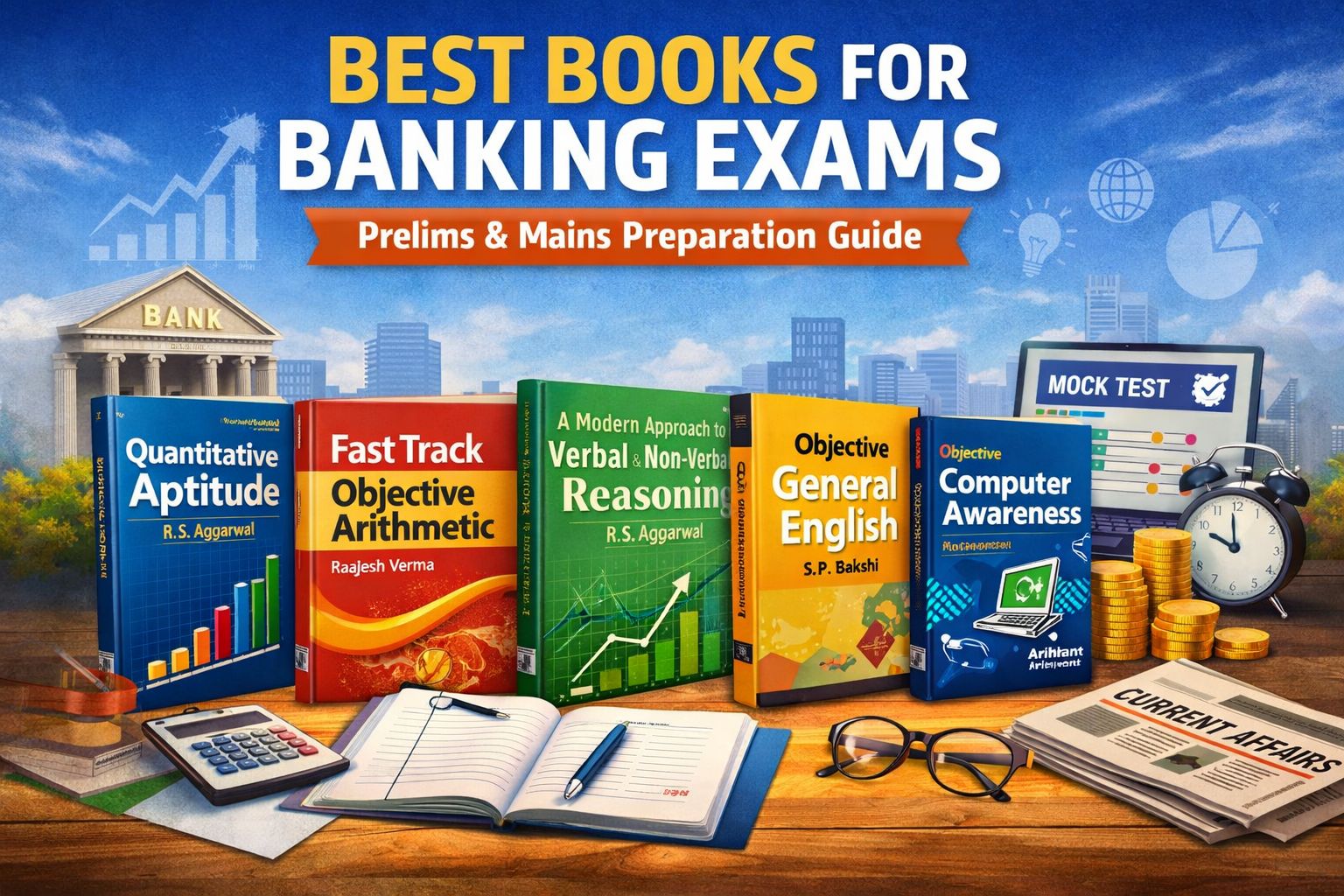
Start Your Banking Exam Preparation with the Right Books
Boost your chances of success with expert-recommended books for SBI, IBPS & RBI exams — Prelims + Mains preparation.
View Best Banking Exam BooksMajor Types of Banking Exams in India
In India, most public sector bank jobs are filled through competitive examinations conducted by national-level recruiting bodies. These exams are mainly organized by IBPS, SBI, and RRB, and each of them recruits for different banks and job roles.
Understanding the main types of banking exams helps candidates choose the right exam based on their qualification, career goals, and preferred job location.
1. IBPS Banking Exams
The Institute of Banking Personnel Selection (IBPS) conducts recruitment exams for most public sector banks in India. IBPS does not recruit for a single bank; instead, it conducts common exams, and selected candidates are allotted different banks based on merit and preferences.
Major IBPS exams include:
- IBPS PO – for Probationary Officer posts
- IBPS Clerk – for clerical positions
- IBPS SO – for Specialist Officer roles
- IBPS RRB – for Regional Rural Bank jobs
These exams are conducted every year and are among the most popular banking exams in the country.
2. SBI Banking Exams
The State Bank of India (SBI) is the largest public sector bank in India. Unlike other banks, SBI conducts its own recruitment exams instead of using IBPS.
Major SBI exams include:
- SBI PO – for Probationary Officer posts
- SBI Clerk – for Junior Associate (Clerk) posts
- SBI SO – for Specialist Officer roles
SBI exams are considered slightly more competitive because they offer higher salary packages and better career growth opportunities.
3. RRB Banking Exams
Regional Rural Banks (RRBs) are government banks that mainly operate in rural and semi-urban areas. Recruitment for these banks is conducted through the IBPS RRB exam.
Major posts under RRB exams:
- Office Assistant (Clerk) – clerical role in rural banks
- Officer Scale I – equivalent to Probationary Officer
- Officer Scale II & III – higher-level officer posts
RRB exams are a good option for candidates who prefer jobs closer to their home region or in rural areas.
4. Other Important Banking Exams
Apart from IBPS and SBI, some specialized banking and financial institutions conduct their own exams.
Important examples:
- RBI Grade B – conducted by the Reserve Bank of India
- RBI Assistant – for clerical roles in RBI
- NABARD Grade A & B – for development banking roles
These exams are fewer in number but offer prestigious positions and attractive salaries.
IBPS Banking Exams Explained
The Institute of Banking Personnel Selection (IBPS) is an autonomous organization that conducts recruitment exams for most public sector banks in India. Instead of each bank holding its own exam, IBPS conducts common recruitment tests, and candidates are allotted banks based on their rank and preferences.
IBPS exams are held every year and attract lakhs of applicants because they provide stable government-sector jobs with good salary and career growth.
Major IBPS Exams
IBPS conducts different exams for various banking posts. The most important ones are:
1. IBPS PO (Probationary Officer)
The IBPS PO exam recruits candidates for the post of Probationary Officer in public sector banks.
Key points:
- Officer-level position
- Good starting salary and fast promotions
- Involves customer handling, loan processing, and branch management tasks
Selection stages:
- Preliminary Exam
- Main Exam
- Interview
Candidates who clear all stages are allotted banks based on their merit rank.
2. IBPS Clerk
The IBPS Clerk exam recruits candidates for clerical posts in public sector banks.
Key points:
- Entry-level banking job
- Focus on customer service, cash handling, and daily banking operations
- No interview stage
Selection stages:
- Preliminary Exam
- Main Exam
Final selection is based on the main exam score.
3. IBPS Specialist Officer (SO)
The IBPS SO exam is conducted for candidates with professional or technical qualifications.
Common SO posts include:
- IT Officer
- Agriculture Field Officer
- Marketing Officer
- HR Officer
- Law Officer
- Rajbhasha Adhikari
Selection stages:
- Preliminary Exam
- Main Exam
- Interview
This exam is suitable for candidates who want to work in a specialized banking department.
4. IBPS RRB Exams
IBPS also conducts exams for Regional Rural Banks (RRBs) across India.
Main posts:
- Office Assistant (Clerk)
- Officer Scale I (PO)
- Officer Scale II
- Officer Scale III
Selection process:
- Clerk: Prelims + Mains
- Officer Scale I: Prelims + Mains + Interview
- Officer Scale II & III: Single exam + Interview
These exams are ideal for candidates who want to work in rural or semi-urban areas.
Why IBPS Exams Are Popular
- Recruitment for multiple banks through a single exam
- Large number of vacancies every year
- Standardized exam pattern
- Clear and transparent selection process
SBI Banking Exams Explained
The State Bank of India (SBI) is the largest public sector bank in the country. Unlike other public sector banks, SBI conducts its own recruitment exams instead of using the IBPS system. Because of its reputation, better salary structure, and career growth opportunities, SBI exams are considered highly competitive.
Every year, SBI releases notifications to recruit candidates for officer and clerical positions across its branches in India.
Major SBI Exams
SBI mainly conducts three types of recruitment exams:
1. SBI PO (Probationary Officer)
The SBI PO exam is conducted to recruit candidates for officer-level positions in SBI branches.
Key points:
- One of the most prestigious banking exams
- Higher starting salary compared to most other bank POs
- Fast career growth opportunities
Job responsibilities:
- Handling customers
- Loan processing
- Branch operations
- Supervising clerical staff
Selection stages:
- Preliminary Exam
- Main Exam
- Group Exercise and Interview
Final selection is based on the combined score of the mains exam and interview.
2. SBI Clerk (Junior Associate)
The SBI Clerk exam recruits candidates for clerical posts, officially called Junior Associates.
Key points:
- Entry-level banking job
- Focus on customer service and daily transactions
- Large number of vacancies every year
Job responsibilities:
- Cash handling
- Passbook updates
- Account opening assistance
- Customer queries
Selection stages:
- Preliminary Exam
- Main Exam
There is no interview for the SBI Clerk exam. Final selection is based on the mains exam score.
3. SBI Specialist Officer (SO)
The SBI SO exam is conducted for candidates with specific professional qualifications.
Common SO posts:
- IT Officer
- Law Officer
- Marketing Officer
- HR Officer
- Risk Manager
Selection process:
- Written test and/or interview
- Sometimes direct interview based on shortlisting
The selection process may vary depending on the specific SO post.
Why SBI Exams Are Highly Preferred
- Higher salary compared to many other public sector banks
- Strong brand value of SBI
- Better promotion opportunities
- Wide branch network across India
Because of these advantages, SBI exams usually have higher competition levels than most IBPS exams.
RRB Banking Exams Explained
Regional Rural Banks (RRBs) are government-supported banks that mainly operate in rural and semi-urban areas. Their primary goal is to provide banking and financial services to farmers, small businesses, and people living in villages and small towns.
Recruitment for these banks is conducted through the IBPS RRB exam, which is organized every year by the Institute of Banking Personnel Selection.
RRB exams are a good option for candidates who prefer working near their home state or in rural locations with a stable government job.
Major Posts Under RRB Exams
The IBPS RRB exam recruits candidates for both clerical and officer-level posts.
1. Office Assistant (RRB Clerk)
The Office Assistant post is similar to the clerk position in public sector banks.
Key points:
- Entry-level banking job
- Focus on customer service and daily transactions
- Posting usually within the candidate’s home state
Job responsibilities:
- Cash handling
- Account-related work
- Customer queries
- Passbook updates
Selection stages:
- Preliminary Exam
- Main Exam
There is no interview for the Office Assistant post.
2. Officer Scale I (RRB PO)
The Officer Scale I post is equivalent to a Probationary Officer in rural banks.
Key points:
- Officer-level job
- Responsible for branch operations and loan processing
- Posting usually in rural or semi-urban branches
Selection stages:
- Preliminary Exam
- Main Exam
- Interview
3. Officer Scale II and III
These are higher-level officer posts in Regional Rural Banks.
Officer Scale II:
- Mid-level managerial position
- Requires experience in the banking or financial sector
Officer Scale III:
- Senior managerial role
- Requires several years of experience
Selection stages for Scale II & III:
- Single written exam
- Interview
Why Choose RRB Exams
- Posting generally in the candidate’s home state
- Lower competition compared to national-level bank exams
- Stable government job
- Good work-life balance
RRB exams are especially suitable for candidates who want a secure banking career without frequent transfers to major cities.
Quick Comparison of IBPS, SBI, and RRB Exams
IBPS, SBI, and RRB are the three main recruitment systems for public sector banking jobs in India. Although their exam patterns are quite similar, there are important differences in salary, competition, posting, and career growth.
The table below gives a simple comparison to help you understand which exam may suit you better.
IBPS vs SBI vs RRB – Comparison Table
| Feature | IBPS Exams | SBI Exams | RRB Exams |
|---|---|---|---|
| Recruiting Body | IBPS (for multiple public sector banks) | State Bank of India | IBPS (for Regional Rural Banks) |
| Main Posts | PO, Clerk, SO | PO, Clerk, SO | Office Assistant, Officer Scale I–III |
| Difficulty Level | Moderate | Slightly higher | Moderate to easy (compared to SBI/IBPS PO) |
| Salary | Good | Highest among PSBs | Slightly lower than IBPS/SBI |
| Competition Level | High | Very high | Moderate |
| Posting Location | Anywhere in India | Anywhere in India | Mostly within home state |
| Interview Stage | For PO & SO | For PO & SO | For Officer posts only |
| Transfer Frequency | Moderate | Higher chances of transfers | Lower, mostly local postings |
Key Differences in Simple Terms
IBPS Exams
- Recruitment for multiple public sector banks
- Balanced competition and salary
- Good option for most candidates
SBI Exams
- Recruitment only for State Bank of India
- Higher salary and faster promotions
- More competitive than IBPS exams
RRB Exams
- Recruitment for rural banks
- Posting usually near home state
- Better work-life balance
Which One Is Easier?
- Easiest (relatively): RRB Office Assistant
- Moderate difficulty: IBPS Clerk, RRB PO
- Most competitive: SBI PO
However, the actual difficulty depends on your preparation and competition in that year.
Basic Banking Exam Eligibility Criteria
Before applying for any banking exam, candidates must meet certain basic conditions related to education, age, and nationality. Although exact rules may vary slightly from one exam to another, the general eligibility criteria remain similar for most IBPS, SBI, and RRB exams.
If you want to understand detailed rules for each exam, you can read the full guide on banking exam eligibility.
1. Educational Qualification
For most banking exams, the minimum qualification is:
- A graduate degree in any stream from a recognized university
- Final-year students may apply if their results are declared before the joining date
There is no restriction on the stream, so candidates from arts, commerce, or science backgrounds can all apply.
2. Age Limit
The age criteria depend on the type of post.
For Clerk and PO posts (general category):
- Minimum age: 20 years
- Maximum age: 28 to 30 years (varies by exam)
For Specialist Officer posts:
- Maximum age may go up to 30–35 years, depending on the role
3. Age Relaxation
Reserved categories receive age relaxation as per government rules.
Common relaxations:
- OBC: 3 years
- SC/ST: 5 years
- PwD: 10 years
- Ex-servicemen: as per rules
Exact relaxation details may vary slightly across exams.
4. Nationality Criteria
A candidate must be:
- A citizen of India, or
- A subject of Nepal or Bhutan, or
- A Tibetan refugee who came to India before January 1, 1962, or
- A person of Indian origin migrated from certain countries with the intention of permanent settlement
Most applicants fall under the Indian citizen category.
5. Number of Attempts
There is usually no fixed attempt limit in most banking exams.
Candidates can apply as many times as they want until they reach the maximum age limit.
Common Banking Selection Process
Most banking exams in India follow a three-stage selection system. Although the exact structure may vary slightly between IBPS, SBI, and RRB exams, the overall process remains quite similar.
If you want a detailed, exam-wise breakdown, you can read the full guide on the banking selection process.
Stage 1: Preliminary Examination
The prelims exam is the first stage of the selection process. It is a screening test used to shortlist candidates for the main exam.
Common prelims sections:
- English Language
- Reasoning Ability
- Quantitative Aptitude
Key features:
- Objective-type questions
- Short duration (usually about 1 hour)
- Qualifying in nature for most exams
- Marks are generally not counted in the final merit (except in some cases)
Only candidates who clear the prelims cutoff are allowed to appear for the mains exam.
Stage 2: Main Examination
The mains exam is the most important stage because it usually determines the final merit.
Common mains sections:
- Reasoning and Computer Aptitude
- Data Analysis and Interpretation
- English Language
- General Awareness (Banking/Financial)
Key features:
- Higher difficulty level than prelims
- Longer exam duration
- Marks counted for final selection
Candidates must score above the sectional and overall cutoffs to move to the next stage.
Stage 3: Interview or Final Stage
The final stage depends on the type of post.
For PO and SO posts:
- Personal Interview (PI)
- Sometimes group exercises (in SBI PO)
For Clerk posts:
- No interview
- Final selection based on mains exam score
Final Merit List
The final selection is based on:
- Mains exam score
- Interview score (for officer posts)
A combined merit list is prepared, and candidates are allotted banks according to their rank and preferences.
Common Banking Exam Syllabus
Most banking exams follow a similar syllabus, especially for IBPS, SBI, and RRB exams. The subjects and topics remain almost the same, although the difficulty level may vary depending on the post and exam.
If you want a detailed subject-wise breakdown, you can read the complete guide on the banking exam syllabus.
1. Reasoning Ability
This section tests logical thinking and problem-solving skills.
Important topics:
- Seating arrangement
- Puzzles
- Syllogism
- Coding–decoding
- Blood relations
- Direction sense
- Inequalities
- Input–output
Reasoning is one of the most important sections in both prelims and mains exams.
2. Quantitative Aptitude
This section checks mathematical ability and numerical problem-solving.
Important topics:
- Simplification and approximation
- Number series
- Percentages
- Profit and loss
- Ratio and proportion
- Time and work
- Time, speed, and distance
- Simple and compound interest
- Data interpretation
In mains exams, questions are usually more calculation-based and time-consuming.
3. English Language
This section evaluates grammar, vocabulary, and reading skills.
Important topics:
- Reading comprehension
- Cloze test
- Error detection
- Sentence improvement
- Para jumbles
- Fill in the blanks
- Vocabulary-based questions
Regular reading and practice are important to score well in this section.
4. General Awareness
This section is mostly asked in the mains exam.
Important areas:
- Banking and financial awareness
- Current affairs
- Static general knowledge
- Government schemes
- Important national and international events
Candidates usually prepare this section through daily current affairs and monthly magazines.
5. Computer Knowledge
Some exams include basic computer awareness questions.
Important topics:
- Basics of computers
- Input and output devices
- Internet and email
- MS Office basics
- Computer shortcuts
- Basic hardware and software concepts
Which Banking Exam Should You Choose?
Many candidates get confused about which banking exam is best for them. The right choice depends on your career goals, preparation level, preferred job location, and salary expectations. Each exam offers different advantages.
Here is a simple guide to help you decide.
Best Exam for Beginners
If you are just starting your banking preparation, these exams are usually more suitable:
- IBPS Clerk
- RRB Office Assistant
Why these are good for beginners:
- Slightly lower difficulty level than PO exams
- No interview stage
- Good starting point to understand the exam pattern
Best Exam for Faster Selection
If your goal is to get a job as quickly as possible, consider:
- RRB Office Assistant
- IBPS Clerk
These exams usually have:
- A simpler selection process
- No interview stage
- Faster final selection compared to officer-level posts
Best Exam for Higher Salary and Career Growth
If you are aiming for a long-term banking career with higher salary and promotions, the best options are:
- SBI PO
- IBPS PO
Why choose PO exams:
- Officer-level position
- Faster promotions
- Higher starting salary
- More responsibilities and leadership roles
Best Exam for Local or Rural Posting
If you prefer a job near your home state or in rural areas:
- RRB Office Assistant
- RRB Officer Scale I
Advantages:
- Posting usually within your state
- Less frequent transfers
- Better work-life balance
Simple Decision Guide
- Want an easier entry into banking → IBPS Clerk or RRB Clerk
- Want a high-level officer job → IBPS PO or SBI PO
- Want a job near home → RRB exams
- Want the best salary in public sector banks → SBI PO
Recommended Resources for Banking Preparation
Choosing the right study material is very important for success in banking exams. Since most exams follow a similar pattern, candidates can prepare using a common set of standard books for reasoning, quantitative aptitude, English, and general awareness.
If you want a detailed subject-wise list, you can check the guide on the best books for banking exams.
Basic Book Strategy
Instead of collecting many books, it is better to:
- Choose one standard book per subject
- Revise it multiple times
- Practice mock tests regularly
- Focus on accuracy and speed
Quality preparation is always more effective than studying from too many sources.
Start Your Banking Exam Preparation with the Right Books
Boost your chances of success with expert-recommended books for SBI, IBPS & RBI exams — Prelims + Mains preparation.
View Best Banking Exam BooksFinal Words
Banking exams in India offer a stable career, good salary, and long-term growth opportunities. Whether you choose IBPS, SBI, or RRB exams, the core preparation strategy remains almost the same because the syllabus and exam pattern are similar.
The key to success is:
- Understanding the banking exam eligibility
- Knowing the banking selection process
- Preparing according to the banking exam syllabus
- Studying from the best books for banking exams
- Practicing mock tests regularly
With consistent preparation and the right strategy, candidates from any educational background can clear banking exams and start a rewarding career in the banking sector.
FAQs
Q1. Which is the main banking exam in India?
The main banking exams are conducted by IBPS, SBI, and RRB for posts like PO, Clerk, and Specialist Officer.
Q2. Which banking exam is easiest?
Generally, RRB Office Assistant and IBPS Clerk are considered easier compared to SBI PO or IBPS PO, but the difficulty depends on preparation and competition.
Q3. Can a 12th pass apply for banking exams?
Most banking exams require a graduate degree. A 12th pass candidate must complete graduation before applying for PO or Clerk exams.
Q4. How many attempts are allowed in banking exams?
There is usually no fixed attempt limit. Candidates can apply until they reach the maximum age limit specified in the exam notification.
Q5. Are banking exams conducted every year?
Yes, most major banking exams like IBPS PO, IBPS Clerk, SBI PO, SBI Clerk, and IBPS RRB are conducted every year.