

Confused about how many books you really need for banking exam preparation? Learn the ideal number of books required for each subject to prepare smartly and avoid study overload.
Are You Using Too Many Books for Banking Exam Preparation?
Every year, thousands of banking aspirants begin their preparation journey with full motivation and determination. However, one of the most common mistakes many students make at the very beginning is collecting too many books for preparation. It is often believed that studying from multiple sources increases the chances of success, but in reality, this approach can lead to confusion, incomplete syllabus coverage, and poor revision.
The real challenge in banking exam preparation is not about how many books you own, but how effectively you use the right ones. Many aspirants spend more time searching for new study materials instead of completing the books they already have. This habit of constantly switching between different books can break your focus and prevent you from building strong conceptual clarity in important subjects like Quantitative Aptitude, Reasoning Ability, and English Language.
So the important question is — how many books are actually enough to crack a banking exam?
Understanding the ideal number of books required for preparation can help you save time, improve your revision strategy, and boost your overall performance in both Prelims and Mains exams. In this guide, we will explain a smart and practical study strategy that focuses on using the minimum number of books while maximizing your chances of success in banking exams.
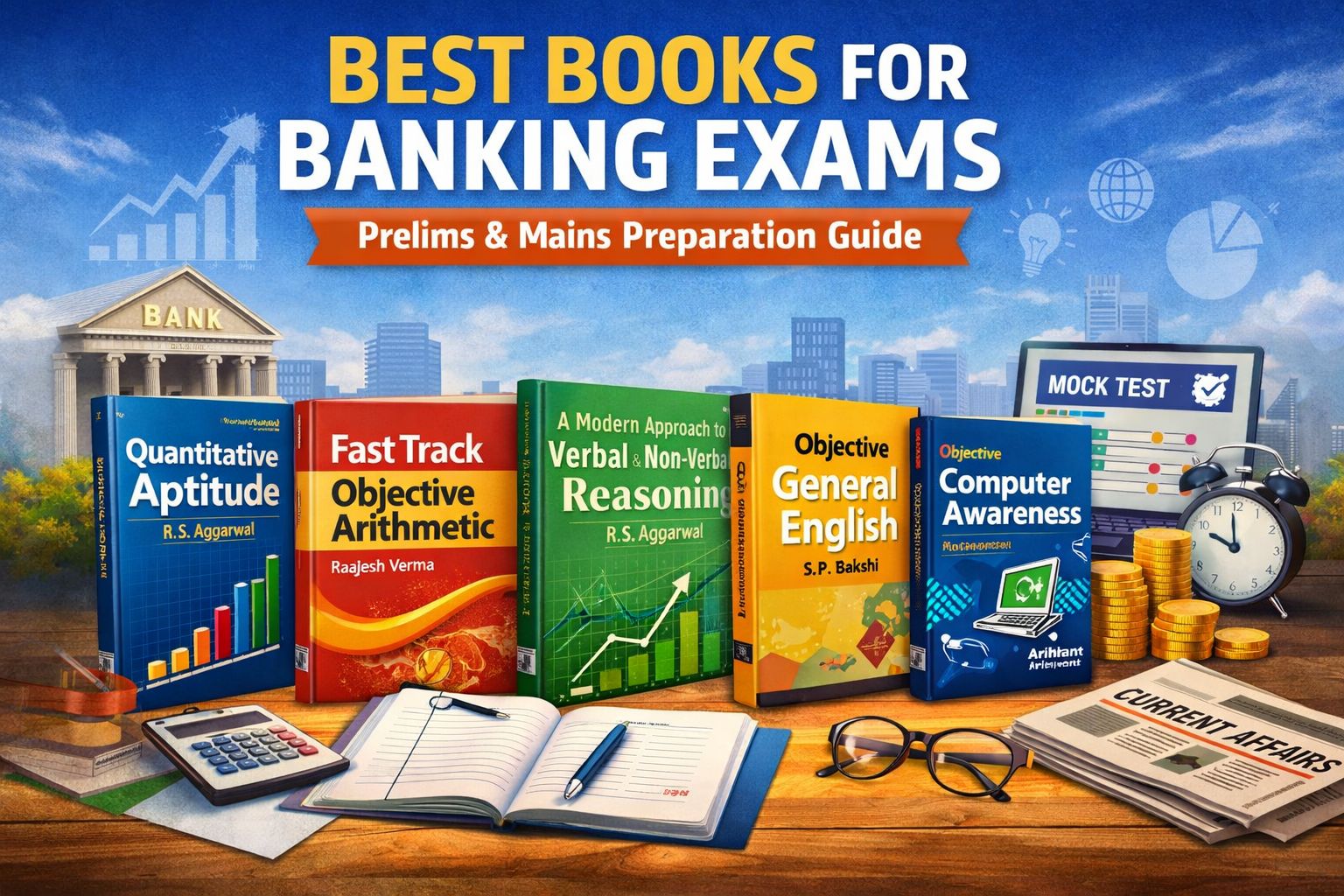
Start Your Banking Exam Preparation with the Right Books
Boost your chances of success with expert-recommended books for SBI, IBPS & RBI exams — Prelims + Mains preparation.
View Best Banking Exam BooksWhy Choosing the Right Number of Books Matters in Banking Exam Preparation
Selecting the right number of books is one of the most important decisions you will make during your banking exam preparation. Many aspirants assume that the more books they study, the better their chances of clearing the exam. But this belief often leads to information overload, lack of revision time, and incomplete preparation.
When you use too many books, you are exposed to different methods, explanations, and solving techniques for the same topic. Instead of helping you, this can create confusion in your mind—especially in subjects like Quantitative Aptitude and Reasoning Ability, where consistency in approach plays a key role in improving speed and accuracy.
Another major issue with studying from multiple books is time management. Banking exams have a vast syllabus, and switching between several study resources can consume valuable time that should be spent on practice and revision. Aspirants who try to follow too many books often struggle to complete even one of them properly before the exam.
Revision is equally important for success in banking exams. If you are constantly moving from one book to another, you may not get enough time to revise previously studied topics. This directly affects your ability to recall concepts during the exam, which can result in mistakes and lower scores.
On the other hand, sticking to a limited number of well-chosen books allows you to:
- Build strong conceptual clarity
- Practice consistently from a reliable source
- Revise topics multiple times
- Develop your own problem-solving strategy
- Improve speed and accuracy over time
In simple terms, banking exam preparation is not about studying more books—it is about studying smarter with the right books.
Ideal Number of Books Required for Each Banking Exam Subject
Now that you understand why limiting your study material is important, the next step is to know how many books are actually enough for each subject in banking exam preparation. The goal should always be to build concepts clearly and practice them thoroughly without creating unnecessary pressure by using too many resources.
Here is a smart and practical approach to selecting the ideal number of books for each major subject:
Quantitative Aptitude
For Quantitative Aptitude, one concept-building book and one practice-oriented book are usually enough for most aspirants.
- The first book should help you understand basic concepts such as Simplification, Percentage, Profit & Loss, Ratio, Time & Work, and Data Interpretation.
- The second book should focus on improving your problem-solving skills through a wide range of practice questions.
Using more than two books for Quantitative Aptitude may lead to confusion because different books often use different shortcut methods and solving techniques. It is better to master one method properly rather than learning multiple approaches superficially.
Reasoning Ability
Reasoning Ability also requires one standard concept book along with one additional practice source.
Topics like Seating Arrangement, Puzzle, Coding-Decoding, Syllogism, and Blood Relations need regular practice. Once your concepts are clear, your performance depends mostly on how much you practice from a reliable source.
Avoid changing books frequently for reasoning, as puzzle-solving techniques improve only when you consistently follow the same pattern of practice.
English Language
For English Language preparation, you generally need:
- One grammar-focused book
- One practice-based book or question bank
Grammar concepts such as Tenses, Articles, Prepositions, and Sentence Correction should be studied from a single trusted source. Reading comprehension and vocabulary can be improved through regular reading practice instead of relying on multiple books.
Too many English books may introduce different rules and explanations, which can be confusing for beginners.
General Awareness
For General Awareness, especially Banking Awareness and Current Affairs:
- One reliable monthly current affairs source is sufficient.
- You do not need multiple static GK books if your focus is mainly on banking exams.
Consistency in reading daily or weekly updates is more important than collecting several current affairs magazines or PDFs.
Computer Awareness
Computer Awareness is a scoring subject in many banking exams. Most of the syllabus is basic and concept-based.
- One simple computer awareness book is enough to cover topics like MS Office, Internet Basics, Hardware & Software, and Networking Fundamentals.
Spending time on multiple computer books is unnecessary, as the exam questions are usually based on fundamental concepts.
Following this subject-wise book strategy will help you stay focused, reduce study pressure, and make your preparation more efficient.
One Book vs Multiple Books – What Actually Works Better?
One of the biggest dilemmas banking aspirants face during preparation is whether they should rely on a single book for each subject or study from multiple books to improve their chances of success. While both approaches have their own advantages, the effectiveness of each strategy depends on how and when it is used.
The Single Book Strategy
For beginners, following a single standard book for each subject is usually the most effective approach. A well-structured book helps you build a strong foundation by explaining concepts in a step-by-step manner. When you stick to one book:
- You become familiar with the solving techniques used in that book
- Your conceptual clarity improves gradually
- You avoid confusion caused by different explanation styles
- Revision becomes easier and faster
- You can track your progress more accurately
Consistency in preparation is extremely important in banking exams. Using the same book regularly helps you develop a fixed problem-solving approach, which improves your speed and accuracy over time.
The Multiple Book Strategy
Studying from multiple books may be useful only after you have completed your basic preparation. Once your concepts are clear and you are comfortable solving standard-level questions, referring to an additional practice book can expose you to a wider variety of questions.
However, using too many books without completing any of them can negatively affect your preparation. It may lead to:
- Conceptual confusion
- Incomplete syllabus coverage
- Lack of proper revision
- Wastage of valuable preparation time
What Should You Choose?
If you are a beginner or preparing through self-study, it is always better to:
- Start with one concept-building book per subject
- Complete it thoroughly
- Revise it multiple times
- Then move to an additional practice book if needed
This balanced approach ensures that you do not overload yourself with study material while still getting enough practice to perform well in the exam.
In banking exam preparation, mastering a limited number of good books is far more beneficial than partially studying from many.
Smart Study Strategy Using Minimum Books
Once you have selected a limited number of books for your banking exam preparation, the next step is to use them in a smart and structured way. Simply owning the right books is not enough — how you study from them plays a crucial role in your success.
Here is an effective study strategy that can help you maximize your preparation using minimum resources:
1. Focus on Concept Building First
Start by using your concept-building book for each subject. Make sure you clearly understand the fundamental topics before moving on to advanced-level questions.
For example:
- In Quantitative Aptitude, understand the logic behind Percentage, Ratio, and Profit & Loss.
- In Reasoning Ability, learn the basic structure of Seating Arrangement and Puzzle questions.
- In English Language, focus on grammar rules such as Tenses and Sentence Formation.
Avoid rushing through chapters just to complete the syllabus. Strong basics will make it easier for you to solve complex questions later.
2. Practice from the Same Source Regularly
After completing the basic concepts, begin practicing questions from your practice-oriented book. Regular practice from the same source helps you:
- Recognize question patterns
- Improve time management
- Increase accuracy
- Develop problem-solving confidence
Solving questions daily from a familiar book can significantly improve your exam performance.
3. Make Short Notes for Revision
While studying from your selected books, create short notes for important formulas, rules, shortcuts, and concepts. These notes will help you revise quickly during the final days before the exam.
Instead of reopening entire books, you can simply go through your personal notes for fast revision.
4. Plan Regular Revision
Revision is one of the most important parts of banking exam preparation. Studying from fewer books allows you to revise topics multiple times, which strengthens your memory and reduces the chances of mistakes during the exam.
Try to revise:
- Weekly for recently completed topics
- Monthly for previously studied chapters
5. Combine Book Study with Mock Tests
Books help you learn concepts, but mock tests help you apply them in a real exam environment. After completing a few chapters from your books, start attempting sectional and full-length mock tests.
This will help you:
- Identify weak areas
- Improve speed under time pressure
- Analyze your performance
- Adjust your preparation strategy accordingly
Using minimum books along with regular mock tests is one of the most effective ways to prepare for banking exams without feeling overwhelmed.
Common Mistakes Students Make While Selecting Banking Exam Books
Choosing the right study material is just as important as following the right study plan. Unfortunately, many banking aspirants make avoidable mistakes while selecting books for preparation, which can slow down their progress and reduce their chances of success.
Here are some of the most common mistakes you should avoid:
1. Changing Books Frequently
Many students start their preparation with one book but switch to another as soon as they find a new recommendation online or from a friend. This habit of constantly changing books can interrupt your learning process and prevent you from completing any single book thoroughly.
Incomplete study from multiple books is far less effective than complete preparation from one reliable source.
2. Following Toppers Blindly
It is common for aspirants to follow the booklists shared by toppers. However, what worked for someone else may not necessarily work for you. Toppers often recommend multiple books because they already have strong basics and experience in exam preparation.
Beginners should focus on building their own understanding instead of copying someone else’s strategy without proper evaluation.
3. Ignoring the Exam Syllabus
Another major mistake is selecting books without checking whether their content matches the banking exam syllabus. Studying topics that are not relevant to the exam can waste valuable time and reduce your focus on important areas.
Always ensure that the books you choose are aligned with the latest exam pattern and syllabus.
4. Collecting Books Instead of Completing Them
Some aspirants believe that having more books means better preparation. As a result, they keep collecting study materials but fail to complete even one of them.
Banking exam success depends on:
- Concept clarity
- Regular practice
- Consistent revision
All of these require focused study from limited resources.
5. Not Giving Enough Time for Revision
When you study from too many books, you may not get enough time to revise what you have already learned. Lack of revision can lead to poor retention of concepts and increased chances of mistakes during the exam.
Avoiding these common mistakes can help you make better use of your time and improve your overall preparation strategy.
How to Decide Whether You Need Another Book or Not?
At some point during your banking exam preparation, you may feel the need to add another book to improve your performance. But before you do that, it is important to evaluate whether an additional resource is actually necessary or if you can achieve better results by revising and practicing from your existing material.
Here are a few practical questions you should ask yourself before selecting a new book:
Self-Evaluation Checklist
Ask yourself the following:
- Have I completed my current book thoroughly?
- Do I clearly understand the concepts covered so far?
- Have I practiced enough questions from this book?
- Have I revised the important topics properly?
- Am I able to solve questions with accuracy and speed?
If your answer to most of these questions is “No”, then you probably do not need another book. Instead, you should focus on completing and revising the one you already have.
Check Your Mock Test Performance
Mock tests are one of the best indicators of your preparation level. If your performance in mock tests is improving steadily, it means your current books are sufficient.
However, you may consider using an additional practice book if:
- You are consistently scoring well in basic-level questions
- You are struggling with advanced-level questions
- You need exposure to a wider variety of question patterns
In such cases, adding one extra practice book can be beneficial — but only after completing your primary study material.
Identify the Actual Problem Area
Sometimes, poor performance in a subject is not due to lack of study material but due to:
- Weak conceptual understanding
- Lack of practice
- Insufficient revision
- Poor time management
Before adding a new book, try revising your concepts and solving more practice questions from your existing resource.
Remember, adding a new book should be a strategic decision, not an emotional one driven by panic or peer pressure.
Recommended Book Strategy for Beginners
If you are just starting your banking exam preparation, it is important to follow a simple and structured book strategy. Beginners often feel overwhelmed by the number of study materials available in the market, which can lead to confusion and poor planning.
Instead of trying to cover too many resources at once, you should focus on building a strong foundation using a limited number of well-selected books.
Step-by-Step Book Strategy for Beginners
Here is an ideal approach you can follow:
Step 1: Start with One Concept-Building Book Per Subject
Choose one standard book for each subject that clearly explains the basics. Your primary focus at this stage should be understanding the concepts rather than solving difficult questions.
Step 2: Complete the Book Thoroughly
Avoid the temptation to switch to another book midway. Make sure you finish all chapters, examples, and basic practice questions from your selected book.
Completing one book properly is more beneficial than partially studying from multiple books.
Step 3: Revise Before Adding Any New Resource
Once you have completed your concept-building book, revise the important topics at least once. This will strengthen your understanding and improve retention.
Step 4: Add One Practice Book (If Needed)
After revision, you can add one additional practice-oriented book for subjects like Quantitative Aptitude or Reasoning Ability to improve your problem-solving skills.
At this stage, you may explore more detailed recommendations through:
- best books for banking exams
- subject-wise best books
These guides can help you select the right practice material without wasting time on unnecessary resources.
Step 5: Focus on Mock Tests and Analysis
Instead of adding more books, start attempting mock tests regularly. Analyzing your performance will help you identify weak areas and improve your overall exam readiness.
Following this beginner-friendly book strategy can help you stay focused, reduce study pressure, and make steady progress in your banking exam preparation journey.
Start Your Banking Exam Preparation with the Right Books
Boost your chances of success with expert-recommended books for SBI, IBPS & RBI exams — Prelims + Mains preparation.
View Best Banking Exam BooksConclusion
In banking exam preparation, success is not determined by how many books you study, but by how well you understand and revise the right ones. Collecting multiple books may give you a sense of productivity, but it often leads to confusion, incomplete preparation, and lack of proper revision.
A smart strategy is to focus on a limited number of carefully selected books that cover the syllabus effectively. Building strong concepts, practicing regularly, and revising consistently from the same resources can significantly improve your performance in both Prelims and Mains exams.
Instead of constantly searching for new study materials, invest your time in completing and revising the books you already have. Combine your book study with regular mock tests and performance analysis to identify your strengths and weaknesses.
Remember, in competitive exams like banking, quality of preparation always matters more than quantity of study material. Sticking to the right books with a disciplined approach can increase your chances of success without unnecessary stress or overload.
Frequently Asked Questions (FAQs)
Q1. How many books are enough for banking exam preparation?
In most cases, one concept-building book and one practice book per subject are enough for effective banking exam preparation. Using more books may lead to confusion and reduce the time available for revision and mock test practice.
Q2. Should beginners use multiple books for banking exams?
Beginners are advised to start with a single standard book for each subject. Once the basic concepts are clear and the book is completed thoroughly, they may consider adding one additional practice book if required.
Q3. Is it necessary to study from different books for Prelims and Mains exams?
No, it is not necessary to use different books for Prelims and Mains. Most standard banking exam books cover the syllabus for both stages. The difference in preparation should come from the level of practice and mock tests, not from changing books.
Q4. Can studying from too many books affect my banking exam preparation?
Yes, studying from too many books can lead to conceptual confusion, incomplete syllabus coverage, and lack of proper revision. It is better to focus on a few reliable books and revise them multiple times.
Q5. When should I consider adding another book to my preparation?
You may consider adding another practice book only after completing your primary study material and if you feel the need for more advanced-level practice questions.