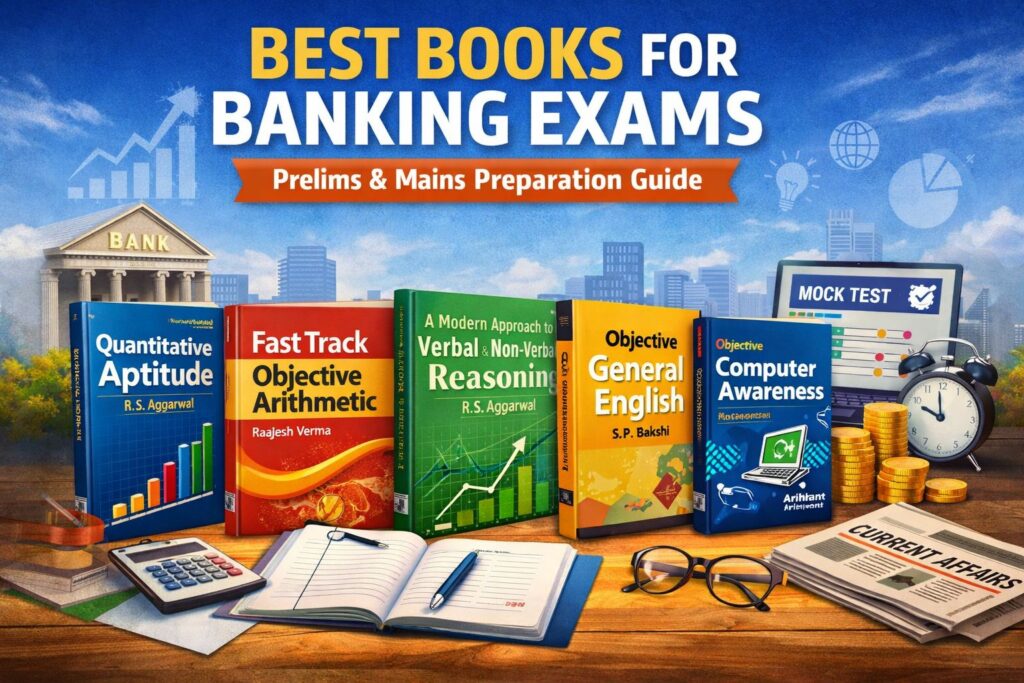
Discover the subject-wise best books for banking exams and learn how to use them effectively in your banking study plan for SBI, IBPS, RBI, and RRB exam preparation.
Crack Banking Exams Faster with the Right Books: Complete Subject-Wise Guide for Smart Preparation
Preparing for competitive banking exams like SBI PO, IBPS PO, IBPS Clerk, RBI Assistant, or RRB Officer requires more than just hard work — it demands the right study resources. Many aspirants spend months studying without seeing real improvement simply because they are using outdated or ineffective material. Choosing the correct books for each subject is one of the most important decisions you will make during your preparation journey.
Banking exams test candidates across multiple sections such as Quantitative Aptitude, Reasoning Ability, English Language, General Awareness, Computer Knowledge, and Data Interpretation. Each of these subjects requires a different approach, practice method, and conceptual clarity. That is why following a subject-wise best books strategy can significantly improve your preparation efficiency and help you focus on topics that actually matter in the exam.
Whether you are a beginner who has just started your preparation or an experienced candidate looking to improve your score, selecting the right combination of conceptual and practice books can make your preparation more structured and result-oriented. The right books will not only strengthen your fundamentals but will also help you solve questions faster and more accurately in both Prelims and Mains exams.
In this detailed guide, we will cover the most recommended and trusted books for all major banking exam subjects. You will also learn how to include these resources effectively in your banking study plan so that you can avoid confusion, save time, and maximize your performance in the upcoming exams.
This guide is suitable for the preparation of:
- SBI PO
- IBPS PO
- IBPS Clerk
- RBI Assistant
- RRB PO & Clerk
- Other PSU Bank Exams
Let’s now explore the subject-wise best books for banking exams that can help you prepare smarter and crack the exam with confidence.
Why Choosing the Right Books is Important for Banking Exam Preparation
One of the most common mistakes banking aspirants make is collecting too many books without understanding which ones are actually useful for the exam. In competitive exams like SBI PO, IBPS PO, IBPS Clerk, or RBI Assistant, your success does not depend on how many books you study — it depends on which books you choose and how effectively you use them.
The banking exam syllabus may look limited at first glance, but the level of questions asked in Prelims and Mains has gradually increased over the years. Questions are now more concept-based, time-consuming, and logic-driven. Without the right study material, candidates often struggle with speed, accuracy, and understanding new question patterns.
Here’s why selecting the right books matters:
1. Builds Strong Conceptual Foundation
Good-quality books explain basic concepts in a simple and structured manner. This is especially important for beginners who are just starting their preparation and need to understand fundamental topics in Quantitative Aptitude, Reasoning, and English.
2. Helps in Understanding Exam-Level Questions
Banking exams are known for tricky and application-based questions. Standard preparation books include practice questions that match the actual exam pattern, which helps in improving your problem-solving skills.
3. Improves Speed and Accuracy
Time management is crucial in banking exams. The right books provide topic-wise exercises and practice sets that help you increase your solving speed without compromising accuracy.
4. Saves Time by Avoiding Irrelevant Topics
Many general competitive exam books contain topics that are not relevant for banking exams. Using exam-specific books ensures that your preparation stays aligned with the actual syllabus.
5. Supports Both Prelims and Mains Preparation
Well-recommended books usually cover both basic and advanced level questions. This allows you to prepare for Prelims and gradually move towards the Mains level without needing separate resources for every stage.
When you integrate the right resources into your daily banking study plan, your preparation becomes more organized and goal-oriented. Instead of jumping between multiple sources, you can focus on mastering one trusted book per subject and track your progress more efficiently.
In the next section, let’s take a look at the major banking exams that are covered through the booklist shared in this guide.
Banking Exams Covered in This Book List
The subject-wise best books mentioned in this guide are carefully selected to match the preparation needs of all major banking recruitment exams conducted in India. These exams follow a similar pattern in terms of syllabus, question types, and difficulty level, which means you can prepare for multiple exams using the same set of reliable resources.
This booklist is suitable for the preparation of the following banking exams:
SBI PO (State Bank of India – Probationary Officer)
SBI PO is one of the most competitive banking exams in India. It includes three stages — Prelims, Mains, and Interview. The books recommended in this guide will help you build strong fundamentals for the objective tests conducted in both Prelims and Mains.
IBPS PO (Institute of Banking Personnel Selection – Probationary Officer)
IBPS PO is conducted annually to recruit officers in various public sector banks. The syllabus includes Quantitative Aptitude, Reasoning Ability, English Language, General Awareness, and Computer Knowledge. The books listed here are aligned with the latest IBPS exam pattern.
IBPS Clerk
IBPS Clerk focuses mainly on objective tests and does not include an interview stage. However, the competition level remains high. A structured banking study plan combined with the right preparation books can help you score well in both Prelims and Mains stages.
RBI Assistant
The RBI Assistant exam is known for its moderate to high difficulty level. Questions often test conceptual clarity and analytical ability. Using standard preparation books for practice and concept-building can be highly beneficial for this exam.
RRB PO and RRB Clerk
Regional Rural Bank exams are conducted to recruit candidates for Officer Scale I and Office Assistant posts. The syllabus is very similar to IBPS exams, which means the same recommended books can be used effectively for preparation.
Other PSU Bank Exams
Apart from the major exams listed above, several Public Sector Banks conduct recruitment exams for various positions. The resources shared in this guide are also helpful for those exams, as they generally follow the same subject structure and question format.
No matter which exam you are preparing for, using trusted preparation books for each subject will help you stay consistent and exam-ready throughout your preparation journey.
Note: Some of the links below are affiliate links. This means we may earn a small commission if you purchase through them, at no additional cost to you. This helps us maintain and update our free educational content regularly.
Best Books for Quantitative Aptitude (Banking Exams)
Quantitative Aptitude is one of the most important and scoring sections in banking exams. However, many candidates find this section difficult due to weak fundamentals in arithmetic topics such as Percentage, Profit and Loss, Ratio and Proportion, Time and Work, and Simple & Compound Interest.
To perform well in this section, you need a combination of concept-building and high-level practice. Below are some of the most recommended books that are widely used by successful banking aspirants across India.
1. Quantitative Aptitude for Competitive Examinations – R.S. Aggarwal
This is one of the best books for beginners who want to strengthen their basic concepts in arithmetic and numerical ability. The explanations are simple and suitable for candidates who are just starting their banking exam preparation.
Best For:
- Basic Concept Building
- Beginners
- Prelims Preparation
2. Fast Track Objective Arithmetic – Rajesh Verma
This book is highly useful for candidates who already understand the basics and want to improve their problem-solving skills. It includes a wide range of practice questions based on exam-level difficulty.
Best For:
- Practice After Concept Clarity
- Speed Improvement
- Prelims + Mains Preparation
3. Magical Book on Quicker Maths – M. Tyra
This book focuses on short tricks and calculation techniques that help in solving questions quickly during the exam. It is especially helpful for improving speed in time-bound tests.
Best For:
- Learning Short Tricks
- Increasing Calculation Speed
- Time Management
4. Quantitative Aptitude Quantum CAT – Sarvesh Kumar Verma
This book is recommended for candidates preparing for the Mains level. It contains advanced-level questions that improve analytical ability and help you tackle complex Data Interpretation problems.
Best For:
- Advanced Level Practice
- Mains Preparation
- Data Interpretation Concepts
You can include these books in your daily banking study plan to systematically improve both accuracy and speed in the Quantitative Aptitude section.
In the next section, we will look at the best books for Reasoning Ability.
Note: Some of the links below are affiliate links. This means we may earn a small commission if you purchase through them, at no additional cost to you. This helps us maintain and update our free educational content regularly.
Best Books for Reasoning Ability (Banking Exams)
Reasoning Ability is another high-scoring section in banking exams, especially for candidates who practice regularly. This section tests your logical thinking, decision-making ability, pattern recognition skills, and problem-solving approach through topics such as Puzzles, Seating Arrangement, Coding-Decoding, Syllogism, Blood Relations, and Inequality.
To master this section, you need books that explain concepts clearly and also provide enough practice questions based on the latest banking exam pattern.
1. A Modern Approach to Verbal and Non-Verbal Reasoning – R.S. Aggarwal
This book is ideal for beginners who want to understand the basic concepts of reasoning from scratch. It covers a wide variety of topics with step-by-step explanations.
Best For:
- Basic Concept Understanding
- Beginners
- Prelims Preparation
2. Analytical Reasoning – M.K. Pandey
This book is highly recommended for candidates who want to improve their logical thinking and analytical skills. It includes conceptual explanations along with practice exercises suitable for banking exams.
Best For:
- Conceptual Clarity
- Logical Reasoning Practice
- Prelims + Mains Preparation
3. A New Approach to Reasoning (Verbal & Non-Verbal) – B.S. Sijwali & Indu Sijwali
This book offers topic-wise explanations along with practice questions that match the level of banking exams. It is helpful for candidates who want to practice different types of reasoning questions regularly.
Best For:
- Topic-Wise Practice
- Strengthening Weak Areas
- Prelims + Mains Preparation
4. Lucent Reasoning
This book is suitable for quick revision and additional practice. It is commonly used by candidates who want to revise important reasoning topics in less time.
Best For:
- Quick Revision
- Extra Practice
- Strengthening Basics
Including these books in your preparation routine will help you solve reasoning questions with better speed and accuracy during the exam.
In the next section, we will explore the best books for the English Language section.
Best Books for English Language (Banking Exams)
The English Language section in banking exams evaluates your understanding of grammar, vocabulary, reading ability, and sentence structure. Topics such as Reading Comprehension, Error Detection, Cloze Test, Fill in the Blanks, Para Jumbles, and Sentence Improvement are commonly asked in both Prelims and Mains exams.
Many candidates from Hindi-medium backgrounds often find this section challenging. However, with regular practice and the right study material, it can become one of the most scoring sections in your overall banking study plan.
Below are some of the most recommended books for English preparation:
1. Objective General English – S.P. Bakshi
This book is ideal for learning grammar rules and practicing objective-type questions asked in competitive exams. It covers a wide range of grammar topics with exercises.
Best For:
- Grammar Practice
- Beginners
- Prelims Preparation
2. Word Power Made Easy – Norman Lewis
This book is highly effective for improving vocabulary. It helps you understand word usage through root words, making it easier to remember new words for a longer time.
Best For:
- Vocabulary Building
- Word Usage
- Long-Term Retention
3. High School English Grammar and Composition – Wren & Martin
This book is widely used for strengthening fundamental grammar concepts. It explains rules in detail, which is useful for improving sentence correction and error detection skills.
Best For:
- Basic Grammar Concepts
- Sentence Structure
- Concept Clarity
4. English Language – Adda247
This book includes practice questions based on the latest banking exam pattern. It is helpful for candidates who want to practice exam-level questions regularly.
Best For:
- Practice Questions
- Prelims + Mains Preparation
- Exam-Level Exercises
Regular reading and practice using these books will help you improve both accuracy and comprehension speed in the English section.
In the next section, we will discuss the best books for General Awareness.
Best Books for General Awareness (Banking Awareness + Current Affairs)
The General Awareness section plays a crucial role in the Mains stage of banking exams. This section mainly includes questions related to Banking Awareness, Financial Awareness, Static GK, Government Schemes, Important Committees, Budget Highlights, and Current Affairs.
Unlike other sections, General Awareness does not require calculations or lengthy problem-solving. With proper reading and revision, candidates can score high marks in less time. However, it is important to choose books that cover banking-related concepts along with updated financial knowledge.
Here are some of the most recommended books for General Awareness preparation:
1. Banking Awareness – Arihant Experts
This book covers important banking and financial concepts such as RBI functions, monetary policies, financial institutions, and banking terminology.
Best For:
- Banking Terminology
- Financial Concepts
- Mains Preparation
2. Lucent General Knowledge
This book is useful for building a strong base in Static GK topics such as History, Geography, Polity, Economy, and Science.
Best For:
- Static GK
- Basic General Awareness
- Quick Revision
3. Manorama Yearbook
This book contains detailed information about current events, government policies, economic developments, and important national and international updates.
Best For:
- Current Affairs
- National & International Events
- Annual Updates
4. Banking Awareness – Adda247
This book includes topic-wise explanations and practice questions based on the latest banking exam pattern.
Best For:
- Practice Questions
- Banking & Financial Awareness
- Prelims + Mains Preparation
Including these resources in your daily preparation will help you stay updated with important banking and financial knowledge required for the exam.
In the next section, we will explore the best books for Computer Knowledge.
Best Books for Computer Knowledge (Banking Exams)
Computer Knowledge is an important scoring section in the Mains stage of many banking exams such as IBPS PO, IBPS Clerk, RBI Assistant, and RRB Officer. This section tests your understanding of basic computer concepts including hardware, software, operating systems, internet usage, networking, MS Office, and digital banking technologies.
Below are some of the most recommended books for Computer Awareness preparation:
1. Objective Computer Awareness – Arihant Experts
This book covers fundamental topics such as computer basics, input/output devices, operating systems, memory, and internet concepts in a simple and easy-to-understand format.
Best For:
- Basic Computer Concepts
- Beginners
- Mains Preparation
2. Lucent Computer
This book is suitable for quick revision of important computer-related topics frequently asked in banking exams.
Best For:
- Quick Revision
- Important Concepts
- Strengthening Basics
3. Computer Awareness for Competitive Exams – Adda247
This book includes practice questions and explanations based on the latest banking exam pattern.
Best For:
- Practice Questions
- Prelims + Mains Preparation
- Exam-Oriented Learning
4. Objective Computer Knowledge – Kiran Publication
This book is useful for practicing objective-type questions that are commonly asked in competitive exams.
Best For:
- Practice Exercises
- Self-Assessment
- Topic-Wise Questions
Including these books in your banking study plan will help you prepare effectively for the Computer Knowledge section without spending too much time on complex topics.
In the next section, we will discuss the best books for Data Interpretation & Analysis.
Best Books for Data Interpretation & Analysis (Banking Exams)
Data Interpretation (DI) and Data Analysis are among the most challenging sections in banking exams, especially at the Mains level. Questions in this section are based on tables, pie charts, bar graphs, line graphs, caselets, and mixed data sets. Candidates are required to interpret numerical data and solve multiple questions accurately within a limited time.
This section tests not only your calculation ability but also your analytical thinking and decision-making skills. That is why practicing DI questions regularly using standard preparation books is extremely important for improving both speed and accuracy.
Below are some of the most recommended books for Data Interpretation preparation:
1. Data Interpretation for Competitive Exams – Arun Sharma
This book is helpful for understanding the basic concepts of data interpretation. It includes a variety of practice questions based on different types of graphs and charts.
Best For:
- Basic DI Concepts
- Beginners
- Prelims Preparation
2. How to Prepare for Data Interpretation for CAT – Arun Sharma
Although designed for CAT aspirants, this book is also useful for banking candidates who want to practice high-level DI questions for the Mains exam.
Best For:
- Advanced Practice
- Analytical Ability
- Mains Preparation
3. Quantitative Aptitude for Competitive Examinations – Abhijit Guha
This book includes chapters on data interpretation along with arithmetic concepts that are useful for solving DI-based questions.
Best For:
- Combined Quant + DI Practice
- Concept Building
- Prelims + Mains Preparation
4. Data Analysis and Interpretation – Adda247
This book contains topic-wise DI questions based on the latest banking exam pattern.
Best For:
- Exam-Level Practice
- Prelims + Mains Preparation
- Regular Practice
Practicing questions from these books regularly will help you handle complex DI sets with better confidence during the exam.
Beginner vs Advanced Book Selection Strategy
Selecting the right books is not just about choosing popular titles — it’s about choosing books that match your current preparation level. Many banking aspirants make the mistake of directly starting with high-level practice books without first building their basic concepts. This often leads to confusion, low accuracy, and slow progress.
To make your preparation more effective, you should divide your book selection strategy into two stages: Beginner Level and Advanced Level.
For Beginners (Starting Preparation from Scratch)
If you are new to banking exams or have weak fundamentals in Quantitative Aptitude, Reasoning, or English, you should begin with concept-based books. These books explain topics in a simple and structured way, helping you understand the basics before moving on to advanced questions.
At the beginner stage, your focus should be on:
- Understanding fundamental concepts
- Learning basic formulas and rules
- Solving easy to moderate level questions
- Improving calculation speed
- Building confidence
Avoid solving difficult puzzles or complex Data Interpretation sets in the initial phase. Instead, follow a structured banking study plan and complete one basic book per subject before attempting advanced-level practice material.
For Advanced Level Preparation
Once you have completed the basic concepts and are comfortable solving standard questions, you should move on to advanced practice books. These books contain high-level questions that are similar to the ones asked in the Mains exam.
At this stage, your focus should be on:
- Practicing exam-level questions
- Improving problem-solving speed
- Enhancing accuracy under time pressure
- Solving puzzles and DI sets
- Attempting mixed-topic exercises
Advanced books will help you develop the analytical skills required for solving complex questions in Reasoning and Data Interpretation sections.
By selecting books according to your preparation level, you can avoid unnecessary stress and ensure steady improvement throughout your preparation journey.
How to Use These Books Effectively in Your Banking Study Plan
Buying the right books is only the first step. Your success in banking exams depends on how effectively you use these books in your daily preparation routine. Many aspirants study multiple books randomly without following a structured approach, which often leads to confusion and incomplete syllabus coverage.
To get the best results from the recommended resources, you should integrate them properly into your banking study plan. Here’s how you can do it:
1. Follow a Subject-Wise Study Approach
Instead of studying all subjects at once, allocate separate time slots for Quantitative Aptitude, Reasoning Ability, English Language, and General Awareness. This will help you maintain consistency and focus on improving one subject at a time.
2. Start with Concept-Based Books
Begin your preparation with books that explain the fundamentals of each topic in a simple way. Focus on understanding concepts such as Percentage, Ratio, Syllogism, Reading Comprehension, and Computer Basics before moving on to practice questions.
3. Move to Practice Books After Concept Clarity
Once you are comfortable with the basics, start solving practice questions from advanced-level books. This will help you understand the pattern of questions asked in banking exams and improve your problem-solving skills.
4. Practice Topic-Wise Questions Daily
Make it a habit to solve a fixed number of questions from each subject every day. Topic-wise practice will help you identify your weak areas and work on them regularly.
5. Revise Important Formulas and Concepts
Revision is the key to remembering important formulas and rules. Keep short notes of Quant formulas, Reasoning rules, and English grammar concepts for quick revision.
6. Combine Book Study with Mock Tests
While books help in concept-building, mock tests help in improving speed and accuracy. Attempting mock tests regularly will allow you to apply what you have learned and manage time effectively during the exam.
7. Avoid Using Too Many Books
Using multiple books for the same subject can slow down your preparation. It is always better to complete one trusted book fully rather than studying partially from many different sources.
By following a structured approach and using these subject-wise best books strategically, you can make your preparation more organized and exam-focused.
Common Mistakes Students Make While Selecting Banking Books
Choosing the right preparation books is an important step in banking exam preparation. However, many aspirants make avoidable mistakes while selecting study material, which can negatively impact their performance in both Prelims and Mains exams.
Below are some of the most common mistakes candidates make:
1. Collecting Too Many Books
Many students believe that studying from multiple books will improve their preparation. In reality, this often leads to confusion and incomplete syllabus coverage. It is always better to follow a limited number of trusted resources and complete them thoroughly as part of your banking study plan.
2. Ignoring Concept-Building Books
Some aspirants directly start solving high-level practice questions without first understanding the basic concepts. This makes it difficult to solve even moderate-level questions during the exam.
3. Choosing Outdated Study Material
Banking exam patterns change over time. Using old or irrelevant books can result in practicing questions that are no longer asked in the exam.
4. Not Checking Exam-Level Questions
Many general competitive exam books include questions that do not match the actual difficulty level of banking exams. It is important to choose books that include exam-oriented practice sets.
5. Switching Books Frequently
Changing study material repeatedly during preparation can slow down your progress and make revision difficult. Once you select a good book, try to complete it before moving on to another resource.
6. Focusing Only on One Subject
Banking exams test candidates across multiple subjects. Ignoring sections like English or General Awareness can reduce your overall score, even if you perform well in Quantitative Aptitude or Reasoning.
7. Avoiding Revision
Studying new topics every day without revising previously learned concepts can affect retention. Regular revision is essential for improving accuracy in objective tests.
Avoiding these common mistakes and selecting the right subject-wise best books will help you prepare more effectively for the exam.
Booklist for Prelims vs Mains – What Should You Choose?
Banking exams are conducted in multiple stages, mainly Prelims and Mains. While the syllabus for both stages may appear similar, the level of questions asked in the Mains exam is usually more difficult and analytical. Therefore, your choice of books should also vary depending on the stage of the exam you are preparing for.
Books Suitable for Prelims Preparation
The Prelims exam focuses on testing your basic understanding of Quantitative Aptitude, Reasoning Ability, and English Language. Questions are generally straightforward but time-bound, which means speed and accuracy play a crucial role.
For Prelims preparation, you should focus on:
- Concept-building books for arithmetic topics
- Basic reasoning question sets
- Grammar and vocabulary improvement
- Moderate-level practice questions
Using beginner-friendly resources in your banking study plan will help you strengthen your fundamentals and improve your solving speed in objective-type questions.
Books Suitable for Mains Preparation
The Mains exam includes advanced-level questions from Quantitative Aptitude, Reasoning, Data Interpretation, General Awareness, and Computer Knowledge. Questions often involve logical thinking and analytical skills.
For Mains preparation, you should focus on:
- Advanced-level practice books
- Puzzle and seating arrangement sets
- Data Interpretation and Data Analysis questions
- Banking Awareness and Financial Awareness
- Current Affairs and Computer Knowledge
Mains-level books are designed to help you tackle complex problems and improve decision-making ability under time pressure.
Prelims vs Mains: Smart Book Selection Strategy
A smart preparation approach is to start with basic concept-based books for Prelims and gradually move to advanced practice material for Mains. This will allow you to build confidence in the initial stages and handle difficult questions more effectively later on.
Avoid directly jumping to advanced books without completing your basics, as this may lead to unnecessary confusion and slow down your preparation.
One-Book Strategy vs Multiple-Book Strategy – Which Works Better?
When it comes to banking exam preparation, one of the most common questions aspirants face is whether they should study from a single book per subject or use multiple books for better practice. Choosing the right approach can make a significant difference in how effectively you cover the syllabus and revise important topics.
One-Book Strategy
The one-book strategy focuses on completing a single trusted book for each subject before moving on to any additional resources. This approach is highly recommended for beginners who are just starting their preparation.
Advantages:
- Helps in building strong conceptual clarity
- Prevents confusion caused by different explanation styles
- Makes revision easier
- Ensures complete syllabus coverage
- Saves time and effort
By following this approach as part of your banking study plan, you can systematically complete topics and monitor your progress more effectively.
Multiple-Book Strategy
The multiple-book strategy involves using more than one book for the same subject. This approach is generally suitable for candidates who have already completed their basics and are preparing for the Mains exam.
Advantages:
- Provides exposure to different question types
- Improves problem-solving ability
- Enhances analytical skills
- Helps in tackling high-level questions
- Useful for advanced practice
However, using too many books without completing any of them can slow down your preparation and make revision difficult.
Which Strategy Should You Follow?
For most aspirants, the ideal approach is to start with the one-book strategy during the initial phase of preparation. Once you have gained confidence in your fundamentals, you can switch to additional practice books for advanced-level preparation.
This balanced strategy will help you make the best use of the subject-wise best books without overwhelming yourself with unnecessary study material.
Where to Buy These Banking Exam Books Safely Online
If you are serious about cracking banking exams, then investing in the right preparation books is not an expense — it is an investment in your career. Most successful candidates rely on a limited set of trusted books that help them build concepts, improve speed, and practice exam-level questions regularly.
Having your own set of preparation books allows you to:
- Study anytime without depending on shared material
- Highlight important formulas and shortcuts
- Make short notes for revision
- Practice questions multiple times
- Track your progress topic-wise
Below are some of the most recommended banking exam books that you should consider for your preparation.
1. Quantitative Aptitude for Competitive Examinations – R.S. Aggarwal
You can check the latest edition and availability of this book online before purchasing.
2. Fast Track Objective Arithmetic – Rajesh Verma
Make sure to select the latest edition while purchasing this book for updated question patterns.
3. A Modern Approach to Verbal & Non-Verbal Reasoning – R.S. Aggarwal
This book is widely used for reasoning preparation in banking exams.
4. Objective General English – S.P. Bakshi
Choose the most recent edition for better practice based on the latest exam pattern.
5. Objective Computer Awareness – Arihant Experts
Check ratings and reviews before purchasing to ensure you get the correct version.
These books are commonly used by candidates preparing for:
- SBI PO
- IBPS PO
- IBPS Clerk
- RBI Assistant
- RRB Officer & Clerk
- Other PSU Bank Exams
Before purchasing any book, make sure to:
- Check the latest edition
- Verify the author name
- Avoid duplicate or pirated copies
- Compare prices across sellers
- Read user ratings and reviews
Using these trusted resources in your banking study plan will help you cover the syllabus more effectively and practice questions that match the actual exam level.
Having your own copy of these subject-wise best books also allows you to revise concepts whenever required — which is essential for improving accuracy in competitive exams.
If you are preparing seriously for upcoming banking exams, getting the right study material at the right time can give you a clear advantage over other candidates.
Final Preparation Tips Using Subject-Wise Best Books
Selecting the subject-wise best books is only the first step towards effective banking exam preparation. To maximize your performance in both Prelims and Mains exams, you need to follow a disciplined and strategic approach while using these resources.
Here are some final preparation tips that can help you make the best use of your study material:
1. Set Clear Study Targets
Divide your preparation into weekly or monthly targets. Assign specific topics from Quantitative Aptitude, Reasoning, English, and General Awareness for each study session.
2. Complete One Book at a Time
Avoid switching between multiple books for the same subject. Focus on completing one trusted resource before moving to another for advanced practice.
3. Practice Regularly
Daily practice is essential for improving your problem-solving ability. Try to solve topic-wise questions from your books every day to maintain consistency.
4. Revise Important Topics Frequently
Make short notes of formulas, grammar rules, reasoning techniques, and banking terminology for quick revision.
5. Combine Book Study with Mock Tests
Books help in concept-building, while mock tests improve your speed and accuracy. Attempting regular mock tests will allow you to apply what you have learned.
6. Analyze Your Performance
After solving practice questions or mock tests, review your mistakes and work on weak areas.
7. Stay Consistent with Your Banking Study Plan
Consistency is the key to success in competitive exams. Stick to your banking study plan and revise topics regularly to ensure steady progress.
By using the right preparation resources and following a structured study routine, you can significantly improve your chances of cracking upcoming banking exams.
FAQs
Q1. Which is the best book for banking exam preparation for beginners?
For beginners, it is recommended to start with concept-based books such as Quantitative Aptitude by R.S. Aggarwal for Maths, A Modern Approach to Verbal & Non-Verbal Reasoning by R.S. Aggarwal for Reasoning, and Objective General English by S.P. Bakshi for English Language. These books help in building a strong foundation.
Q2. Can I prepare for banking exams using only one book per subject?
Yes, you can start your preparation with one trusted book per subject to understand the basics. Once your concepts are clear, you can move on to advanced practice books for better preparation for the Mains exam.
Q3. Are these books suitable for both Prelims and Mains exams?
Most of the recommended books include questions for both beginner and advanced levels, which makes them useful for preparation for both Prelims and Mains stages.
Q4. How many hours should I study daily for banking exams?
On average, candidates should dedicate 4–6 hours of focused study daily. However, the number of study hours may vary depending on your current preparation level and exam timeline.
Q5. Is General Awareness important for banking exams?
Yes, General Awareness plays a crucial role in the Mains stage of banking exams. A good score in this section can significantly improve your overall performance.
Q6. Should I follow a banking study plan along with these books?
Yes, following a structured banking study plan will help you complete the syllabus on time and revise important topics regularly.

Upgrade Your Study Setup for Faster Career Growth!
Discover the Best Online Learning Gadgets for Career Growth (Must-Have Study Tools for Students & Professionals) and choose the right devices that improve focus, productivity, and learning efficiency.
Explore the Gadget Guide →Conclusion
Preparing for banking exams becomes much easier when you choose the right study material and follow a structured approach. Instead of relying on random resources, using subject-wise best books for each section can help you build strong concepts, improve your problem-solving ability, and increase your accuracy in the exam.
Whether you are preparing for SBI PO, IBPS PO, IBPS Clerk, RBI Assistant, or RRB exams, selecting trusted preparation books and including them in your daily banking study plan will allow you to stay consistent and exam-ready throughout your preparation journey.
Focus on understanding the basics first, practice regularly, revise important topics, and gradually move towards advanced-level questions for Mains preparation. With the right combination of preparation books and disciplined study routine, you can significantly improve your chances of success in upcoming banking exams.
Stay consistent, stay focused, and make the most of the recommended resources to achieve your goal of a banking career.

Government Job Preparation & Career Guidance for Indian Exams
Read helpful blogs and preparation guides for SSC, Banking, Railway, and State Government exams. Learn exam strategies, syllabus insights, paper patterns, and make confident career decisions.
Govt Job Preparation Guides →
Exploring Your Career Options?
Career decisions are not made in one step. Exploring different paths and real-world realities helps you make clearer, more confident career choices.
Explore Career Path Guidance →