

Understand the complete banking exam selection process, including prelims, mains, interview stages, and how final merit is prepared.
Introduction: How the Banking Selection Process Works
Every year, lakhs of candidates apply for different banking exams in India with the dream of getting a secure and respected government job. However, many beginners focus only on studying subjects and ignore one very important thing—the selection process. Understanding how the recruitment stages work helps you prepare in a smarter and more focused way.
Most banking exams in India are conducted by major organizations such as:
- Institute of Banking Personnel Selection (IBPS)
- State Bank of India (SBI)
- Reserve Bank of India (RBI)
Although each exam has its own rules, the overall selection process is quite similar across most bank exams.
Basic Structure of Banking Selection
In general, the selection process for banking exams includes the following stages:
- Preliminary Examination (Prelims)
- Main Examination (Mains)
- Interview or Personality Test (for officer-level posts)
For clerical posts, the process usually ends after the mains exam, while officer-level posts like PO and SO include an additional interview stage.
The prelims exam is mainly a screening test, while the mains exam plays a major role in the final selection. This is why understanding the overall Banking Exam Pattern is essential before starting your preparation.
Once you know the exact stages, subjects, and weightage of each phase, it becomes easier to build a realistic study plan and avoid unnecessary mistakes.
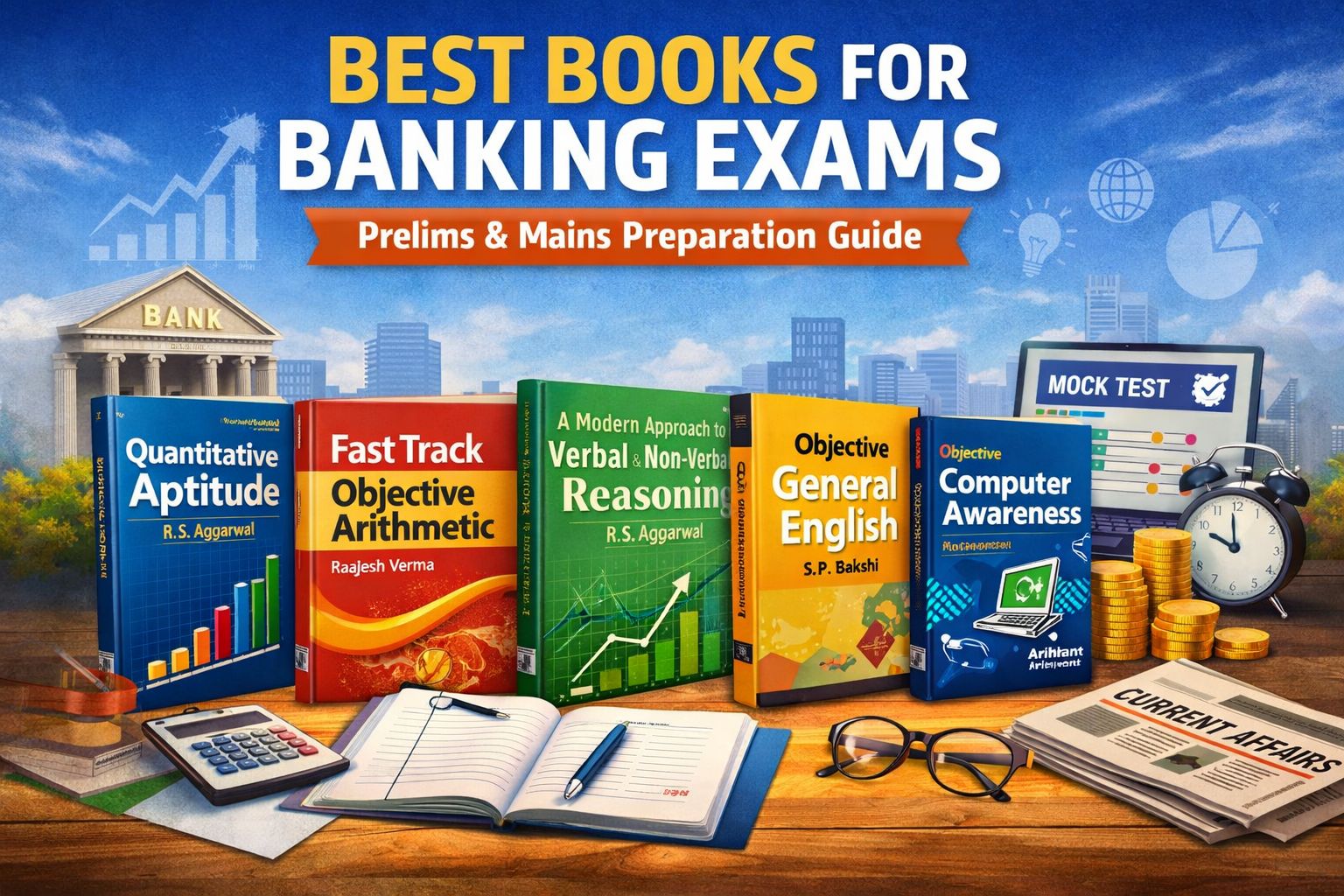
Start Your Banking Exam Preparation with the Right Books
Boost your chances of success with expert-recommended books for SBI, IBPS & RBI exams — Prelims + Mains preparation.
View Best Banking Exam BooksMajor Banking Exams and Their Selection Stages
In India, most government bank jobs are filled through national-level competitive exams. These exams are conducted by different organizations, but their selection processes are quite similar. Understanding the stages of each major exam helps you prepare with the right strategy.
Below are the most popular banking exams and their selection stages.
IBPS Exams (Institute of Banking Personnel Selection)
IBPS conducts recruitment for most public sector banks (except SBI).
IBPS Probationary Officer (IBPS PO)
Selection Stages:
- Preliminary Examination
- Main Examination
- Interview
This is one of the most popular officer-level exams. The final merit list is prepared using marks from the mains exam and the interview.
IBPS Clerk
Selection Stages:
- Preliminary Examination
- Main Examination
There is no interview for clerk posts. Final selection is based only on mains marks.
IBPS Specialist Officer (IBPS SO)
Selection Stages:
- Preliminary Examination
- Main Examination
- Interview
This exam is for specialized roles like IT Officer, Marketing Officer, Law Officer, and others.
SBI Exams (State Bank of India)
SBI conducts its own recruitment exams separately from IBPS.
SBI Probationary Officer (SBI PO)
Selection Stages:
- Preliminary Examination
- Main Examination
- Group Exercises and Interview
This is considered one of the most competitive banking exams in India.
SBI Clerk
Selection Stages:
- Preliminary Examination
- Main Examination
- Language Proficiency Test (if required)
There is no interview for SBI Clerk posts.
RBI Exams (Reserve Bank of India)
RBI conducts exams for its own vacancies, which are considered highly prestigious.
RBI Assistant
Selection Stages:
- Preliminary Examination
- Main Examination
- Language Proficiency Test
RBI Grade B Officer
Selection Stages:
- Phase 1 Examination
- Phase 2 Examination
- Interview
This exam has a more advanced and specialized selection process compared to other banking exams.
Key Differences in Selection Stages
| Exam Type | Prelims | Mains | Interview | Other Stages |
|---|---|---|---|---|
| IBPS Clerk | Yes | Yes | No | — |
| IBPS PO | Yes | Yes | Yes | — |
| SBI Clerk | Yes | Yes | No | Language Test |
| SBI PO | Yes | Yes | Yes | Group Exercise |
| RBI Assistant | Yes | Yes | No | Language Test |
| RBI Grade B | Phase 1 | Phase 2 | Yes | — |
Although the names of stages may vary slightly, the core structure remains similar. Most exams follow a two-step written process, and officer-level posts include an interview at the end.
Stage 1: Preliminary Examination (Screening Test)
The preliminary examination, commonly known as Prelims, is the first stage of the banking selection process. Almost all major banking exams such as IBPS PO, IBPS Clerk, SBI PO, SBI Clerk, and RBI Assistant begin with this stage.
The main purpose of the prelims exam is to shortlist candidates for the next stage. It acts as a screening test to reduce the number of applicants before the mains examination.
Purpose of the Prelims Exam
- To test basic aptitude and speed
- To filter candidates for the mains exam
- To check fundamental understanding of key subjects
The prelims exam is usually qualifying in nature, which means its marks are not counted in the final merit list in most banking exams. However, you must clear the sectional and overall cut-off to move to the mains stage.
Common Subjects in the Prelims Exam
Although the exact structure may vary slightly between exams, most prelims exams include three core subjects based on the Banking Exam Syllabus:
- English Language
- Reading comprehension
- Cloze test
- Error detection
- Sentence improvement
- Quantitative Aptitude
- Simplification and approximation
- Number series
- Arithmetic problems
- Data interpretation (basic level)
- Reasoning Ability
- Puzzles and seating arrangement
- Syllogism
- Inequality
- Coding-decoding
- Direction sense
Typical Prelims Exam Pattern
Most banking prelims exams follow this basic structure:
| Section | Questions | Marks | Time |
|---|---|---|---|
| English Language | 30 | 30 | 20 minutes |
| Quantitative Aptitude | 35 | 35 | 20 minutes |
| Reasoning Ability | 35 | 35 | 20 minutes |
| Total | 100 | 100 | 60 minutes |
Note: Exact pattern may vary depending on the exam.
Key Points About the Prelims Stage
- It is a qualifying round in most exams.
- Marks usually do not count in final selection.
- Speed and accuracy are very important.
- Sectional timing is common in many exams.
Clearing the prelims requires strong basics and regular practice. Candidates who focus on speed, mock tests, and time management usually perform better at this stage.
Stage 2: Main Examination (Final Written Test)
The main examination, commonly called the Mains, is the most important stage of the banking selection process. Unlike the prelims exam, the marks obtained in the mains are usually counted in the final merit list. This means your performance in this stage directly affects your chances of selection.
The mains exam is designed to test a candidate’s conceptual understanding, problem-solving ability, and decision-making skills at a higher level of difficulty.
Role of the Mains Exam in Final Selection
- It is the main scoring stage of the selection process.
- Marks from the mains exam are used to prepare the final merit list.
- Only candidates who clear the mains cut-off move to the interview stage (for officer posts).
Because of its importance, serious preparation is required for the mains exam.
Structure of the Mains Examination
The exact structure depends on the exam, but most mains exams include a mix of objective and descriptive sections.
Common Objective Sections
- Reasoning Ability and Computer Aptitude
- Advanced puzzles
- Logical reasoning
- Data sufficiency
- Input-output
- Basic computer knowledge
- Quantitative Aptitude / Data Analysis
- Data interpretation (moderate to advanced)
- Arithmetic word problems
- Caselet DI
- Probability and permutation (in some exams)
- General Awareness / Banking Awareness
- Current affairs
- Banking and financial knowledge
- Static general knowledge related to banking
- English Language
- Reading comprehension
- Error correction
- Sentence connectors
- Vocabulary-based questions
Descriptive Section (In Officer-Level Exams)
Some exams, especially PO-level exams, include a descriptive English section. This usually consists of:
- Essay writing
- Letter or email writing
This section tests your written communication skills, grammar, and clarity of expression.
Typical Mains Exam Pattern (Example for PO-Level Exams)
| Section | Questions | Marks | Time |
|---|---|---|---|
| Reasoning & Computer Aptitude | 45 | 60 | 60 minutes |
| Data Analysis & Interpretation | 35 | 60 | 45 minutes |
| General/Economy/Banking Awareness | 40 | 40 | 35 minutes |
| English Language | 35 | 40 | 40 minutes |
| Total (Objective) | 155 | 200 | 180 minutes |
| Descriptive (Essay & Letter) | 2 | 25 | 30 minutes |
Note: Pattern may vary slightly depending on the exam.
Difficulty Level of the Mains Exam
- Higher difficulty than prelims
- Questions are more concept-based
- Time pressure is greater
- Requires strong practice and accuracy
Candidates who rely only on basic concepts may struggle in the mains exam. A deeper understanding and regular mock test practice are essential to perform well.
Stage 3: Interview or Personality Test (For Officer Posts)
The interview stage is the final step in the selection process for most officer-level banking posts such as Probationary Officer (PO) and Specialist Officer (SO). Candidates who successfully clear the mains examination are called for the interview.
This stage is designed to evaluate a candidate’s personality, communication skills, confidence, and overall suitability for a banking career.
Exams That Include an Interview Stage
The interview or personality test is generally included in the following exams:
- IBPS PO
- IBPS SO
- SBI PO
- RBI Grade B
Clerical-level exams such as IBPS Clerk and SBI Clerk do not include an interview stage.
What Is Evaluated in the Interview
During the interview, a panel of banking professionals and experts assesses different aspects of the candidate. The focus is not only on knowledge but also on behavior and attitude.
Common areas evaluated include:
- Communication Skills
- Clarity of speech
- Confidence while answering
- Ability to express ideas clearly
- Banking and Current Affairs Knowledge
- Basic banking concepts
- Recent financial and economic news
- Awareness of government schemes
- Personality and Attitude
- Body language
- Professional behavior
- Positive attitude and honesty
- Educational and Personal Background
- Questions related to graduation subject
- Questions about hometown or work experience
Weightage of the Interview in Final Selection
The interview carries a specific weightage in the final merit list. Although the exact ratio may vary slightly, the typical pattern is:
- Mains Exam: 80% weightage
- Interview: 20% weightage
The final selection is based on the combined score of the mains exam and the interview.
Important Points About the Interview Stage
- Only a limited number of candidates are called for the interview.
- The interview is usually conducted face-to-face at designated centers.
- Minimum qualifying marks are required in the interview.
- Final selection depends on the combined score.
A candidate with strong mains marks but poor interview performance may miss the final selection. Therefore, interview preparation is just as important as written exam preparation.
Special Stages in Some Banking Exams
While most banking exams follow the standard process of Prelims → Mains → Interview, some exams include additional stages depending on the post and the recruiting organization. These stages are meant to check specific skills required for the job.
Not every exam includes these steps, but candidates should be aware of them to avoid surprises during the selection process.
1. Group Discussion or Psychometric Test
Some officer-level exams, especially SBI PO, may include:
- Group Discussion (GD): Candidates discuss a given topic in a group.
- Psychometric Test: A personality-based test that evaluates behavior, decision-making, and attitude.
These tests help the bank understand whether a candidate is suitable for leadership and customer-facing roles.
2. Language Proficiency Test (LPT)
Certain exams, especially for clerical posts, include a Language Proficiency Test after the mains exam.
This test is conducted in the local language of the state where the candidate is selected.
Purpose of the Language Test
- To check reading, writing, and speaking ability
- To ensure the candidate can communicate with local customers
Exams That May Include LPT
- SBI Clerk
- RBI Assistant
- Some IBPS Clerk allotments (if language proof is not provided)
Candidates who cannot demonstrate basic proficiency in the local language may be disqualified at this stage.
3. Document Verification
After clearing all exam stages, candidates must go through document verification.
During this stage, candidates must submit original documents such as:
- Educational certificates
- Identity proof
- Category certificate (if applicable)
- Age proof
- Interview call letter and scorecard
If any document is missing or incorrect, the candidate’s selection may be cancelled.
Key Points to Remember
- Not all exams include special stages.
- Officer-level exams may include GD or psychometric tests.
- Clerical posts may require a language test.
- Document verification is mandatory for final appointment.
Understanding these additional stages helps candidates stay fully prepared throughout the selection process.
How the Final Merit List Is Prepared
After all the stages of the selection process are completed, the recruiting body prepares a final merit list. This list decides which candidates will receive the appointment or provisional allotment to banks.
The merit list is prepared based on the combined performance of candidates in the main stages of the selection process.
Score Calculation in Banking Exams
The method of score calculation may vary slightly depending on the exam, but the general process is similar across most banking recruitments.
- Prelims Exam
- Used only for shortlisting candidates.
- Marks are usually not counted in the final merit list.
- Mains Exam
- Marks obtained in the mains exam are converted into a normalized score.
- This score plays the major role in final selection.
- Interview (For Officer Posts)
- Conducted after the mains exam.
- Marks are added to the mains score with a specific weightage.
Typical Weightage in Final Selection (Officer Posts)
| Stage | Weightage in Final Merit |
|---|---|
| Mains Examination | 80% |
| Interview | 20% |
| Total | 100% |
Note: Exact weightage may vary slightly depending on the exam.
For clerical posts, there is usually no interview, so the final merit list is based only on the mains exam score.
Cut-Off Marks and Final Allotment
Once the combined scores are calculated, the recruiting body:
- Fixes a final cut-off based on:
- Number of vacancies
- Difficulty level of the exam
- Category-wise reservations
- Prepares a merit list of candidates who scored above the cut-off.
- Allots candidates to different banks based on:
- Rank in the merit list
- Preferences filled during application
- Available vacancies
Candidates who meet the cut-off and rank high enough in the merit list receive a provisional allotment or final selection.
Important Points About the Merit List
- Prelims marks usually do not count in final selection.
- Mains performance is the most important factor.
- Interview marks matter for officer-level posts.
- Final selection depends on both score and vacancy availability.
Understanding how the merit list is prepared helps candidates focus their energy on the stages that truly affect their final selection.
Selection Process for Different Posts (Quick Comparison)
The selection process in banking exams depends on the type of post you are applying for. The three main categories of bank jobs are:
- Clerk (clerical level)
- Probationary Officer (PO)
- Specialist Officer (SO)
Each post has a slightly different selection structure based on job responsibilities and required skill levels.
Clerk Selection Process
Clerical posts are entry-level positions in banks. The selection process is simpler compared to officer-level posts.
Stages:
- Preliminary Examination
- Main Examination
There is no interview for clerk posts in most banking exams. Final selection is based only on the mains exam score.
Some exams may include a Language Proficiency Test after the mains, especially if the candidate has not studied the local language.
Probationary Officer (PO) Selection Process
The PO post is an officer-level position with higher responsibilities. Therefore, the selection process includes an additional interview stage.
Stages:
- Preliminary Examination
- Main Examination
- Interview or Group Exercise + Interview
Final selection is based on the combined score of the mains exam and the interview.
Specialist Officer (SO) Selection Process
Specialist Officers are recruited for specific departments such as:
- IT
- Law
- Marketing
- HR
- Agriculture
Since these posts require specialized knowledge, the selection process includes an interview stage.
Stages:
- Preliminary Examination
- Main Examination
- Interview
Final selection depends on the combined performance in the mains exam and the interview.
Quick Comparison Table
| Post Type | Prelims | Mains | Interview | Special Tests |
|---|---|---|---|---|
| Clerk | Yes | Yes | No | Language Test (if required) |
| Probationary Officer (PO) | Yes | Yes | Yes | Group Exercise (SBI PO) |
| Specialist Officer (SO) | Yes | Yes | Yes | Department-specific interview |
Key Differences at a Glance
- Clerk posts usually have no interview.
- Officer-level posts always include an interview stage.
- SO posts require specialized knowledge in a particular field.
Understanding these differences helps you choose the right exam based on your qualification, interest, and career goals.
Complete Timeline: From Application to Joining
The banking selection process takes several months to complete. From the release of the notification to final joining, the entire process usually spans 5 to 9 months, depending on the exam and recruiting organization.
Understanding the timeline helps candidates plan their preparation and stay patient throughout the process.
Typical Timeline of a Banking Exam
Below is a general timeline followed by most banking exams such as IBPS and SBI.
| Stage | Expected Time Gap |
|---|---|
| Official Notification Release | Month 0 |
| Online Application Period | Month 0–1 |
| Preliminary Exam | Month 2–3 |
| Prelims Result | Month 3 |
| Main Exam | Month 4–5 |
| Mains Result | Month 5–6 |
| Interview (for officer posts) | Month 6–7 |
| Final Result | Month 7–8 |
| Joining/Training | Month 8–9 |
Note: Exact timelines may vary depending on the exam and administrative processes.
Example of a Typical Selection Flow
- Application submission after notification.
- Prelims exam conducted within 2–3 months.
- Mains exam held about 1–2 months after prelims.
- Interview stage for officer posts.
- Final merit list released.
- Provisional allotment and joining instructions.
Total Time for Different Post Types
| Post Type | Total Selection Duration |
|---|---|
| Clerk | 5–7 months |
| Probationary Officer (PO) | 7–9 months |
| Specialist Officer (SO) | 7–9 months |
| RBI Grade B | 6–8 months |
Important Points About the Timeline
- Delays may happen due to administrative reasons.
- Interview dates are announced after mains results.
- Joining dates vary from bank to bank.
- Candidates must regularly check official notifications.
Being aware of the timeline helps candidates stay focused and avoid unnecessary stress during the waiting periods.
Common Mistakes Candidates Make in the Selection Process
Many candidates prepare hard for banking exams, but still fail to reach the final selection. In most cases, the reason is not lack of effort, but strategic mistakes during the preparation and selection stages.
Understanding these common mistakes can help you avoid them and improve your chances of success.
1. Taking the Prelims Exam Lightly
Some candidates believe that prelims is only a qualifying stage, so they do not prepare seriously for it. As a result, they fail to clear the cut-off.
Reality:
Prelims is highly competitive, and only a small percentage of candidates qualify for the mains exam.
2. Ignoring the Mains-Level Preparation
Many students focus only on basic concepts suitable for prelims. When they reach the mains exam, they struggle with advanced questions and time pressure.
Common issues:
- Weak data interpretation skills
- Poor general awareness preparation
- Lack of practice for high-level reasoning questions
3. Not Preparing for the Interview Stage
Some candidates think that clearing the mains exam is enough. They start interview preparation only after the mains result is declared, which leaves very little time.
Result:
- Lack of confidence during the interview
- Poor communication skills
- Weak knowledge of banking and current affairs
4. Poor Time Management During Exams
Candidates often:
- Spend too much time on one section
- Attempt very difficult questions first
- Ignore sectional cut-offs
This leads to incomplete attempts and lower scores.
5. Skipping Mock Tests
Many beginners rely only on books and theory. They avoid mock tests due to fear of low scores.
Problem:
- No real exam experience
- Weak time management
- Difficulty handling exam pressure
6. Not Checking Documents in Advance
Some candidates reach the final stage but face problems during document verification because of:
- Incorrect certificates
- Missing documents
- Name or date of birth mismatches
This can lead to disqualification even after clearing all exam stages.
How to Avoid These Mistakes
The best approach is to follow a proper Banking Preparation Strategy that covers:
- Prelims and mains preparation together
- Regular mock tests
- Interview practice
- Proper document organization
A balanced and well-planned preparation strategy greatly improves your chances of final selection.
Tips to Clear Each Stage of the Banking Selection Process
Success in banking exams requires a stage-wise preparation strategy. Each phase of the selection process tests different skills, so your preparation should be focused and structured according to the stage.
Below are practical tips to help you perform well in every step of the banking selection process.
Tips for the Prelims Stage
The prelims exam focuses on speed, accuracy, and basic concepts.
Preparation tips:
- Strengthen basic concepts of reasoning, aptitude, and English.
- Practice short tricks and calculation techniques.
- Attempt daily sectional quizzes.
- Focus on time management.
- Take at least 2–3 mock tests per week.
Exam strategy:
- Attempt easy questions first.
- Do not get stuck on difficult puzzles.
- Maintain accuracy to avoid negative marking.
Tips for the Mains Stage
The mains exam is the most important stage for final selection.
Preparation tips:
- Study advanced reasoning and data interpretation.
- Prepare daily current affairs and banking awareness.
- Practice high-level mock tests regularly.
- Improve reading speed for the English section.
Exam strategy:
- Attempt sections based on your strengths.
- Avoid guesswork in difficult questions.
- Manage time carefully across sections.
Tips for the Interview Stage (Officer Posts)
The interview tests your personality, communication, and awareness.
Preparation tips:
- Revise basic banking concepts.
- Stay updated with current affairs.
- Practice common interview questions.
- Work on body language and confidence.
During the interview:
- Dress formally and professionally.
- Listen carefully to the questions.
- Answer honestly and clearly.
- Maintain eye contact and a calm attitude.
General Tips for the Entire Selection Process
- Follow a daily study routine.
- Solve previous years’ question papers.
- Keep all documents ready in advance.
- Stay consistent and avoid long study gaps.
A disciplined approach and regular practice can help you clear every stage of the banking selection process successfully.
Start Your Banking Exam Preparation with the Right Books
Boost your chances of success with expert-recommended books for SBI, IBPS & RBI exams — Prelims + Mains preparation.
View Best Banking Exam BooksConclusion: Step-by-Step Path to a Bank Job
The banking selection process may seem complicated at first, but it becomes simple when you understand each stage clearly. Most banking exams follow a structured path that includes a preliminary exam, main exam, and interview (for officer posts). Each stage has its own purpose and weightage in the final selection.
The prelims exam acts as a screening round, while the mains exam plays the most important role in determining your final score. For officer-level posts, the interview stage evaluates your personality, communication skills, and overall suitability for a banking career.
If you understand the complete process in advance, you can plan your preparation more effectively. Instead of studying randomly, you can focus on the right subjects, practice mock tests regularly, and prepare for each stage with a clear strategy.
Success in banking exams is not only about hard work. It also depends on smart preparation, consistency, and proper planning throughout the entire selection process.
Frequently Asked Questions
Q1. How many stages are there in the banking selection process?
Most banking exams have two or three stages. Clerical posts usually have Prelims and Mains, while officer posts include Prelims, Mains, and Interview.
Q2. Are prelims marks counted in the final selection?
In most banking exams, prelims marks are not counted in the final merit list. The prelims exam is only used to shortlist candidates for the mains stage.
Q3. Is there an interview for clerk posts in banking exams?
No, most clerk-level exams such as IBPS Clerk and SBI Clerk do not include an interview. Final selection is based on mains exam marks.
Q4. Which stage is most important for final selection?
The mains examination is the most important stage because its marks are used to prepare the final merit list. For officer posts, interview marks are also added.
Q5. How long does the banking selection process take?
The complete process, from notification to joining, usually takes 5 to 9 months, depending on the exam and recruiting organization.