A complete beginner-friendly guide covering the right banking study plan, book selection, preparation strategy, and self-study roadmap to crack banking exams confidently.
Introduction – Why a Proper Strategy is Important
Preparing for banking exams as a beginner can feel overwhelming in the beginning. Most candidates start their preparation with high motivation but soon get confused due to the vast syllabus, multiple subjects, and the pressure of time management. Without a clear direction, many aspirants spend months studying hard but still fail to see improvement in their performance.
This usually happens not because of lack of effort, but because of the absence of a proper preparation strategy.
Understanding the Nature of Banking Exams
Banking exams such as IBPS PO, SBI Clerk, IBPS Clerk, and other similar competitive exams are designed to test a candidate’s logical thinking ability, numerical skills, language proficiency, and general awareness. These exams are not just about knowledge, but about speed, accuracy, and smart decision-making under time pressure.
That is why random preparation without a structured plan often leads to frustration and poor results.
Importance of a Planned Preparation Strategy
A well-planned preparation strategy helps beginners understand what to study, how much to study, and when to study. It allows candidates to focus on important topics instead of wasting time on less relevant material. Moreover, having a clear roadmap improves consistency and builds confidence over time.
When you know your daily targets and long-term goals, it becomes easier to track your progress and stay motivated throughout the preparation journey.
Competition Level in Banking Exams
Another important reason why strategy matters is the competitive nature of banking exams. Every year, lakhs of candidates apply for a limited number of vacancies. In such a competitive environment, simply working hard is not enough.
Smart preparation, proper time management, and the right selection of study resources play a crucial role in determining success.
Avoiding Common Beginner Mistakes
Beginners often make the mistake of collecting too many books or switching study materials frequently. This leads to confusion and lack of conceptual clarity. Instead of improving performance, it slows down the entire preparation process.
A structured approach helps in choosing the right resources and following a step-by-step learning method.
In this guide, you will learn how to create an effective banking study plan, develop your own banking self study guide, understand how many books are enough for preparation, and identify the best books for banking exams.
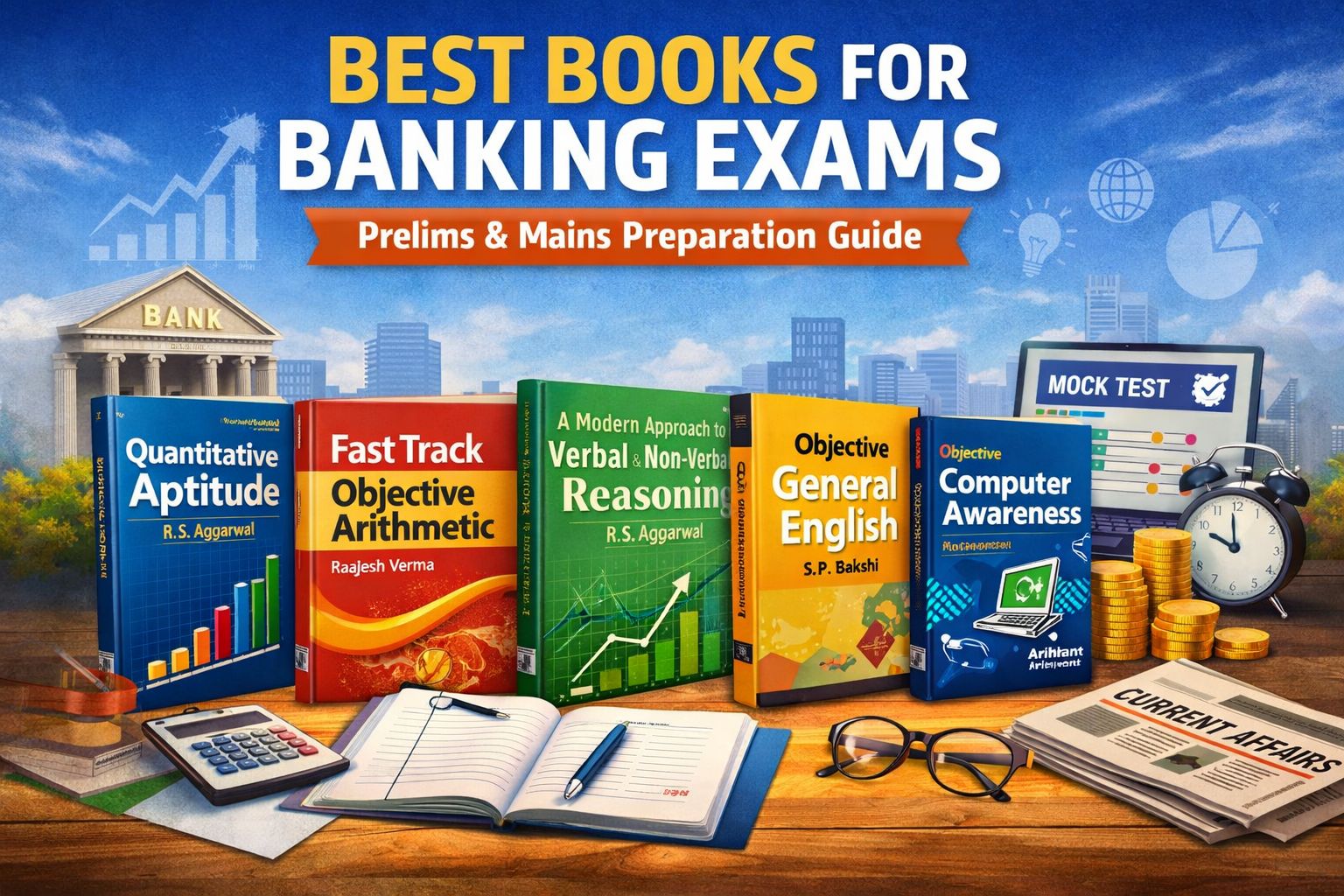
Start Your Banking Exam Preparation with the Right Books
Boost your chances of success with expert-recommended books for SBI, IBPS & RBI exams — Prelims + Mains preparation.
View Best Banking Exam BooksUnderstanding Banking Exams Structure (Prelims & Mains Overview)
Before starting preparation, every beginner must clearly understand the structure of banking exams. Without knowing the exam pattern, marking scheme, and subject distribution, it becomes difficult to plan studies effectively.
Most major banking exams in India, such as IBPS PO, IBPS Clerk, SBI PO, and SBI Clerk, follow a similar structure. They are generally conducted in three stages:
- Preliminary Examination (Prelims)
- Main Examination (Mains)
- Interview (for Probationary Officer posts)
Clerk-level exams usually have only Prelims and Mains, while PO-level exams include an interview stage as well.
1. Preliminary Examination (Prelims)
The Preliminary exam is the first stage and acts as a screening test. It usually includes three sections:
- Quantitative Aptitude
- Reasoning Ability
- English Language
The total duration is generally 60 minutes, with separate time limits for each section. The questions are objective type (multiple choice). The Prelims exam mainly tests speed and basic conceptual clarity.
Although the marks of Prelims are not counted in the final merit list (in most exams), clearing this stage is mandatory to qualify for the Mains examination. Therefore, accuracy and time management are extremely important.
2. Main Examination (Mains)
The Mains exam is more difficult and detailed compared to Prelims. It usually includes:
- Reasoning Ability (High-level puzzles and logical questions)
- Quantitative Aptitude / Data Interpretation
- English Language (Reading Comprehension, Grammar, Vocabulary)
- General Awareness (Banking & Financial Awareness)
- Computer Awareness (in some exams)
For PO exams, there may also be a descriptive paper including essay and letter writing.
The Mains exam tests deep conceptual understanding, analytical ability, and knowledge of current affairs related to banking and finance. Marks obtained in Mains are counted in the final selection.
3. Interview (For PO Posts)
Candidates who clear the Mains exam for PO posts are called for an interview. This stage evaluates personality, communication skills, banking awareness, and confidence. The final merit list is prepared based on Mains marks and Interview performance.
Important Features of Banking Exams
• Sectional time limits
• Negative marking (usually 0.25 marks deducted for each wrong answer)
• Online computer-based test
• High competition and limited vacancies
Understanding this structure helps beginners prepare smartly. For example, if you know that puzzles carry high weightage in reasoning, you can allocate more time to mastering them. If you understand that General Awareness plays a crucial role in Mains, you can start reading current affairs early.
Once you clearly understand the exam pattern, the next step is to design a proper banking study plan that matches your preparation time and learning speed.
Step 1 – Build the Right Banking Study Plan
The first and most important step in banking exam preparation is to create a practical and realistic banking study plan. Many beginners start studying without any fixed schedule, which leads to irregular preparation and incomplete syllabus coverage. A well-designed study plan helps you stay consistent, avoid confusion, and make steady progress every day.
A proper banking study plan should always be based on three key factors:
• Your current knowledge level
• The time available before the exam
• Your daily study capacity
Instead of copying someone else’s timetable, it is always better to create a personalized study plan that suits your routine and learning speed.
Divide Your Preparation into Phases
Beginners should ideally divide their preparation into three phases:
Phase 1: Concept Building (First 2–3 Months)
In this phase, focus on understanding the basic concepts of all subjects:
• Quantitative Aptitude (Number System, Simplification, Percentage, Ratio)
• Reasoning Ability (Coding-Decoding, Direction, Syllogism, Inequality)
• English Language (Grammar Basics, Vocabulary, Sentence Structure)
Avoid solving too many difficult questions in the beginning. First, make sure your fundamentals are clear.
Phase 2: Practice & Application (Next 2 Months)
Once your concepts are clear, start solving:
• Topic-wise practice questions
• Sectional quizzes
• Previous year questions
This phase helps you understand how questions are asked in the actual exam and improves your problem-solving ability.
Phase 3: Mock Tests & Revision (Last 1–2 Months)
This is the most crucial phase. Here you should:
• Attempt full-length mock tests regularly
• Analyze your mistakes
• Improve speed and accuracy
• Revise important formulas and concepts
Mock test analysis is as important as attempting the test itself.
Daily Study Time Allocation (Example)
If you can study for 5–6 hours daily, you may divide your time as follows:
• Quantitative Aptitude: 2 Hours
• Reasoning Ability: 2 Hours
• English Language: 1 Hour
• General Awareness / Computer: 30–60 Minutes
• Revision: 30 Minutes
Consistency is more important than studying for long hours occasionally. Even 4–5 hours of focused study daily can give excellent results if followed regularly.
Weekly Targets
Your study plan should also include:
• Weekly topic completion targets
• One sectional test every week
• One full-length mock test after completing basics
• Weekly revision of previously studied topics
Tracking your weekly performance helps in identifying weak areas early so that you can work on them before the exam.
A structured banking study plan not only improves your preparation quality but also reduces stress by giving you a clear path to follow. Once your study schedule is ready, the next step is to create your own banking self study guide to make learning more effective.
Step 2 – Create Your Personal Banking Self Study Guide
After preparing your banking study plan, the next important step is to create your own banking self study guide. This is especially useful for beginners who are preparing without coaching and want to study effectively at home.
A banking self study guide is nothing but a clear roadmap that helps you understand what to study, from where to study, and how to revise regularly. It keeps your preparation organized and prevents you from wasting time searching for study materials every day.
Why Self Study is Important for Banking Exams?
Many candidates believe that coaching is necessary to crack banking exams, but this is not true. Thousands of successful candidates clear these exams every year through self-study. What matters most is discipline, consistency, and the right study approach.
Self-study allows you to:
• Learn at your own pace
• Focus more on weak subjects
• Save time and money
• Build deeper conceptual understanding
• Practice more without external pressure
When you create your own banking self study guide, you take full control of your preparation.
Step-by-Step Self Study Method
Beginners can follow this simple method while preparing at home:
1. Select Limited Study Resources
Choose only one book or source for each subject in the beginning. Studying from multiple books at the same time creates confusion and slows down your preparation.
2. Study Concepts First
Do not jump directly into practice questions. Start by learning the basic concepts of each topic and understand the logic behind them.
3. Practice Topic-Wise Questions
After completing a topic, solve practice questions related to that topic daily. This improves both speed and confidence.
4. Maintain Short Notes
Make your own handwritten notes for:
• Important formulas
• Grammar rules
• Shortcut tricks
• Current affairs facts
These notes will help you during the revision phase.
5. Revise Weekly
Revision is the key to remembering concepts for a long time. At the end of every week, revise all the topics you studied during the week.
Self Study Tips for Beginners
• Fix a daily study time and follow it strictly
• Avoid switching between too many topics in one day
• Focus more on understanding rather than memorizing
• Track your progress through practice tests
• Stay consistent even if progress feels slow in the beginning
A well-prepared banking self study guide can make your preparation more focused and productive. Once your self-study method is clear, the next important question is how many books are enough for banking exam preparation.
Step 3 – How Many Books Are Enough for Banking Exams?
One of the most common questions beginners ask is: how many books are enough for banking exams? Many candidates make the mistake of collecting too many books, PDFs, and online materials. Instead of helping, this creates confusion and slows down preparation.
The truth is simple — you do not need a large number of books to crack banking exams. What you need is clarity of concepts, regular practice, and proper revision.
The Ideal Number of Books
For most beginners, the following approach works best:
• One main book for Quantitative Aptitude
• One main book for Reasoning Ability
• One reliable source for English Language
• One source for General Awareness and Banking Awareness
• Regular mock tests
That means 4 to 5 core study resources are usually enough.
Trying to study from multiple books for the same subject often leads to repetition of similar content. Instead of finishing one book properly, students keep switching materials and never complete any of them fully.
Why Too Many Books Can Be Harmful
Using too many books can create the following problems:
• Lack of focus
• Confusion in methods and shortcuts
• Incomplete syllabus coverage
• Reduced revision time
• Mental stress
For example, if you study Quantitative Aptitude from three different books, you may find different shortcut methods for the same topic. This can confuse you during the exam and reduce your speed.
The Right Approach
Instead of asking how many books are enough, ask yourself:
- Check whether the current book has been completed thoroughly.
- Make sure important topics have been revised properly.
- Review if previous year questions have been solved.
- Evaluate improvement based on mock test performance.
If the answer is no, adding another book will not solve the problem.
Master one resource completely before moving to another. Depth of understanding is more important than the number of books.
Focus on Practice Over Collection
Banking exams are speed-based exams. After learning the concept from one good book, your main focus should be:
• Practice questions
• Sectional tests
• Full-length mock tests
• Error analysis
Quality preparation always beats quantity of books.
Now that you understand how many books are enough, the next step is to know the best books for banking exams subject-wise.
Step 4 – Best Books for Banking Exams (Subject-Wise List)
Choosing the best books for banking exams is an important part of your preparation strategy. Using the right study material not only saves time but also helps in building strong concepts from the beginning.
Beginners should always select books that explain concepts in a simple manner and provide enough practice questions for better understanding.
Quantitative Aptitude
For Quantitative Aptitude, beginners should focus on books that cover basic concepts along with practice exercises. Topics like Simplification, Percentage, Ratio, Profit and Loss, Time and Work, and Data Interpretation require both conceptual clarity and regular practice.
While selecting a book, make sure it includes:
• Basic theory and explanation
• Practice questions for each topic
• Previous year exam questions
• Level-wise difficulty progression
Reasoning Ability
Reasoning Ability is a scoring subject if prepared properly. Beginners should choose books that explain logical concepts step by step.
Important topics include:
• Coding-Decoding
• Direction Sense
• Blood Relation
• Inequality
• Syllogism
• Seating Arrangement
• Puzzles
Books that provide puzzle-based exercises with solutions are very helpful in improving logical thinking and problem-solving speed.
English Language
English preparation should include both grammar and comprehension skills.
A good English preparation book should cover:
• Basic grammar rules
• Vocabulary building
• Error detection
• Sentence improvement
• Reading comprehension
• Cloze test and fill in the blanks
Daily reading practice along with grammar exercises can significantly improve your performance in this section.
General Awareness (Banking Awareness)
For the General Awareness section, candidates should focus on:
• Current Affairs
• Banking Terminology
• Financial Awareness
• Government Schemes
• Static General Knowledge
Monthly current affairs magazines or reliable online sources can be used for preparation.
Computer Awareness
Computer Awareness is usually asked in the Mains examination. Basic knowledge of:
• Computer fundamentals
• Input and output devices
• Internet and networking
• MS Office basics
• Operating systems
is sufficient for this section.
Always remember, the best books for banking exams are those that you can understand easily and complete on time. Consistent practice from limited but reliable resources is more effective than collecting multiple books without completing any of them.
Now that your study material is clear, the next step is to follow a structured 6-month preparation strategy as a beginner.
6-Month Preparation Strategy for Beginners
If you are starting from the basic level, a 6-month preparation strategy is generally sufficient to prepare for most banking exams like IBPS PO, SBI Clerk, or IBPS Clerk. The key is to follow a structured plan that covers concept building, practice, and revision in a balanced manner.
Beginners should divide these six months into three preparation stages to ensure complete syllabus coverage along with adequate practice.
Month 1–2: Concept Building Stage
During the first two months, your main focus should be on understanding the fundamentals of each subject.
Focus Areas:
• Quantitative Aptitude – Simplification, Percentage, Ratio and Proportion, Profit and Loss, Number System
• Reasoning Ability – Coding-Decoding, Inequality, Syllogism, Blood Relation, Direction Test
• English Language – Basic Grammar, Parts of Speech, Sentence Formation, Vocabulary
Avoid attempting difficult puzzles or high-level data interpretation questions in this stage. Instead, build your conceptual clarity through basic-level questions.
Also start reading daily current affairs for at least 20–30 minutes.
Month 3–4: Practice Stage
Once your basics are clear, start practicing topic-wise questions daily.
Focus Areas:
• Moderate-level Quantitative Aptitude questions
• Seating Arrangement and Puzzle-based Reasoning
• Reading Comprehension in English
• Weekly Current Affairs Revision
You should also begin solving sectional tests during this stage. These tests will help you understand your strengths and weaknesses.
Try to solve at least:
• 2 Quantitative Aptitude quizzes per week
• 2 Reasoning Ability quizzes per week
• 1 English Language quiz per week
Month 5: Mock Test Stage
In the fifth month, start attempting full-length mock tests.
Goals for this stage:
• Attempt 2–3 full mock tests per week
• Analyze each test carefully
• Identify weak areas
• Work on time management
Mock test analysis is important because it helps you understand:
• Which section takes more time
• Where you are making mistakes
• Which topics need more practice
Month 6: Revision & Final Practice
The final month should be completely dedicated to revision and practice.
Focus Areas:
• Revise formulas and shortcut methods
• Practice previous year questions
• Improve speed and accuracy
• Attempt 3–4 mock tests per week
Avoid starting any new topic in the last month. Focus only on strengthening the topics you have already studied.
Following this 6-month preparation strategy with consistency can help beginners prepare effectively without feeling overwhelmed. Now let us understand how to create a practical daily and weekly study timetable for banking exam preparation.
Daily & Weekly Study Timetable for Banking Exam Preparation
A proper timetable is the backbone of successful banking exam preparation. Without a structured daily routine, even the best study plan may fail. Beginners often feel confused about how many hours to study and how to divide subjects properly. The key is not studying for long hours, but studying consistently with focus.
Your timetable should be practical, flexible, and easy to follow every day.
Ideal Daily Study Routine (For 5–6 Hours Study Time)
If you are preparing full-time, you can follow this example structure:
Morning Session (2–3 Hours)
• Quantitative Aptitude – Concept + Practice
• Revise formulas from previous topics
Afternoon Session (1.5–2 Hours)
• Reasoning Ability – Topic practice or puzzles
Evening Session (1–1.5 Hours)
• English Language – Grammar + Reading Comprehension
• Vocabulary practice
Night (30–45 Minutes)
• Current Affairs / Banking Awareness
• Quick revision of the day’s learning
If you are a working candidate or student, even 3–4 focused hours daily can give good results. The important thing is daily consistency.
Weekly Study Plan Structure
To keep your preparation organized, divide your week strategically.
Monday to Friday
• Cover new topics
• Practice 40–60 questions daily
• Read current affairs daily
Saturday
• Take one sectional test (Quant / Reasoning / English)
• Analyze mistakes
Sunday
• Attempt one full-length mock test (after basics are covered)
• Weekly revision of important formulas and concepts
Weekly revision prevents forgetting old topics and strengthens retention.
How to Balance All Subjects
Many beginners focus too much on one subject and ignore others. This creates imbalance and reduces overall score.
To avoid this:
• Study at least two subjects daily
• Rotate subjects every 2–3 days
• Give extra time to weaker sections
• Do not ignore English or General Awareness
Balanced preparation ensures that you clear sectional cut-offs as well as overall cut-offs.
Tips for Following Timetable Consistently
• Fix a specific study location
• Keep mobile distractions away
• Set small daily targets
• Track your weekly progress
• Avoid skipping revision
A timetable works only when you follow it regularly. Discipline and time management are more important than motivation.
Now that your study routine is clear, the next step is to understand subject-wise preparation strategies in detail.
Subject-Wise Preparation Strategy
Each subject in banking exams requires a different preparation approach. Beginners should not follow the same study method for all sections. Understanding the right strategy for each subject can significantly improve both accuracy and speed.
Quantitative Aptitude
Quantitative Aptitude is considered one of the most challenging sections for beginners. However, it becomes easier with regular practice and strong conceptual understanding.
Preparation Strategy:
• Start with basic arithmetic topics such as Simplification, Percentage, Ratio and Proportion
• Learn formulas and shortcut methods gradually
• Practice calculation-based questions daily
• Focus on Data Interpretation after clearing basics
• Revise important formulas regularly
Avoid solving difficult questions in the beginning. First build confidence through basic-level practice.
Reasoning Ability
Reasoning Ability is a scoring section if prepared properly. Logical thinking and puzzle-solving skills are important here.
Preparation Strategy:
• Begin with easy topics like Coding-Decoding, Direction Sense, Blood Relations
• Practice Syllogism and Inequality daily
• Gradually move towards Seating Arrangement and Puzzles
• Solve different types of puzzles regularly
• Practice questions within time limits
Consistent puzzle practice improves both logical thinking and speed.
English Language
English is often ignored by beginners, but it plays a crucial role in clearing sectional cut-offs.
Preparation Strategy:
• Learn basic grammar rules
• Practice error detection and sentence improvement
• Read newspapers or articles daily
• Improve vocabulary through word lists
• Solve reading comprehension passages regularly
Daily reading habit improves comprehension and helps in answering questions quickly.
General Awareness
General Awareness is important for the Mains examination.
Preparation Strategy:
• Read daily current affairs
• Focus on banking and financial news
• Revise weekly current affairs
• Learn important government schemes
• Study basic static general knowledge
Monthly revision is necessary to remember important facts for a long time.
Computer Awareness
Computer Awareness is usually easy but should not be ignored.
Preparation Strategy:
• Study basic computer fundamentals
• Understand input and output devices
• Learn MS Office basics
• Understand internet and networking concepts
• Revise computer terminology regularly
Even basic preparation can help you score well in this section.
Preparing each subject with the right strategy helps in improving overall performance in the exam. Now let us understand how to improve speed and accuracy during preparation.
How to Improve Speed and Accuracy
Banking exams are not just about solving questions correctly — they are about solving them quickly and accurately within a limited time. Many beginners know the concepts but fail to clear the exam because they cannot manage time properly. That is why improving speed and accuracy should be a major part of your preparation strategy.
Understand the Importance of Time Management
In most banking exams, each section has a fixed time limit. You cannot spend too much time on one question because it may reduce your chances of attempting other easy questions.
The goal is to:
• Identify easy questions quickly
• Skip difficult questions initially
• Attempt maximum correct questions within time
Smart question selection is more important than attempting every question.
Practice Calculation Speed Daily
For Quantitative Aptitude, slow calculations reduce performance.
To improve speed:
• Practice basic calculations without a calculator
• Learn tables up to 20
• Memorize squares and cubes of important numbers
• Practice approximation techniques
• Solve 15–20 calculation-based questions daily
Regular calculation practice increases confidence and reduces time pressure during the exam.
Improve Accuracy Through Concept Clarity
Accuracy improves when your fundamentals are strong.
To increase accuracy:
• Avoid guessing answers randomly
• Read questions carefully before solving
• Understand common mistake patterns
• Analyze errors after every mock test
Since there is negative marking in banking exams, careless mistakes can reduce your overall score significantly.
Solve Sectional Timed Quizzes
Timed practice is essential to simulate real exam pressure.
You should:
• Attempt 20-minute sectional tests
• Track the number of correct and incorrect attempts
• Gradually try to improve your score
• Analyze time taken per question
This helps in building exam temperament and confidence.
Learn to Skip and Return
One common mistake beginners make is spending too much time on a single difficult puzzle or Data Interpretation set. Instead:
• Attempt easy questions first
• Mark difficult ones for review
• Return to them if time permits
This strategy ensures that you maximize your score.
Regular Mock Test Practice
Mock tests are the best way to improve both speed and accuracy.
After each mock test:
• Identify weak areas
• Check accuracy percentage
• Improve time distribution
• Note repeated mistakes
Improvement comes from proper analysis, not just from attempting more tests.
Improving speed and accuracy requires consistent practice and patience. Now let us understand the most important part of banking exam preparation — the mock test strategy.
Mock Test Strategy (Most Important Part)
Mock tests play a decisive role in banking exam preparation. No matter how strong your concepts are, without regular mock test practice, it is difficult to clear the exam. Many beginners prepare for months but delay mock tests because they feel underprepared. This is a mistake.
Mock tests are not only for evaluation; they are a learning tool.
When Should You Start Mock Tests?
You should start sectional mock tests after completing basic concepts of each subject. Full-length mock tests can be started once you are comfortable with all major topics.
A suggested approach:
• After 1–2 months: Begin sectional tests
• After 3–4 months: Start full-length mock tests
• Last 2 months: Focus heavily on full mocks
Do not wait until the syllabus is 100% complete. Mock tests help you identify weak areas early.
How Many Mock Tests Should You Attempt?
For serious preparation:
• Attempt at least 15–20 full-length mock tests before the actual exam
• Attempt 2–3 mock tests per week in the final phase
• Solve regular sectional tests for weak subjects
Quality matters more than quantity. Proper analysis is more important than the number of tests attempted.
How to Analyze Mock Tests Properly
Most candidates attempt mock tests but do not analyze them properly. This reduces improvement.
After every mock test:
• Check overall score
• Check sectional score
• Calculate accuracy percentage
• Identify topics where mistakes occurred
• Re-solve incorrect questions
Maintain a notebook of common mistakes and revise it weekly.
Improve Strategy After Every Mock
Mock tests help you refine your exam strategy.
Ask yourself:
- Check whether too much time was spent on puzzles.
- Identify if calculation speed was slow.
- Review the order in which sections were attempted.
- Analyze the section where maximum marks were lost.
Gradually adjust your strategy based on performance.
Simulate Real Exam Conditions
While attempting mock tests:
• Sit in a quiet environment
• Avoid distractions
• Follow exact time limits
• Do not pause the test
This builds exam temperament and reduces nervousness on the actual exam day.
Mock tests are the bridge between preparation and performance. Candidates who regularly analyze and improve after each test significantly increase their chances of success.
Now let us discuss some common mistakes beginners must avoid during banking exam preparation.
Common Mistakes Beginners Must Avoid
During banking exam preparation, beginners often make certain mistakes that slow down their progress and reduce their chances of success. Avoiding these mistakes can save valuable time and improve overall performance.
Studying Without a Proper Plan
One of the biggest mistakes is starting preparation without a structured study plan. Randomly studying different topics without following a timetable leads to incomplete syllabus coverage and confusion.
Always follow a clear daily and weekly schedule.
Collecting Too Many Study Materials
Many beginners believe that more books mean better preparation. In reality, using too many books creates confusion and reduces revision time.
Stick to limited and reliable study resources.
Ignoring Weak Subjects
Some candidates focus only on their strong subjects and ignore weaker ones. This can be risky because banking exams have sectional cut-offs.
Give extra time to subjects where you score less.
Avoiding Mock Tests
Fear of low scores often makes beginners delay mock tests. This prevents them from understanding the actual exam pattern and time pressure.
Start mock tests early and learn from mistakes.
Not Revising Regularly
Without revision, it is easy to forget concepts and formulas.
Revise:
• Important formulas
• Grammar rules
• Shortcut tricks
• Current affairs
Weekly revision helps in long-term retention.
Guessing Answers
Due to negative marking, random guessing can reduce your score.
Attempt questions only when you are reasonably sure about the answer.
Lack of Consistency
Studying for long hours occasionally but skipping preparation on other days affects performance.
Daily consistency is more important than studying for many hours once in a while.
Avoiding these common mistakes can make your preparation more efficient and less stressful. Now let us understand the final revision strategy before the exam.
Final Revision Strategy Before Exam
The last few weeks before the banking exam are extremely important. This is the time when your entire preparation should be focused on revision, practice, and improving exam performance. Starting new topics during this phase can create confusion and reduce your confidence.
A smart revision strategy helps in strengthening what you have already studied.
Focus on Important Topics
During the final phase:
• Revise frequently asked Quantitative Aptitude topics
• Practice important Reasoning puzzles
• Revise grammar rules for English
• Go through current affairs of the last 4–6 months
• Revise banking and financial awareness concepts
Do not try to learn anything completely new at this stage.
Revise Short Notes
Your handwritten notes play a crucial role during revision.
Revise daily:
• Formulas
• Shortcut methods
• Vocabulary lists
• Important current affairs facts
• Computer awareness terminology
Quick revision improves confidence before the exam.
Attempt Mock Tests Regularly
In the final month:
• Attempt 3–4 full-length mock tests every week
• Analyze performance after each test
• Improve time management
• Work on weak areas
Mock tests help in building exam confidence and reducing nervousness.
Practice Previous Year Questions
Previous year questions help in understanding:
• Exam difficulty level
• Question pattern
• Important topics
• Time required for each section
Solving these questions improves familiarity with the exam format.
Maintain Accuracy
Avoid attempting too many questions with low accuracy. It is better to attempt fewer questions correctly than to make multiple mistakes due to hurry.
Remember that negative marking can reduce your overall score.
Stay Calm and Confident
Avoid stress during the last few days. Maintain a proper sleep schedule and stay mentally relaxed.
Confidence comes from consistent revision and regular practice.
Following a proper revision strategy can improve your final performance significantly. Now let us move to some frequently asked questions related to banking exam preparation.
Frequently Asked Questions (FAQs)
Q1. How many months are enough for banking exam preparation?
For beginners, 5 to 6 months of consistent preparation is generally sufficient to prepare for banking exams like IBPS PO, SBI Clerk, or IBPS Clerk. However, the exact time depends on your current level, daily study hours, and understanding of basic concepts. Candidates with strong fundamentals in Mathematics and English may require less time.
Q2. Is coaching necessary to crack banking exams?
No, coaching is not compulsory. Many candidates successfully clear banking exams through self-study. What matters most is having a structured banking study plan, regular practice, proper revision, and mock test analysis. Self-discipline and consistency play a bigger role than coaching.
Q3. How many hours should I study daily for banking exams?
If you are preparing full-time, 5 to 6 focused study hours daily are enough. Working candidates can prepare effectively with 3 to 4 quality hours per day. Consistency is more important than studying for very long hours occasionally.
Q4. Which subject is the most difficult in banking exams?
The difficulty level varies from person to person. Generally, Quantitative Aptitude and high-level Reasoning puzzles are considered challenging by beginners. However, with regular practice and concept clarity, these sections become manageable.
Q5. How important are mock tests for banking exams?
Mock tests are extremely important. They help in improving speed, accuracy, time management, and exam confidence. Regular mock test analysis is one of the most effective ways to improve performance before the actual exam.
Q6. Can I prepare for banking exams without Mathematics background?
Yes, you can. Banking exam mathematics is mostly based on arithmetic and basic concepts. With regular practice and proper understanding, even candidates without a strong mathematics background can score well in Quantitative Aptitude.
Q7. Is English compulsory in banking exams?
Yes, English Language is a compulsory section in both Prelims and Mains exams. It is important to clear the sectional cut-off in English along with other subjects.
Start Your Banking Exam Preparation with the Right Books
Boost your chances of success with expert-recommended books for SBI, IBPS & RBI exams — Prelims + Mains preparation.
View Best Banking Exam BooksConclusion – Smart Strategy Beats Hard Work
Preparing for banking exams as a beginner may seem challenging at first, but with the right approach, it becomes manageable and structured. Success in these exams does not depend only on how many hours you study, but on how effectively you use your time and resources.
A well-planned banking study plan, a personalized banking self study guide, limited but reliable books, and regular mock test practice can make a significant difference in your preparation journey. Instead of collecting too many study materials, focus on understanding concepts, practicing regularly, and revising consistently.
Remember that banking exams are designed to test your speed, accuracy, logical thinking, and decision-making ability under time pressure. Therefore, smart preparation and proper time management are more important than random hard work.
Avoid common mistakes, stay consistent with your timetable, analyze your mock tests carefully, and keep improving your weak areas. Even beginners can perform well in banking exams by following a systematic preparation strategy from the beginning.
With dedication, discipline, and the right preparation method, cracking banking exams becomes an achievable goal.