
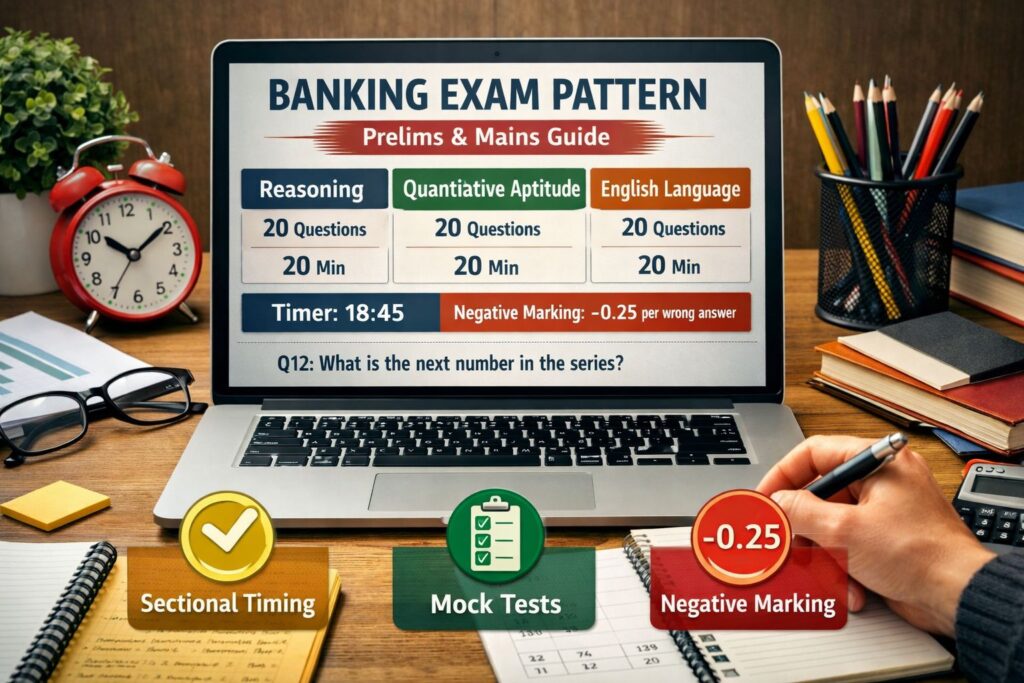
Understand the complete Banking Exam Pattern for Prelims and Mains including section-wise marks, time duration, negative marking, and preparation tips for smart exam strategy.
Introduction to Banking Exam Pattern
Every year, lakhs of candidates apply for various banking exams such as IBPS PO, SBI Clerk, IBPS RRB, and SBI PO with the aim of securing a stable and respected government job in the banking sector. However, many aspirants begin their preparation without clearly understanding how the actual examination is structured. This often leads to confusion, poor time management, and ineffective preparation.
The banking exam pattern refers to the overall structure of the examination, including the number of sections, types of questions asked, total marks, duration of the exam, and marking scheme. Most banking recruitment exams conducted in India follow a similar structure that is divided into two main stages — Preliminary Examination (Prelims) and Main Examination (Mains). Some posts may also include an Interview stage after the Mains exam.
Understanding the exam pattern is extremely important because it gives you a clear idea about:
- What subjects will be asked in the exam
- How many questions you need to attempt
- The time limit for each section
- The marking scheme and negative marking
- The level of difficulty expected in each stage
Once you are familiar with these details, you can prepare more efficiently and focus on the areas that carry higher weightage in the exam. A proper understanding of the Prelims and Mains exam pattern also helps candidates avoid unnecessary topics and concentrate only on what is relevant for the actual test.
In simple terms, knowing the banking exam pattern before starting your preparation allows you to build a smarter and more targeted approach, increasing your chances of qualifying for both Prelims and Mains successfully.
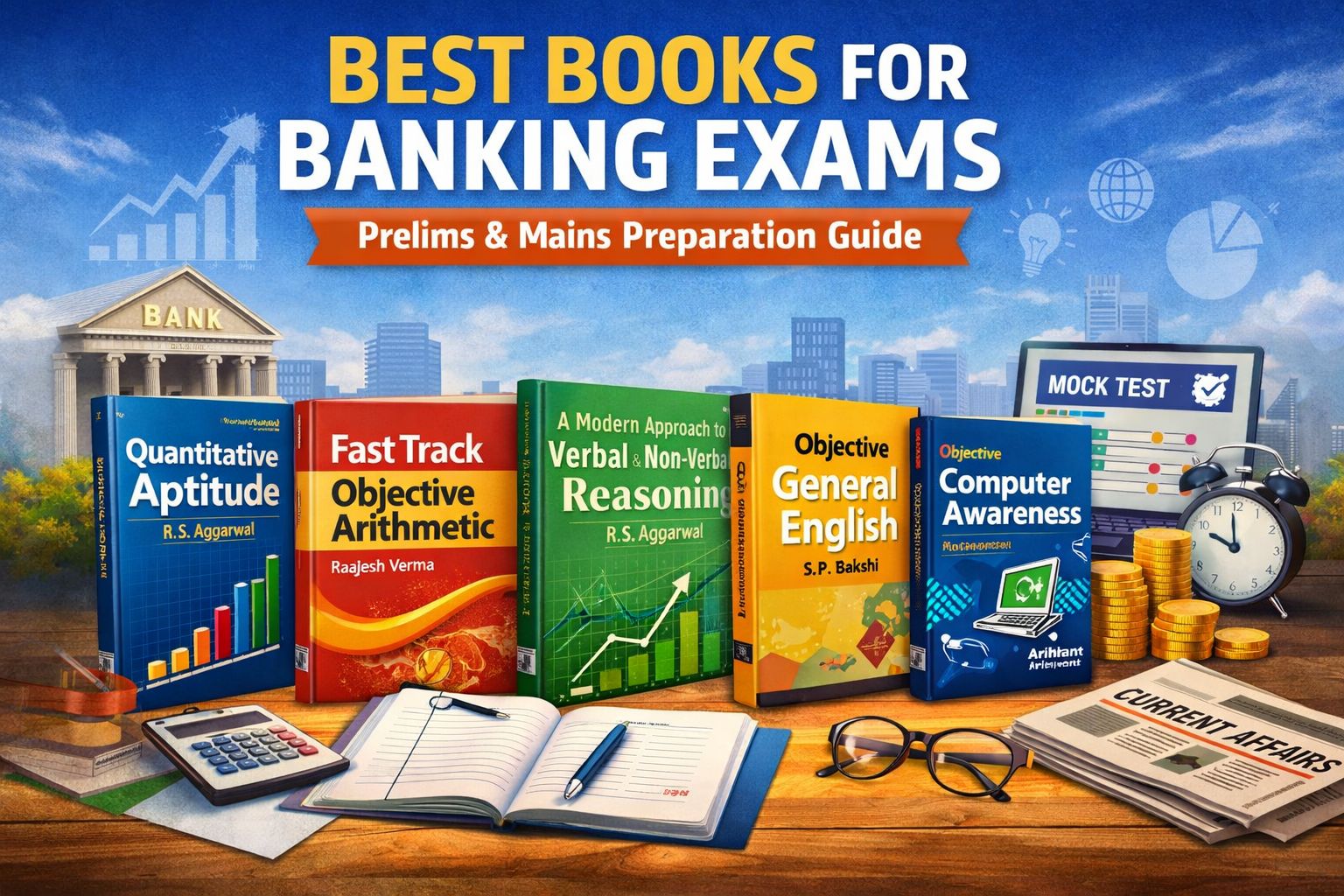
Start Your Banking Exam Preparation with the Right Books
Boost your chances of success with expert-recommended books for SBI, IBPS & RBI exams — Prelims + Mains preparation.
View Best Banking Exam BooksOverview of Banking Exam Stages
Most banking recruitment exams in India are conducted in multiple stages to assess a candidate’s aptitude, knowledge, and suitability for the job role. Although the exact process may vary slightly depending on the post (such as Clerk or Probationary Officer), the overall selection procedure generally consists of the following three stages:
Preliminary Examination (Prelims)
The Preliminary Examination is the first stage of the banking exam selection process. It is designed to test a candidate’s basic aptitude skills in areas such as reasoning ability, numerical ability, and English language. This stage acts as a screening test to shortlist candidates for the next phase.
Key points about the Prelims exam:
- It is objective in nature (Multiple Choice Questions)
- Conducted online
- Includes sectional timing
- Has negative marking for wrong answers
- Qualifying in nature (marks are not counted in final merit for most posts)
Candidates must clear both sectional and overall cut-off marks in order to qualify for the Mains examination.
Main Examination (Mains)
The Mains Examination is the most important stage in the banking exam process because the marks obtained in this stage are considered for final selection. The Mains exam is comparatively more difficult than the Prelims and includes advanced-level questions from multiple subjects.
Key features of the Mains exam:
- Includes both objective and descriptive tests
- Covers reasoning, data interpretation, general awareness, English, and computer aptitude
- Higher difficulty level than Prelims
- Sectional timing is applicable
- Marks are counted in the final merit list
Candidates who perform well in the Mains exam move to the final stage of the selection process.
Interview / Final Selection Stage
For posts such as Probationary Officer (PO) and Specialist Officer (SO), an Interview round is conducted after the Mains examination. This stage evaluates a candidate’s communication skills, confidence, banking awareness, and overall personality.
Important points about the Interview stage:
- Conducted face-to-face
- Usually carries 20% weightage in final selection
- Combined with Mains score to prepare final merit list
For Clerk-level exams, there is generally no interview stage, and the final selection is based solely on the Mains examination score.
Banking Exam Prelims Pattern
The Preliminary Examination (Prelims) is the first stage of most banking exams conducted for posts such as Clerk and Probationary Officer (PO). This stage is mainly designed to test a candidate’s basic aptitude and problem-solving ability within a limited time frame.
The Prelims exam is conducted in an online mode and consists of objective-type (multiple-choice) questions. Although the exact pattern may vary slightly depending on the conducting authority, the general structure of the banking Prelims exam remains almost the same across major exams like IBPS, SBI, and RRB.
Sections Included in Prelims
The Prelims examination typically consists of the following three sections:
- English Language
- Quantitative Aptitude
- Reasoning Ability
Each section is aimed at evaluating a specific skill set required for banking roles, such as logical thinking, numerical accuracy, and language comprehension.
Number of Questions
The total number of questions asked in the Prelims exam is usually 100, which are divided among the three sections. The distribution is generally as follows:
- English Language – 30 Questions
- Quantitative Aptitude – 35 Questions
- Reasoning Ability – 35 Questions
Time Duration
The total duration of the Prelims exam is 60 minutes. However, this time is further divided into sectional timing, meaning candidates must attempt each section within a fixed time limit.
Typical sectional timing:
- English Language – 20 Minutes
- Quantitative Aptitude – 20 Minutes
- Reasoning Ability – 20 Minutes
Candidates cannot switch between sections until the allotted time for a particular section is completed.
Marking Scheme
Each question in the Prelims exam generally carries 1 mark for a correct answer. There is also a penalty for incorrect responses.
- Correct Answer: +1 Mark
- Incorrect Answer: -0.25 Mark (Negative Marking)
- Unattempted Questions: No penalty
Sectional Timing
Sectional timing plays a very important role in the Prelims exam. Since each section has a fixed time limit, candidates must manage their time efficiently and avoid spending too much time on any single question.
Clearing the Prelims stage requires candidates to achieve both:
- Sectional Cut-Off Marks
- Overall Cut-Off Marks
Only those who qualify in both criteria are eligible to appear for the Mains Examination.
Section-wise Prelims Exam Pattern
To perform well in the Preliminary Examination, it is important to understand the type of questions asked in each section. The Prelims exam evaluates candidates on three major subjects — Quantitative Aptitude, Reasoning Ability, and English Language. Each section has its own question pattern and level of difficulty.
1. Quantitative Aptitude Pattern
The Quantitative Aptitude section is designed to test a candidate’s numerical ability, calculation speed, and problem-solving skills. Questions in this section are generally based on basic mathematical concepts and require both accuracy and time management.
Common topics asked in this section include:
- Simplification and Approximation
- Number Series (Missing or Wrong)
- Data Interpretation (Bar Graph, Pie Chart, Table)
- Quadratic Equations
- Arithmetic Problems (Percentage, Profit and Loss, Ratio, Time & Work, Speed & Distance, Simple and Compound Interest, etc.)
Candidates are required to solve 35 questions within 20 minutes, which makes speed and shortcut techniques extremely important.
2. Reasoning Ability Pattern
The Reasoning Ability section evaluates logical thinking, analytical skills, and decision-making ability. This section is considered scoring if practiced properly but can be time-consuming if approached without strategy.
Important topics usually asked:
- Seating Arrangement (Linear and Circular)
- Puzzles
- Inequality
- Coding-Decoding
- Syllogism
- Blood Relation
- Direction Sense
- Order and Ranking
This section also contains 35 questions to be solved in 20 minutes, so candidates must focus on solving easy and moderate-level questions first.
3. English Language Pattern
The English Language section tests a candidate’s understanding of grammar, vocabulary, and reading ability. This section is important as it helps in assessing communication skills required in the banking profession.
Commonly asked topics:
- Reading Comprehension
- Cloze Test
- Fill in the Blanks
- Error Detection
- Sentence Improvement
- Para Jumbles
- Vocabulary-based Questions
A total of 30 questions are asked from this section, and candidates get 20 minutes to complete them.
Understanding the section-wise pattern helps candidates plan their attempt strategy more effectively during the actual exam.
Banking Exam Mains Pattern
The Main Examination (Mains) is the second and most crucial stage of the banking exam selection process. Unlike the Preliminary Examination, the marks obtained in the Mains exam are considered while preparing the final merit list for selection. Therefore, candidates must prepare thoroughly for this stage to improve their chances of securing a banking job.
The Mains exam is conducted in online mode and includes both objective as well as descriptive-type questions (for certain posts such as Probationary Officer).
Sections Included in Mains
The Mains examination generally consists of the following sections:
- Reasoning Ability and Computer Aptitude
- Data Analysis and Interpretation
- General / Banking Awareness
- English Language
In addition to these objective sections, some exams (such as PO-level exams) also include a descriptive test.
Descriptive Test
The descriptive test is conducted to evaluate a candidate’s writing ability and communication skills in English. It usually includes:
- Essay Writing
- Letter Writing
This test is conducted online and candidates are required to type their answers within the given time limit.
Total Marks Distribution
The total marks for the objective test in the Mains examination are generally 200 marks, while the descriptive test may carry an additional 25 marks (for applicable posts).
The final merit list is usually prepared based on:
- Mains Examination Score
- Interview Score (if applicable)
Sectional Timing
Just like the Prelims exam, the Mains exam also follows sectional timing. Each section is allotted a specific time duration, and candidates are required to attempt questions within that particular time frame.
Effective time management and familiarity with the exam pattern are essential to successfully clear the Mains examination.
Section-wise Mains Exam Pattern
The Mains Examination includes advanced-level questions that test a candidate’s analytical ability, banking awareness, data interpretation skills, and language proficiency. Each section is designed to assess the candidate’s readiness for real-world banking responsibilities.
1. Reasoning & Computer Aptitude
This section evaluates logical reasoning along with basic computer knowledge required for banking operations. The level of questions asked in Mains is more complex compared to the Prelims exam.
Important topics covered:
- Advanced Puzzles and Seating Arrangement
- Logical Reasoning
- Input-Output
- Coding-Decoding (New Pattern)
- Data Sufficiency
- Computer Fundamentals
- Internet Basics
- Operating Systems
- MS Office Concepts
Candidates must develop strong analytical skills to perform well in this section.
2. Data Analysis & Interpretation
This section is an advanced version of Quantitative Aptitude and focuses on the candidate’s ability to analyze numerical data and solve complex problems.
Common topics include:
- Data Interpretation (Caselet, Line Graph, Pie Chart, Tabular Form)
- Probability
- Permutation and Combination
- Quadratic Equations
- Quantity Comparison
- Arithmetic Word Problems
Accuracy and conceptual clarity are essential in this section due to the higher level of difficulty.
3. General / Banking Awareness
This section tests a candidate’s knowledge about current events and the banking and financial sector.
Major areas include:
- Current Affairs (National and International)
- Banking Terminology
- Financial Awareness
- RBI Policies
- Government Schemes
- Static General Knowledge
Regular reading of newspapers and financial news is helpful for scoring well in this section.
4. English Language
The English Language section in Mains is more difficult than in Prelims and focuses on comprehension and grammar skills.
Topics generally asked:
- Reading Comprehension
- Error Detection
- Sentence Correction
- Vocabulary-based Questions
- Para Jumbles
- Cloze Test
Candidates are expected to demonstrate a good command of the English language.
5. Descriptive Test (Essay & Letter Writing)
The descriptive test assesses writing skills and clarity of thought. Candidates are usually required to:
- Write an Essay on a given topic
- Draft a Formal or Informal Letter
Answers must be typed within the given time limit using a computer interface.
Key Differences Between Prelims and Mains
Although both the Preliminary and Main examinations are important stages in the banking exam selection process, they differ significantly in terms of purpose, difficulty level, and role in final selection. Understanding these differences can help candidates adjust their preparation strategy accordingly.
Difficulty Level
The Prelims exam is designed to test basic aptitude skills and generally includes easy to moderate-level questions. It mainly focuses on speed and accuracy within a limited time frame.
On the other hand, the Mains exam is more challenging and includes moderate to high-level questions. It tests a candidate’s conceptual understanding, analytical thinking, and decision-making ability.
Time Management
In the Prelims exam, candidates are required to solve straightforward questions quickly due to the strict sectional timing. Speed plays a crucial role in clearing this stage.
In contrast, the Mains exam demands both speed and accuracy along with strong time management skills, as the questions are more complex and time-consuming.
Role in Final Selection
The marks obtained in the Prelims examination are usually qualifying in nature and are not counted in the final merit list for most banking posts.
However, the marks obtained in the Mains examination are extremely important because they are considered during the final selection process. For posts like Probationary Officer, the Mains score is combined with the Interview score to prepare the final merit list.
Understanding these key differences allows candidates to focus more on accuracy and conceptual clarity while preparing for the Mains exam, rather than relying only on speed as required in the Prelims stage.
Negative Marking System Explained
Negative marking is an important aspect of banking exams that candidates must clearly understand before attempting the question paper. It is introduced to discourage random guessing and ensure that only accurate answers are rewarded.
In most banking exams such as IBPS, SBI, and RRB, a penalty is applied for every incorrect answer marked by the candidate.
How Negative Marking Works
The general marking scheme followed in banking exams is:
- Correct Answer: +1 Mark
- Incorrect Answer: -0.25 Mark
- Unattempted Question: No Mark Deduction
This means that for every four incorrect answers, one mark is deducted from your total score.
For example:
- If a candidate answers 80 questions correctly, they earn 80 marks.
- If they answer 20 questions incorrectly, then 5 marks (20 × 0.25) will be deducted.
- Final Score = 80 – 5 = 75 Marks
Why Negative Marking Matters
Negative marking can significantly affect your overall score if questions are attempted without proper calculation or understanding. Even a few incorrect answers can reduce your chances of clearing the sectional or overall cut-off marks.
Therefore, candidates are advised to:
- Attempt only those questions they are confident about
- Avoid blind guessing
- Maintain a balance between accuracy and speed
A well-planned attempt strategy that considers negative marking can help maximize your score in both Prelims and Mains examinations.
Sectional Cut-Off vs Overall Cut-Off
In banking exams, qualifying for the next stage does not depend only on your total score. Candidates are also required to meet the minimum qualifying marks set for each individual section. These qualifying marks are known as Sectional Cut-Off and Overall Cut-Off.
Understanding the difference between these two is very important for effective exam preparation.
Sectional Cut-Off
Sectional cut-off refers to the minimum marks that a candidate must score in each individual section of the exam.
For example:
If the Prelims exam includes three sections — English Language, Quantitative Aptitude, and Reasoning Ability — then candidates must score the minimum required marks separately in all three sections.
Even if your total score is high, failing to meet the sectional cut-off in any one section will result in disqualification from the next stage.
Overall Cut-Off
Overall cut-off is the minimum total score that a candidate must achieve by combining marks from all sections.
For instance:
If the overall cut-off for a particular exam is 60 marks out of 100, then scoring below this mark — even after clearing sectional cut-offs — will prevent you from qualifying for the next round.
Why Both Cut-Offs Are Important
To successfully clear the Preliminary or Main Examination, candidates must:
- Score above the sectional cut-off in each section
- Score above the overall cut-off in the entire exam
Focusing only on strong subjects while ignoring weaker ones can be risky, as not clearing even one section may lead to elimination.
Therefore, balanced preparation across all subjects is essential for clearing banking exams.
Importance of Understanding Exam Pattern Before Preparation
Many candidates begin their preparation without taking the time to properly understand the structure of the banking exam. This often leads to studying irrelevant topics, poor time management, and ineffective revision strategies. Knowing the exam pattern in advance helps you prepare in a more focused and structured manner.
A clear understanding of the exam pattern allows you to identify:
- The sections included in the exam
- The number of questions asked from each subject
- The level of difficulty expected
- The time allotted for each section
- The marking scheme and negative marking system
Once you are aware of these details, you can plan your preparation in a way that aligns with the actual exam requirements. For example, if a particular section carries more weightage or is time-consuming, you can dedicate additional practice time to that subject.
Understanding the exam pattern is also the first step in building an effective banking preparation strategy. It helps candidates prioritize important topics, manage their time efficiently during practice sessions, and improve their overall performance in mock tests.
Candidates who study according to the exam pattern are generally able to attempt the paper more confidently and accurately, which increases their chances of qualifying for both Prelims and Mains examinations.
How Exam Pattern Helps in Creating a Study Plan
Creating a proper study plan is essential for success in any competitive exam, especially in banking exams where time management and subject balance play a crucial role. However, designing an effective preparation schedule becomes difficult if you are not familiar with the exam pattern.
Once you understand the structure of the Prelims and Mains examinations, you can develop a practical and result-oriented banking study plan based on:
- The number of sections in the exam
- The weightage of each subject
- The difficulty level of topics
- The time allotted for each section
- Your personal strengths and weaknesses
For instance, if the reasoning section contains puzzles and seating arrangement questions that require more practice time, you can allocate additional hours to that section in your daily routine. Similarly, if the general awareness section is scoring but requires regular revision, you can plan weekly current affairs updates in your schedule.
Knowing the exam pattern also helps you:
- Set realistic daily and weekly targets
- Divide preparation time subject-wise
- Include mock tests and revision sessions
- Improve accuracy and speed over time
A study plan created according to the exam pattern ensures that no important section is left unprepared and helps maintain a balanced approach throughout your preparation journey.
Link Between Pattern and Syllabus
While preparing for any banking exam, it is important to understand that the exam pattern and the syllabus are closely connected. The exam pattern defines how the questions will be presented in the examination, whereas the syllabus outlines the topics from which those questions will be asked.
A clear understanding of the exam pattern helps candidates identify which topics from the banking exam syllabus are more important and require greater focus during preparation.
For example:
- If the exam pattern shows that Data Interpretation carries significant weightage in the Mains exam, then candidates should focus more on DI-related topics in the syllabus.
- If puzzles and seating arrangement questions frequently appear in the reasoning section, then practicing these topics regularly becomes essential.
- If the general awareness section includes banking and financial awareness, then studying RBI policies and current financial news becomes necessary.
In this way, the exam pattern acts as a guide that helps candidates prioritize relevant topics from the syllabus and avoid wasting time on less important areas.
By aligning your preparation with both the syllabus and the exam pattern, you can ensure a more targeted and efficient study approach, which ultimately improves your performance in the actual examination.
Common Mistakes Students Make
While preparing for banking exams, many candidates focus only on studying different subjects without paying attention to the exam pattern. This often leads to avoidable mistakes that can negatively impact their performance in both Prelims and Mains examinations.
Some of the most common mistakes made by aspirants include:
Ignoring Sectional Timing
Many candidates practice questions without considering the sectional time limits followed in the actual exam. As a result, they struggle to complete all questions within the given time during the real test.
Attempting Too Many Questions
Due to negative marking, attempting questions without proper accuracy can reduce the overall score. Random guessing often leads to unnecessary mark deductions.
Focusing Only on Strong Subjects
Some aspirants spend most of their preparation time on subjects they are comfortable with while neglecting weaker sections. This can result in failure to clear the sectional cut-off even if the overall score is good.
Not Practicing According to Exam Pattern
Practicing questions without following the actual exam pattern may lead to poor time management and difficulty in handling complex questions in the Mains exam.
Ignoring Mock Tests
Mock tests are essential for understanding the real exam environment. Skipping regular mock tests prevents candidates from analyzing their performance and improving their speed and accuracy.
Avoiding these mistakes can help candidates attempt the exam more effectively and increase their chances of qualifying for the next stage.
Preparation Tips Based on Exam Pattern
Preparing for banking exams according to the exam pattern can significantly improve your performance in both the Preliminary and Main examinations. Instead of following a random study approach, candidates should align their preparation strategy with the actual structure of the exam.
Here are some useful preparation tips based on the banking exam pattern:
Understand Sectional Weightage
Identify which sections carry more marks and require additional practice. For example, reasoning and data interpretation questions in the Mains exam often demand more time and analytical thinking.
Practice Time-Bound Questions
Since both Prelims and Mains exams follow sectional timing, candidates should practice solving questions within a fixed time limit. This helps in improving speed and accuracy.
Focus on Accuracy
Due to the presence of negative marking, maintaining accuracy is as important as attempting more questions. Avoid blind guessing and attempt only those questions you are confident about.
Attempt Easy Questions First
During the exam, start with questions that are easier to solve. This will help you save time for more complex questions later and reduce the chances of getting stuck.
Take Regular Mock Tests
Mock tests based on the latest exam pattern help in understanding the actual exam environment. They also assist in identifying weak areas that require improvement.
Revise Important Topics Regularly
Revision is essential for retaining concepts and formulas, especially in quantitative aptitude and general awareness sections.
Following these tips while keeping the exam pattern in mind can make your preparation more structured and result-oriented.
FAQs
Q1. What is the exam pattern for banking exams?
The banking exam pattern generally consists of two main stages — Preliminary Examination (Prelims) and Main Examination (Mains). The Prelims exam includes objective-type questions from English Language, Quantitative Aptitude, and Reasoning Ability. The Mains exam includes advanced-level questions from Reasoning, Data Interpretation, General Awareness, English Language, and Computer Aptitude. Some exams also include a descriptive test in the Mains stage.
Q2. Are Prelims marks counted in the final selection?
In most banking exams such as IBPS and SBI, the marks obtained in the Preliminary Examination are qualifying in nature and are not included in the final merit list. Final selection is usually based on the marks scored in the Mains exam and Interview (if applicable).
Q3. Is there negative marking in banking exams?
Yes, most banking exams have a negative marking system. For every incorrect answer, 0.25 marks are deducted from the total score. There is no penalty for unanswered questions.
Q4. What is sectional cut-off in banking exams?
Sectional cut-off refers to the minimum marks that a candidate must score in each individual section of the exam. Candidates must clear both sectional and overall cut-off marks to qualify for the next stage.
Q5. Is the exam pattern the same for all banking exams?
While the basic structure of banking exams remains similar across different exams such as IBPS, SBI, and RRB, there may be slight variations in the number of questions, marking scheme, or sections included.
Start Your Banking Exam Preparation with the Right Books
Boost your chances of success with expert-recommended books for SBI, IBPS & RBI exams — Prelims + Mains preparation.
View Best Banking Exam BooksConclusion
Understanding the banking exam pattern for both Prelims and Mains is one of the most important steps in the preparation journey of any banking aspirant. It not only helps you become familiar with the structure of the examination but also enables you to prepare in a more focused and strategic manner.
A clear knowledge of sectional timing, marking scheme, and subject-wise weightage allows candidates to manage their time efficiently during the exam and avoid unnecessary mistakes caused by negative marking. It also helps in identifying important topics from the banking exam syllabus and allocating sufficient preparation time to each section.
Moreover, aligning your preparation approach with the actual exam structure plays a key role in building an effective banking preparation strategy and designing a practical banking study plan. Candidates who prepare according to the exam pattern are better equipped to handle time pressure, maintain accuracy, and improve their overall performance.
In simple terms, a strong understanding of the banking exam pattern lays the foundation for smart preparation and increases your chances of successfully qualifying for both the Preliminary and Main examinations.