
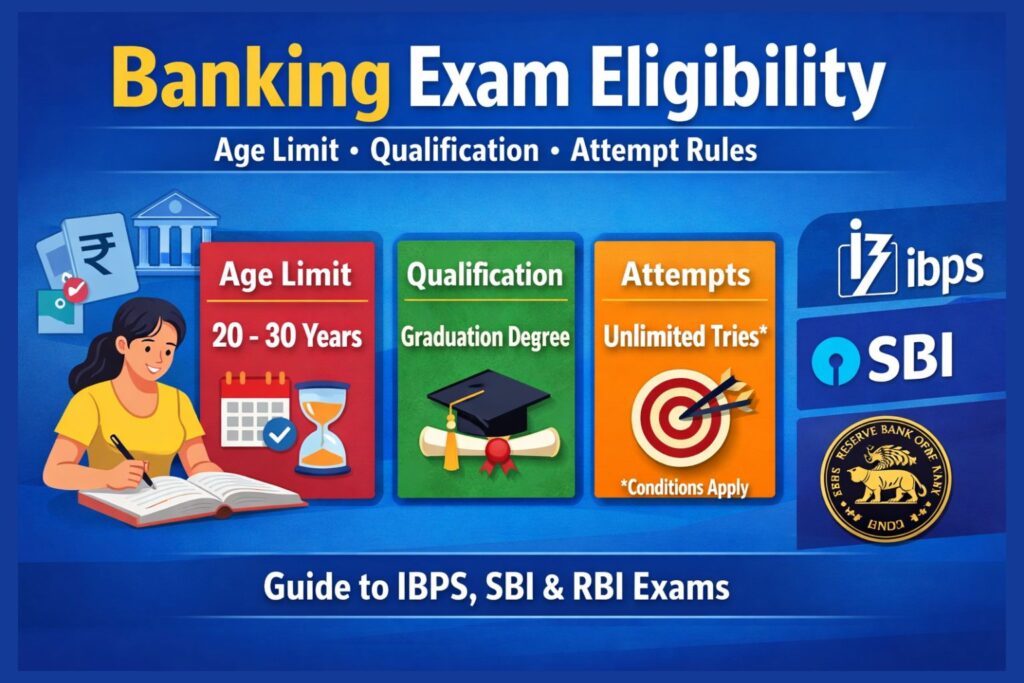
Check the complete banking exam eligibility including age limit, educational qualification, and attempt rules for IBPS, SBI, and RBI exams in one simple guide.
Introduction: Banking Exam Eligibility Explained
Banking exams are one of the most popular career options for students and graduates in India. Every year, lakhs of candidates apply for various government bank jobs because these jobs offer stability, good salary, career growth, and social respect. However, before starting preparation, it is very important to understand the eligibility criteria for banking exams.
Banking exam eligibility mainly includes three key factors:
- Age limit
- Educational qualification
- Number of attempts allowed
If a candidate does not meet even one of these conditions, the application can be rejected. That is why checking eligibility before applying is the first and most important step.
In India, most public sector bank recruitments are conducted through organizations like IBPS (Institute of Banking Personnel Selection), SBI (State Bank of India), and RBI (Reserve Bank of India). These exams include popular posts such as Probationary Officer (PO), Clerk, and Specialist Officer (SO).
If you are new to this field, you can first check the list of banking exams to understand which exams are conducted every year and which ones suit your goals.
Once you know the exams, the next step is to understand the banking selection process, which usually includes a preliminary exam, main exam, and interview or language test depending on the post.
After confirming your eligibility, you can move to the banking exam syllabus and start following a proper banking preparation strategy to increase your chances of selection.
This guide will explain all the important eligibility rules for major banking exams in a simple and clear way, so you can easily check whether you qualify or not.
Start Your Banking Exam Preparation with the Right Books
Boost your chances of success with expert-recommended books for SBI, IBPS & RBI exams — Prelims + Mains preparation.
View Best Banking Exam BooksBasic Eligibility for Banking Exams
Before applying for any banking exam, every candidate must meet some basic eligibility conditions. These conditions are almost similar across major exams such as IBPS PO, IBPS Clerk, SBI PO, SBI Clerk, and RBI Assistant. Although some rules may vary slightly depending on the exam and post, the core requirements remain the same.
If you are not sure which exam suits your profile, you can first explore the list of banking exams and then check the eligibility for each one.
Below are the main eligibility factors that every candidate should understand.
1. Nationality Criteria
To apply for most government banking exams in India, a candidate must meet one of the following nationality conditions:
- Must be a citizen of India, or
- A subject of Nepal or Bhutan, or
- A Tibetan refugee who came to India before January 1, 1962, with the intention of permanently settling in India, or
- A person of Indian origin who migrated from Pakistan, Sri Lanka, Burma, or certain East African countries with the intention of permanently settling in India.
Candidates belonging to categories other than Indian citizens may need to produce a certificate of eligibility issued by the Government of India at the time of final selection.
For most applicants, this condition is simple: Indian citizens are fully eligible to apply for all major banking exams.
2. Age Limit for Banking Exams
Age limit is one of the most important factors in banking exam eligibility. Each exam has a minimum and maximum age requirement, and candidates must fall within that range on the cut-off date mentioned in the official notification.
In general, the age limits for major banking exams are:
- Clerk posts:
Minimum age – 20 years
Maximum age – 28 years - Probationary Officer (PO) posts:
Minimum age – 20 years
Maximum age – 30 years - Specialist Officer (SO) posts:
Usually between 20 to 30 years, depending on the specific role.
Age is calculated based on the date mentioned in the official notification. Even a difference of one day can make a candidate ineligible, so it is very important to check the cut-off date carefully.
Reserved category candidates such as SC, ST, OBC, PwD, and others get age relaxation as per government rules. These relaxations will be explained in detail in a later section.
3. Educational Qualification
Educational qualification is another key requirement for banking exams. Most bank recruitment exams require a minimum graduation degree from a recognized university.
- The degree can be in any stream, such as Arts, Commerce, Science, Engineering, or Management.
- The university must be recognized by the Government of India or an approved regulatory body.
For most banking exams:
- Minimum qualification: Graduation (Bachelor’s degree)
- No specific stream required for PO or Clerk posts.
However, for Specialist Officer (SO) posts, candidates must have a degree in a relevant field such as:
- IT
- Law
- Agriculture
- HR
- Marketing
- Finance
Details about specific qualification requirements for different exams will be explained in a later section.
4. Computer Knowledge Requirement
Basic computer knowledge is required for most banking exams. This is because banking jobs involve working with digital systems, online transactions, and banking software.
Candidates are usually required to have:
- Basic computer knowledge, or
- A computer-related subject in school or college, or
- A certificate or diploma in computer applications.
In many exams, this requirement is verified at the time of document verification or joining.
Computer knowledge is also important for the exam itself because most banking exams are conducted in online mode.
5. Language Proficiency
Language proficiency is an important requirement, especially for clerk-level posts.
Candidates must:
- Be able to read, write, and speak the local language of the state they are applying to.
- Pass a local language test if required by the recruiting bank.
For example:
- If you apply for a post in Maharashtra, you may need knowledge of Marathi.
- If you apply in Tamil Nadu, knowledge of Tamil may be required.
This requirement ensures that selected candidates can communicate effectively with local customers.
Age Limit for Major Banking Exams
Although the basic age range for banking exams is similar, each exam has its own specific age criteria. Candidates must check the exact age limits mentioned in the official notification before applying.
Below are the standard age limits for the most popular banking exams in India. These limits are based on commonly followed recruitment rules and may change slightly in different years, but the general range remains the same.
If you are new to the field, you can also explore the list of banking exams to understand all available opportunities.
1. IBPS PO Age Limit
The IBPS Probationary Officer (PO) exam is one of the most popular banking exams in India.
Age criteria:
- Minimum age: 20 years
- Maximum age: 30 years
This means the candidate must be at least 20 years old and not more than 30 years old on the cut-off date mentioned in the official notification.
Age relaxation is provided to reserved categories as per government rules.
2. IBPS Clerk Age Limit
The IBPS Clerk exam is suitable for candidates who want to start their banking career at the clerical level.
Age criteria:
- Minimum age: 20 years
- Maximum age: 28 years
Candidates above 28 years may still be eligible if they fall under reserved categories and qualify for age relaxation.
3. SBI PO Age Limit
The State Bank of India conducts its own recruitment for the Probationary Officer post.
Age criteria:
- Minimum age: 21 years
- Maximum age: 30 years
This is slightly different from IBPS PO, where the minimum age is 20 years. Candidates should always check the exact age rules before applying.
4. SBI Clerk Age Limit
The SBI Clerk exam is one of the most applied banking exams every year.
Age criteria:
- Minimum age: 20 years
- Maximum age: 28 years
Age relaxation is applicable for SC, ST, OBC, PwD, and other eligible categories.
5. RBI Assistant & RBI Grade B Age Limit
The Reserve Bank of India conducts exams for Assistant and Grade B Officer posts.
RBI Assistant:
- Minimum age: 20 years
- Maximum age: 28 years
RBI Grade B Officer:
- Minimum age: 21 years
- Maximum age: 30 years
RBI exams are considered more competitive, and the eligibility rules must be checked carefully in the official notification.
In all these exams, candidates who meet the age criteria can move forward in the banking selection process, which usually includes preliminary and main examinations, followed by an interview or language test depending on the post.
Category-Wise Age Relaxation
Candidates belonging to reserved categories are given age relaxation in banking exams as per government rules. This relaxation allows candidates from specific categories to apply even if they cross the general age limit.
The exact relaxation may vary slightly from one exam to another, but the standard age relaxation followed in most IBPS, SBI, and RBI exams is given below.
Standard Age Relaxation for Reserved Categories
| Category | Age Relaxation |
|---|---|
| SC (Scheduled Caste) | 5 years |
| ST (Scheduled Tribe) | 5 years |
| OBC (Non-Creamy Layer) | 3 years |
| PwD (General/EWS) | 10 years |
| PwD (OBC) | 13 years |
| PwD (SC/ST) | 15 years |
| Ex-servicemen | 5 years (varies by exam) |
| Widows/Divorced Women (certain exams) | Up to 9 years (varies) |
Example of Age Relaxation
Suppose the maximum age limit for a PO exam is 30 years:
- A General category candidate can apply up to 30 years.
- An OBC candidate can apply up to 33 years (30 + 3 years).
- An SC/ST candidate can apply up to 35 years (30 + 5 years).
- A PwD SC/ST candidate may apply up to 45 years (30 + 15 years).
Important Points About Age Relaxation
- Age relaxation is available only if you have a valid category certificate.
- The certificate must follow the prescribed government format.
- OBC candidates must belong to the Non-Creamy Layer to claim relaxation.
- Age is always calculated based on the cut-off date mentioned in the official notification.
Candidates should always verify the age relaxation details in the official exam notice before applying. This ensures there are no issues during document verification or final selection.
Educational Qualification Details
Educational qualification is one of the most important eligibility conditions for banking exams. Most bank recruitment exams require candidates to have a minimum graduation degree from a recognized university. However, some specific posts may require specialized degrees.
Before applying, candidates should carefully check the qualification requirements mentioned in the official notification. This helps avoid rejection during document verification.
1. Minimum Degree Requirement
For most banking exams such as IBPS PO, IBPS Clerk, SBI PO, and SBI Clerk:
- The minimum qualification is a Bachelor’s degree (graduation).
- The degree can be from any stream, such as:
- Arts
- Commerce
- Science
- Engineering
- Management
- Any other recognized discipline
The university or institution must be recognized by:
- The Government of India, or
- A recognized regulatory body such as UGC, AICTE, etc.
There is no specific subject requirement for PO or Clerk posts.
2. Final-Year Students Eligibility
In most banking exams:
- Candidates must have completed their graduation on or before the date mentioned in the official notification.
- Final-year students can apply only if their result is declared before the specified cut-off date.
If the candidate cannot produce the graduation certificate or marksheet at the time of document verification, the candidature may be cancelled.
3. Percentage Requirement (If Any)
For most banking exams like:
- IBPS PO
- IBPS Clerk
- SBI PO
- SBI Clerk
There is no minimum percentage requirement in graduation. Candidates only need to pass their degree.
However, some exams or specific posts (especially in RBI or Specialist Officer roles) may require:
- A minimum percentage, such as 50% or 60% marks, depending on the post.
Candidates should always check the official notification for exact details.
4. Stream or Subject Restrictions
For general banking posts like:
- Probationary Officer (PO)
- Clerk
There are no stream restrictions. Candidates from any educational background can apply.
However, for Specialist Officer (SO) posts, specific qualifications are required. For example:
- IT Officer – Degree in Computer Science, IT, or related field
- Law Officer – LLB degree
- Agriculture Officer – Degree in Agriculture or related subject
- HR Officer – MBA in HR or related field
- Marketing Officer – MBA in Marketing
These posts are meant for candidates with professional or technical qualifications.
Understanding the correct educational requirements is essential before starting your banking preparation strategy, because eligibility issues at later stages can cancel your selection even after clearing the exams.
Attempt Limits in Banking Exams
Many candidates worry about how many times they can attempt a banking exam. The good news is that most banking exams in India do not have a fixed attempt limit. Instead, candidates can apply as many times as they want, as long as they meet the age and eligibility criteria.
Understanding the attempt rules is important so you can plan your banking preparation strategy properly and make the most of your eligible years.
1. Exams With No Attempt Limit
Most major banking exams allow unlimited attempts within the prescribed age limit. This means you can apply every year until you cross the maximum age.
Exams with no fixed attempt limit include:
- IBPS PO
- IBPS Clerk
- IBPS Specialist Officer
- SBI Clerk
- RBI Assistant
For these exams, the only restriction is the maximum age limit. Once you cross the age limit (after applying age relaxation if applicable), you can no longer apply.
2. Exams With Attempt Restrictions
Some banking or related exams may have attempt limits or additional conditions.
For example:
SBI PO:
- General/EWS: Up to 4 attempts
- OBC: Up to 7 attempts
- SC/ST: No restriction (within age limit)
The number of attempts is counted from the year you actually appear in the main exam stage, as per the official rules.
Because attempt rules may change over time, candidates should always check the latest official notification before applying.
3. Category-Wise Attempt Rules
Attempt limits, where applicable, usually vary based on the candidate’s category.
Typical structure (for exams with attempt limits like SBI PO):
| Category | Attempt Limit |
|---|---|
| General / EWS | 4 attempts |
| OBC | 7 attempts |
| SC / ST | No limit (within age) |
| PwD | Same as their category |
If an exam does not mention any attempt limit, it means candidates can apply unlimited times within the age limit.
Important Points About Attempts
- Attempt count usually applies only to specific exams like SBI PO.
- If you do not appear in the exam after applying, it is generally not counted as an attempt.
- Always check the latest notification for updated attempt rules.
Understanding attempt limits helps you plan your preparation based on your available years and chances.
Additional Eligibility Conditions
Apart from age, education, and attempt limits, candidates must also meet some additional conditions during the selection and joining process. These requirements ensure that the selected candidates are suitable for banking roles and meet the standards set by the recruiting organization.
Although these conditions are not part of the written exam, failing to meet them can lead to cancellation of the selection. Therefore, candidates should be aware of these rules before entering the banking selection process.
Medical Fitness
Candidates must be medically fit according to the standards prescribed by the bank.
- A medical examination is conducted after the final selection.
- Candidates with serious medical conditions that affect job performance may be declared unfit.
- Basic physical and mental fitness is required for handling banking duties.
Background Verification
Before joining the bank, candidates must undergo document and background verification.
This includes:
- Verification of educational certificates
- Identity proof
- Category certificate (if applicable)
- Address proof
- Character or conduct certificate (in some cases)
If any document is found to be false or incorrect, the candidature may be cancelled even after clearing the exam.
Bond or Service Agreement
Some banks, especially for officer-level posts like PO, may require candidates to sign a service bond at the time of joining.
Key points about the service bond:
- The bond usually requires the candidate to serve the bank for a fixed period, such as 2 to 3 years.
- If the candidate leaves the job before the bond period ends, they may have to pay a penalty amount to the bank.
- The bond amount and duration vary from one bank to another.
This condition ensures that the bank recovers its training investment and retains employees for a minimum period.
Understanding these additional conditions helps candidates avoid surprises after clearing the exam and ensures a smooth joining process.
Quick Comparison: Eligibility of Major Banking Exams
The table below gives a simple comparison of the eligibility criteria for some of the most popular banking exams in India. This will help you quickly understand the differences in age limits, qualification, and attempt rules.
| Exam Name | Post | Age Limit | Educational Qualification | Attempt Limit |
|---|---|---|---|---|
| IBPS PO | Probationary Officer | 20–30 years | Graduation in any stream | No fixed limit (within age) |
| IBPS Clerk | Clerk | 20–28 years | Graduation in any stream | No fixed limit (within age) |
| SBI PO | Probationary Officer | 21–30 years | Graduation in any stream | General: 4, OBC: 7, SC/ST: No limit |
| SBI Clerk | Clerk | 20–28 years | Graduation in any stream | No fixed limit (within age) |
| RBI Assistant | Assistant | 20–28 years | Graduation in any stream | No fixed limit (within age) |
| RBI Grade B | Officer | 21–30 years | Graduation (often with minimum marks) | No fixed limit (within age) |
Key Takeaways
- Most banking exams require graduation in any stream.
- The common age range is 20 to 30 years for officer posts.
- Clerk exams usually have a maximum age of 28 years.
- Most exams have no fixed attempt limit; the age limit is the main restriction.
- SBI PO is one of the few exams with specific attempt limits.
After checking your eligibility, the next step is to understand the banking exam syllabus and follow a proper banking preparation strategy to improve your chances of success.
Common Mistakes Candidates Make in Eligibility
Many candidates lose valuable opportunities in banking exams because of small eligibility mistakes. Sometimes, they prepare for months but later find out that they do not meet the required conditions. To avoid such problems, it is important to understand the most common mistakes related to banking exam eligibility.
1. Wrong Age Calculation
One of the most common mistakes is incorrect age calculation.
- Candidates often calculate age based on the current date instead of the cut-off date mentioned in the notification.
- Even a difference of one day can make a candidate ineligible.
Tip: Always check the exact cut-off date and calculate your age according to that date.
2. Assuming Any Degree Is Acceptable for All Posts
While PO and Clerk posts accept graduation in any stream, this is not true for all banking jobs.
- Specialist Officer (SO) posts require specific degrees.
- Many candidates apply for SO posts without the required qualification.
Tip: Read the qualification section carefully before applying for any post.
3. Ignoring Category Certificate Rules
Candidates from reserved categories sometimes face problems during document verification.
Common issues include:
- Using an outdated or incorrect certificate format
- OBC candidates not having a Non-Creamy Layer certificate
- Certificate issued after the cut-off date
Tip: Always use the latest certificate in the prescribed format mentioned in the notification.
4. Not Checking Final-Year Eligibility Rules
Some candidates apply while they are still in the final year of graduation without checking the rules.
- If the result is not declared before the cut-off date, the candidate becomes ineligible.
- This leads to cancellation during document verification.
Tip: Apply only if your graduation result will be available before the required date.
5. Ignoring Local Language Requirement
For clerk-level posts, knowledge of the local language is often mandatory.
- Some candidates apply for states where they do not know the local language.
- They later fail the language test or document verification.
Tip: Apply only for states where you can read, write, and speak the local language.
Avoiding these simple mistakes can save time, effort, and exam fees, and it will help you move smoothly through the banking selection process.
What to Do If You Are Not Eligible Yet
Many candidates find out that they are not eligible for certain banking exams due to age, qualification, or other criteria. However, this does not mean that the banking career option is closed for you. With proper planning, you can still prepare for future opportunities or choose alternative paths.
1. Wait Until You Complete Graduation
If you are still in school or college:
- Focus on completing your graduation first.
- Use this time to build strong basics in:
- Quantitative aptitude
- Reasoning
- English
- General awareness
This will give you a strong advantage when you become eligible.
2. Improve Your Skills During the Waiting Period
If you are not eligible yet, use the time productively by developing useful skills such as:
- Basic computer skills
- Typing speed
- Communication skills
- Financial awareness
- Current affairs reading
These skills are helpful not only for banking exams but also for other government and private jobs.
3. Prepare for Alternative Exams
If you are not eligible for a specific banking exam, you can explore other government exams with different age or qualification criteria.
Some alternatives include:
- SSC exams
- Railway exams
- Insurance exams
- State-level government exams
You can check the list of banking exams and similar government exams to find options that match your eligibility.
4. Plan for the Next Attempt
If you are currently not eligible due to age or qualification:
- Note the eligibility date for the next exam cycle.
- Create a long-term banking preparation strategy.
- Start preparation early so that you are fully ready when you become eligible.
Starting early gives you more attempts and a higher chance of success.
Even if you are not eligible today, proper planning and preparation can help you enter the banking sector in the future.
Start Your Banking Exam Preparation with the Right Books
Boost your chances of success with expert-recommended books for SBI, IBPS & RBI exams — Prelims + Mains preparation.
View Best Banking Exam BooksFAQs: Banking Exam Eligibility
Q1. What is the minimum qualification for banking exams?
The minimum qualification for most banking exams such as IBPS PO, IBPS Clerk, SBI PO, and SBI Clerk is a graduation degree in any stream from a recognized university.
Q2. Can final-year students apply for banking exams?
Final-year students can apply only if their graduation result is declared before the cut-off date mentioned in the official notification. Otherwise, they may become ineligible during document verification.
Q3. What is the age limit for banking exams?
The age limit depends on the post:
- Clerk posts: Usually 20 to 28 years
- PO posts: Usually 20 to 30 years
Age relaxation is available for reserved categories as per government rules.
Q4. Is there any attempt limit in banking exams?
Most banking exams such as IBPS PO, IBPS Clerk, and SBI Clerk do not have a fixed attempt limit. Candidates can apply as many times as they want within the age limit. However, some exams like SBI PO have attempt restrictions.
Q5. Can candidates from any stream apply for banking exams?
Yes, for most posts like PO and Clerk, candidates from any stream (Arts, Commerce, Science, Engineering, etc.) can apply, as long as they have a graduation degree.
Q6. Is computer knowledge necessary for banking exams?
Yes, basic computer knowledge is required because banking jobs involve working on digital systems. Many exams also require computer awareness as part of the syllabus.
Q7. Is knowledge of the local language compulsory?
For clerk-level posts, candidates usually need to know the local language of the state they apply to. Some banks conduct a language test after selection.