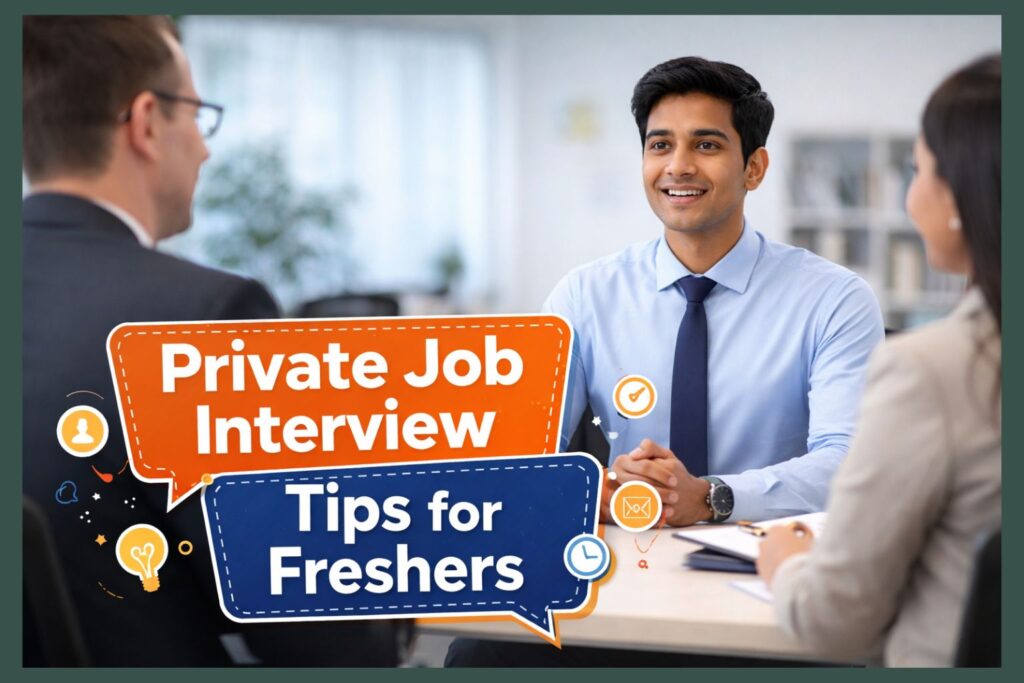
Learn the most effective private job interview tips for freshers, including preparation strategies, common questions, and practical advice to succeed in interviews.
Why Interview Preparation Is Important for Freshers
For many freshers, getting a call for a job interview is an exciting moment. However, it can also be stressful if you are not well prepared. A job interview is the stage where employers evaluate your skills, personality, communication ability, and suitability for the role. Even if you have the required qualifications, poor preparation can reduce your chances of getting selected.
Most companies do not expect freshers to have years of experience. Instead, they focus on qualities such as willingness to learn, confidence, basic knowledge of the job role, and a positive attitude. If you prepare properly, you can create a strong impression even without prior work experience.
Good interview preparation helps you in several ways. It allows you to understand the job role clearly, learn about the company, and practice how to answer common interview questions. When you prepare in advance, you feel more confident and less nervous during the interview. This confidence often makes a big difference in how interviewers perceive you.
Another important advantage of preparation is that it helps you communicate your abilities effectively. Many freshers have good skills but fail to explain them properly during interviews. Preparing your answers, reviewing your resume, and understanding the employer’s expectations can help you present yourself in a professional and convincing way.
Before attending any interview, it is also important to know how to find the right job opportunities and apply for them correctly. If you are still learning this process, you can read our guide on How to Find a Private Job in India, which explains different ways to discover job openings and apply successfully.
Once you start getting interview calls, the next step is to make sure you perform well in the interview. In the following sections, we will discuss practical and proven tips that will help freshers prepare for private job interviews and improve their chances of getting selected.
Understand the Job Role Before the Interview
One of the most common mistakes freshers make is attending interviews without properly understanding the job role. Many candidates apply for multiple jobs and do not carefully read the job description. During the interview, when the employer asks about the role, they struggle to answer confidently. This can immediately create a negative impression.
Before attending any interview, take time to carefully review the job description provided in the job listing. Try to understand what the company expects from the person they hire. Look at the responsibilities mentioned in the job post and think about how your skills, education, or training relate to those tasks.
For example, if the role is related to customer support, the company may expect good communication skills, patience, and the ability to handle customer problems. If the role is for data entry or office work, they may look for basic computer knowledge, typing ability, and attention to detail. Understanding these expectations will help you prepare your answers accordingly.
It is also helpful to think about how you can contribute to the company in that role. Even as a fresher, you can explain how your learning ability, dedication, and willingness to improve can help you perform well in the job. Employers often appreciate candidates who show genuine interest in the position.
Another important step is to match your resume with the job role. The interviewer will often ask questions based on your resume. If you clearly understand the role and your own qualifications, you will be able to answer confidently and naturally.
If you are still learning how to create a strong resume that highlights your abilities properly, you can read our guide on How to Make a Resume for Private Jobs, which explains the process step by step.
When you understand the job role clearly before the interview, you show the interviewer that you are serious about the opportunity. This preparation also helps you give better answers and increases your chances of getting selected.
Research the Company Properly
Before attending a job interview, it is very important to learn about the company you are applying to. Many freshers ignore this step and go to the interview without knowing anything about the organization. When the interviewer asks simple questions like “What do you know about our company?” they are unable to answer properly. This can create a poor impression.
Doing basic research about the company shows that you are serious about the opportunity and genuinely interested in working there. It also helps you understand the company’s work culture, products, services, and goals.
Start by visiting the official website of the company. Most company websites have sections like About Us, Services, Products, or Careers. These pages usually explain what the company does, when it was founded, and what kind of work it is involved in. Reading this information will give you a good understanding of the organization.
You can also check the company’s LinkedIn page, social media accounts, or recent news related to the company. This helps you learn about their latest projects, achievements, or business activities. Even a few minutes of research can provide useful information that you can mention during the interview.
For example, if the interviewer asks why you want to work in their company, you can answer more confidently by mentioning something specific about the company’s work, reputation, or growth. This shows that you have done your homework and are genuinely interested in the position.
Another advantage of researching the company is that it helps you understand whether the job role suits your career goals. You will have a clearer idea of the industry, the work environment, and the opportunities the company may offer in the future.
Taking time to research the company before the interview is a simple step, but it can make a big difference. It helps you answer questions more confidently, build better conversations with the interviewer, and present yourself as a prepared and motivated candidate.
Prepare Your Resume and Documents
Before attending a job interview, make sure that your resume and all important documents are properly prepared. Many freshers make the mistake of reaching the interview location without organizing their documents, which can create a negative impression on the interviewer.
Your resume is often the first thing an employer looks at. It gives them an overview of your education, skills, and abilities. Therefore, your resume should be clear, well-structured, and easy to read. Avoid adding unnecessary information or long paragraphs. Focus on important details such as your educational qualifications, relevant skills, certifications, and any training you have completed.
It is always a good idea to carry multiple printed copies of your resume. Sometimes interviews involve more than one interviewer, and having extra copies shows that you are well prepared.
Along with your resume, keep the following documents ready in a neat folder:
- Educational certificates and mark sheets
- Identity proof (such as Aadhaar card or other valid ID)
- Passport-size photographs
- Certificates of courses or training programs
- Experience letter or internship certificate (if available)
Arrange these documents in a proper order so that you can quickly show them if the interviewer asks. Being organized during the interview creates a professional impression and shows that you take the opportunity seriously.
Another important step is to review your resume carefully before the interview. The interviewer may ask questions about anything mentioned in it, such as your skills, projects, or achievements. If you clearly remember what you have written in your resume, you will be able to answer confidently and avoid confusion.
For freshers, a well-prepared resume can significantly increase the chances of getting selected for a job interview. When your resume and documents are ready in advance, you can focus on answering questions and presenting your abilities in the best possible way.
Practice Common Interview Questions
One of the best ways to prepare for a job interview is to practice answering common interview questions. Many interviewers ask similar types of questions to understand a candidate’s personality, skills, and attitude toward work. If you practice these questions in advance, you will feel more confident and answer more clearly during the interview.
Freshers often become nervous because they are unsure about what questions may be asked. Practicing common interview questions helps reduce this nervousness and allows you to organize your thoughts before the interview.
Some of the most frequently asked interview questions for freshers include:
- Tell me about yourself.
- Why do you want to work in this company?
- What are your strengths and weaknesses?
- Why should we hire you?
- Where do you see yourself in the next five years?
While practicing these questions, try to give clear and honest answers. Avoid memorizing answers word for word, because it can make your responses sound unnatural. Instead, understand the idea behind each question and explain your thoughts in a simple and confident manner.
You can practice by speaking in front of a mirror or by asking a friend or family member to conduct a mock interview. This helps you become comfortable with answering questions and improves your speaking confidence.
Another helpful technique is to think about examples from your education, projects, training, or daily experiences. Even if you do not have work experience, you can talk about your learning ability, teamwork during college projects, or skills you developed during your studies.
Regular practice helps you express your thoughts clearly and avoid long pauses during the interview. When you answer questions confidently and naturally, interviewers are more likely to see you as a capable and motivated candidate.
Preparing for common interview questions may seem simple, but it plays a very important role in improving your chances of success in a private job interview.
Improve Your Communication Skills
Good communication skills play a very important role in job interviews. Even if you have the right qualifications and skills, it can be difficult to impress the interviewer if you are unable to express your thoughts clearly. For freshers, improving communication skills can greatly increase the chances of getting selected.
Communication does not only mean speaking fluent English. What matters most is the ability to explain your ideas in a clear, confident, and polite manner. Many companies value candidates who can communicate effectively with colleagues, customers, and managers.
During the interview, try to speak in a calm and confident tone. Listen carefully to the interviewer’s question before answering. If you do not fully understand a question, it is perfectly acceptable to politely ask the interviewer to repeat or clarify it.
Here are some simple ways to improve your communication during interviews:
- Speak clearly and avoid speaking too fast.
- Use simple and professional language.
- Maintain eye contact with the interviewer.
- Avoid using too many filler words like “um” or “uh.”
- Listen carefully before answering any question.
Another useful method is to practice speaking about yourself, your education, and your skills. This will help you explain your background smoothly during the interview.
Reading newspapers, watching educational videos, and practicing conversations with friends can also improve your communication skills over time. Even small improvements in the way you speak and present your ideas can create a positive impression on the interviewer.
Remember that interviewers are not expecting perfection from freshers. They simply want to see that you are confident, honest, and capable of communicating your thoughts effectively.
Improving your communication skills will not only help you perform better in interviews but will also benefit you throughout your professional career.
Dress Professionally for the Interview
Your appearance during a job interview plays an important role in creating the first impression. Even before you start answering questions, the interviewer notices how professionally you present yourself. Dressing properly for the interview shows that you respect the opportunity and take the job seriously.
You do not need to wear very expensive clothes for an interview, but your clothing should be clean, simple, and professional. Avoid flashy colors, heavy accessories, or casual outfits that may look unprofessional.
For most private job interviews, the following dressing style is considered appropriate:
For men:
- A clean formal shirt (light colors such as white, light blue, or grey)
- Formal trousers
- Polished formal shoes
- Well-groomed hair and a neat appearance
For women:
- Formal shirt and trousers, or a simple professional dress
- Salwar suit with neat and simple design
- Comfortable and clean footwear
- Minimal accessories and light makeup
Apart from clothing, personal grooming is also important. Make sure your hair is neat, your nails are clean, and your overall appearance looks tidy and professional. Avoid strong perfumes or anything that may distract the interviewer.
Another small but important detail is to carry your documents in a professional folder instead of holding loose papers in your hands. This simple step shows that you are organized and prepared.
Dressing professionally does not guarantee that you will get the job, but it helps create a positive first impression. When you look confident and well prepared, interviewers are more likely to take you seriously as a candidate.
Be Confident and Maintain Positive Body Language
Confidence and body language play a major role in job interviews. Interviewers do not only evaluate your answers; they also observe how you behave, how you sit, and how you communicate through your gestures and expressions. Positive body language helps create a strong impression and shows that you are confident and professional.
When you enter the interview room, greet the interviewer politely and maintain a friendly attitude. A simple greeting such as “Good morning” or “Good afternoon” can create a positive start to the conversation.
Sit comfortably with a straight posture and avoid slouching. Good posture shows confidence and attentiveness. Try to maintain natural eye contact with the interviewer while speaking, but do not stare continuously in a way that feels uncomfortable.
Your facial expressions should also appear calm and positive. A slight natural smile can make you look more approachable and confident. Avoid looking nervous or constantly looking down at the table or floor.
Here are some simple body language tips for interviews:
- Sit straight and maintain a relaxed posture.
- Maintain natural eye contact while listening and speaking.
- Avoid crossing your arms, as it may look defensive.
- Do not fidget with objects such as pens or papers.
- Nod slightly to show that you are listening carefully.
Confidence does not mean pretending to know everything. It simply means answering questions honestly and calmly. Even if you do not know the answer to a particular question, you can politely say that you are willing to learn.
Positive body language combined with clear communication helps the interviewer see you as a confident and capable candidate. For freshers, this can significantly improve the chances of making a good impression during the interview.
Reach the Interview Location on Time
Punctuality is one of the simplest but most important qualities employers look for in job candidates. Arriving on time for an interview shows that you are responsible, disciplined, and respectful of the interviewer’s schedule.
It is always recommended to reach the interview location 10–15 minutes before the scheduled time. This gives you enough time to relax, adjust your documents, and mentally prepare before the interview begins. Arriving too late can create a negative impression and may even result in losing the opportunity.
Before the interview day, try to plan your travel properly. Check the exact location of the company office and calculate how much time it will take to reach there. If possible, use map applications to understand the route and avoid confusion on the day of the interview.
You should also consider possible delays such as traffic, public transport issues, or unexpected situations. Leaving early from home can help you avoid stress and ensure that you reach the interview on time.
If your interview is online, make sure your internet connection, device, microphone, and camera are working properly. Join the meeting link a few minutes early so that you are ready when the interview starts.
Being punctual may seem like a small detail, but it reflects your professionalism and reliability. Employers often appreciate candidates who respect time and show seriousness toward the job opportunity.
Answer Questions Honestly and Clearly
During a job interview, the way you answer questions plays a major role in the selection process. Interviewers ask questions to understand your knowledge, attitude, and suitability for the job. Therefore, it is important to answer each question honestly, clearly, and confidently.
Many freshers try to impress the interviewer by giving complicated answers or by pretending to know things they actually do not understand. This approach can backfire because experienced interviewers can easily notice when a candidate is not being genuine. It is always better to give simple and honest answers rather than trying to exaggerate your abilities.
When answering a question, first listen carefully to what the interviewer is asking. Take a moment to organize your thoughts and then respond in a clear and structured way. Avoid speaking too quickly or giving long and confusing explanations.
If you do not know the answer to a particular question, it is perfectly acceptable to say something like:
“I am not completely sure about that, but I am willing to learn and improve my knowledge.”
Such responses show honesty and a positive learning attitude, which many employers appreciate in freshers.
Another helpful tip is to support your answers with small examples whenever possible. For example, if the interviewer asks about teamwork, you can talk about a college project where you worked with others to complete a task successfully. Practical examples help the interviewer understand your abilities better.
Remember that interviews are not meant to test perfection. Employers mainly want to see whether you are sincere, willing to learn, and capable of communicating your ideas clearly. When you answer questions honestly and confidently, you build trust with the interviewer and increase your chances of getting selected.
Ask Smart Questions to the Interviewer
Many candidates think that interviews are only about answering questions. However, good interviews are actually a two-way conversation. At the end of the interview, the interviewer often asks, “Do you have any questions for us?” This is a great opportunity to show your interest in the job and the company.
Freshers sometimes say “No, I don’t have any questions,” which can make it seem like they are not very interested in the role. Asking thoughtful questions shows that you are serious about the opportunity and eager to understand the job better.
You do not need to ask very complicated questions. Simple and relevant questions can leave a positive impression. For example, you may ask about the responsibilities of the role, the team you will work with, or the opportunities for learning and growth in the company.
Here are a few good questions that freshers can ask during an interview:
- What are the main responsibilities of this role?
- What skills are most important for success in this position?
- What does a typical working day look like in this job?
- Are there opportunities for training or learning in the company?
- What are the next steps in the hiring process?
However, it is better to avoid questions related to salary, holidays, or benefits in the first interview unless the interviewer brings up the topic. At this stage, your focus should be on understanding the job and showing your interest in the company.
Asking smart questions helps create a positive conversation with the interviewer. It also shows that you are thoughtful, curious, and motivated to learn. These qualities are highly valued by employers, especially when hiring freshers.
Avoid Common Interview Mistakes
Even well-qualified candidates sometimes lose job opportunities because of simple interview mistakes. Being aware of these common mistakes can help freshers avoid them and perform better during the interview.
One of the most common mistakes is coming unprepared. Some candidates attend interviews without understanding the job role, the company, or even their own resume. This lack of preparation becomes obvious when the interviewer asks basic questions.
Another mistake is speaking negatively about previous experiences, teachers, or employers. Even if you had a bad experience somewhere, it is better to remain professional and avoid negative comments. Employers prefer candidates who maintain a positive and respectful attitude.
Many candidates also make the mistake of talking too much or giving very long answers. While it is important to explain your ideas clearly, try to keep your answers focused and relevant to the question being asked.
Here are some common interview mistakes that freshers should avoid:
- Arriving late for the interview
- Not researching the company beforehand
- Giving unclear or confusing answers
- Using casual or unprofessional language
- Looking at the phone during the interview
- Interrupting the interviewer while they are speaking
- Showing nervous or negative body language
Another important mistake to avoid is overconfidence. Confidence is good, but appearing arrogant or acting as if you know everything can create a negative impression. Employers value candidates who are confident yet humble and willing to learn.
By being aware of these common mistakes, you can prepare yourself better and present a more professional image during the interview. Small improvements in behavior and preparation can significantly increase your chances of getting selected.
What to Do After the Interview
Many candidates believe that the process ends once the interview is over. However, what you do after the interview can also leave a lasting impression on the employer. Taking a few simple steps after the interview shows professionalism and seriousness about the job opportunity.
First, thank the interviewer for their time before leaving the interview room. A polite statement such as “Thank you for the opportunity to speak with you today” creates a positive closing impression.
If the interview was conducted online, you can send a short thank-you email within 24 hours. In the email, express your appreciation for the interview opportunity and briefly mention that you are interested in the role. This simple gesture can make you stand out from other candidates.
It is also important to remain patient after the interview. Many companies take a few days or even weeks to make their final decision. Avoid sending repeated messages or calling the company frequently to ask about the result.
Another useful step is to review your interview performance. Think about the questions you were asked and how you answered them. If you notice areas where you could improve, use that experience to prepare better for future interviews.
Even if you are not selected for a particular job, do not feel discouraged. Every interview is a learning experience that helps you improve your confidence, communication skills, and understanding of the hiring process.
By maintaining a professional attitude after the interview, you show employers that you are responsible, respectful, and genuinely interested in building your career.
Extra Interview Tips to Increase Your Selection Chances
Apart from basic preparation, a few additional strategies can significantly improve your chances of success in a private job interview. These extra tips may seem simple, but they often make a strong difference in how interviewers perceive you as a candidate.
One helpful tip is to stay calm and control your nervousness. It is completely normal to feel nervous before an interview, especially if it is your first one. Taking a few deep breaths and reminding yourself that the interview is simply a conversation can help reduce anxiety.
Another important tip is to listen carefully to every question before answering. Some candidates start speaking immediately without fully understanding what the interviewer asked. Listening carefully allows you to give more accurate and relevant answers.
You should also try to highlight your strengths and willingness to learn. Since freshers usually have limited work experience, employers often focus on qualities such as motivation, adaptability, and a positive attitude toward learning new skills.
Here are a few additional tips that can help you perform better in interviews:
- Carry a notebook and pen in case you need to write something important.
- Keep your phone on silent mode during the interview.
- Stay polite and respectful throughout the conversation.
- Avoid interrupting the interviewer while they are speaking.
- Maintain a positive attitude even if you feel nervous.
It is also helpful to remember that the interviewer is not trying to make you fail. Their goal is to find a suitable candidate who can contribute to the company. When you approach the interview with a calm and positive mindset, it becomes easier to communicate your abilities effectively.
Following these extra tips can help you stand out from other candidates and create a professional impression during the interview.
Final Advice for Freshers
Preparing for a private job interview may feel challenging for freshers, but with the right preparation and mindset, it becomes much easier to succeed. Interviews are not only about testing your knowledge; they are also about understanding your personality, attitude, and willingness to learn.
By researching the company, understanding the job role, preparing your resume, and practicing common interview questions, you can enter the interview room with confidence. Simple habits such as dressing professionally, maintaining positive body language, and arriving on time can also create a strong first impression.
It is equally important to answer questions honestly and communicate your ideas clearly. Employers often value candidates who are sincere, confident, and eager to learn rather than those who try to appear perfect.
Remember that every interview is an opportunity to learn and improve. Even if you do not get selected for a particular job, the experience will help you perform better in future interviews. With continuous preparation and practice, your chances of getting a good private job will gradually increase.
If you stay positive, keep improving your skills, and prepare properly for interviews, you will be able to build a successful professional career.
Frequently Asked Questions (FAQs)
Q1. How can a fresher prepare for a private job interview?
Freshers can prepare for interviews by researching the company, understanding the job role, preparing their resume, practicing common interview questions, and improving their communication skills.
Q2. What are the most common interview questions for freshers?
Some common questions include “Tell me about yourself,” “Why do you want to work here?”, “What are your strengths and weaknesses?”, and “Why should we hire you?”
Q3. What should a fresher wear for a job interview?
Freshers should wear clean and professional clothing such as formal shirts, trousers, or simple professional outfits. The goal is to look neat, confident, and professional.
Q4. How can I reduce nervousness during an interview?
You can reduce nervousness by preparing well, practicing interview questions, taking deep breaths before the interview, and focusing on speaking clearly and calmly.
Q5. What should I do after a job interview?
After the interview, thank the interviewer for their time, remain patient while waiting for the result, and review your performance to improve for future interviews.