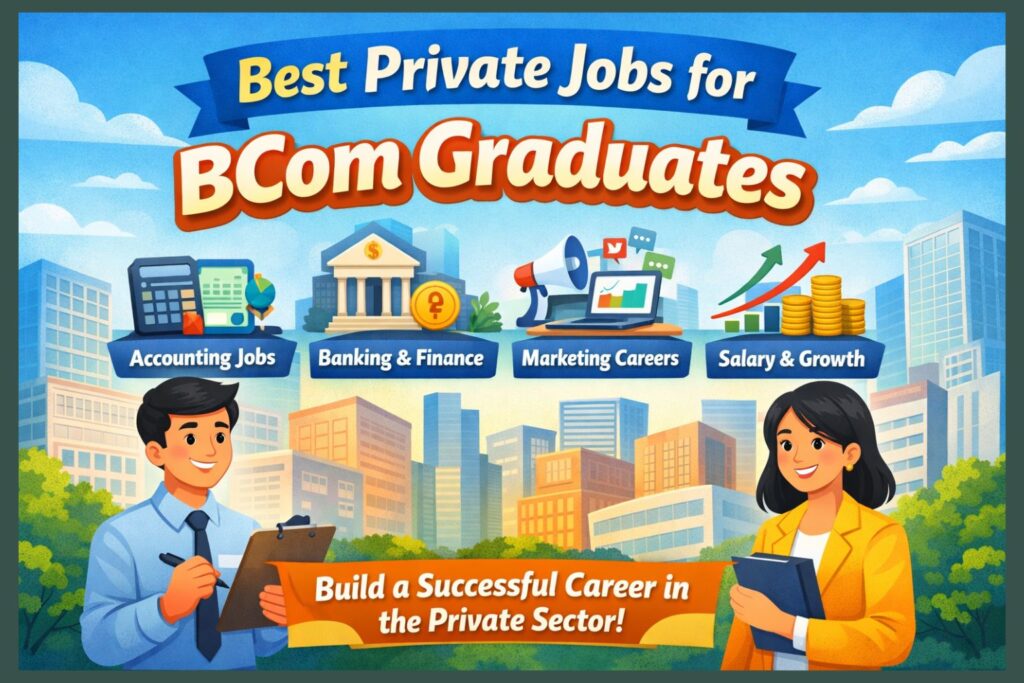
Explore the best private jobs for BCom graduates, including accounting, banking, finance, marketing, salary expectations, and career growth opportunities.
Best Private Jobs for BCom Graduates
A Bachelor of Commerce (BCom) degree opens the door to many career opportunities in the private sector. Every year, thousands of students complete their BCom and start looking for stable and rewarding jobs. While many graduates aim for government jobs, the reality is that government vacancies are limited and the competition is extremely high. Because of this, many BCom graduates choose to build their careers in the private sector where there are plenty of opportunities.
The private sector offers a wide range of jobs for BCom graduates in fields such as accounting, banking, finance, marketing, taxation, insurance, and business management. Companies prefer BCom graduates because they already have basic knowledge of accounting, business operations, finance, and commerce-related subjects. This makes them suitable for many entry-level positions in corporate organizations, banks, financial companies, and startups.
Another advantage of private sector jobs is that career growth can be faster compared to many traditional paths. With the right skills, experience, and continuous learning, BCom graduates can move from entry-level roles to higher positions such as senior accountant, financial analyst, finance manager, or even business manager. Many professionals also build successful careers in consulting, finance, and corporate management after gaining experience.
In today’s competitive job market, having a degree alone is not enough. Employers also look for practical skills, communication ability, and knowledge of modern tools such as accounting software, Excel, and digital platforms. Graduates who focus on improving their skills and gaining real-world experience can find excellent career opportunities in the private sector.
In this guide, we will explore some of the best private jobs for BCom graduates, the skills required to get these jobs, salary expectations, and practical tips to start a successful career after graduation. This information will help fresh graduates understand the available options and make better career decisions.
Why the Private Sector is a Good Option for BCom Graduates
Many BCom graduates initially focus on preparing for government jobs. However, government vacancies are limited and the selection process can take a long time. Because of this, the private sector has become one of the best career options for commerce graduates who want to start working and growing professionally.
The private sector offers a wide variety of opportunities in industries such as banking, finance, accounting, marketing, insurance, consulting, and corporate management. Companies actively hire commerce graduates because they already understand business operations, accounting principles, financial management, and taxation basics.
One of the biggest advantages of private sector jobs is faster career growth. In many companies, employees who perform well can receive promotions and salary increases within a few years. Unlike some traditional career paths, private companies often reward employees based on their skills, performance, and ability to contribute to the business.
Another benefit is the availability of diverse career roles. BCom graduates are not limited to a single job profile. They can work as accountants, financial analysts, sales executives, banking professionals, HR executives, or business development managers. This flexibility allows graduates to explore different industries and choose the field that suits their interests and strengths.
Private companies also provide valuable practical experience and skill development. When graduates start working, they learn how businesses operate in the real world. They gain experience in financial reporting, client communication, data analysis, and business decision-making. These practical skills help professionals grow faster and open the door to higher positions in the future.
Another important advantage is the opportunity to work with modern tools and technologies. Many companies use advanced accounting software, financial systems, and data analysis tools. Learning these tools improves a graduate’s professional profile and increases their chances of getting better job opportunities in the future.
For students who are unsure about their career path after graduation, exploring Best Private Jobs After Graduation can help them understand the wide range of opportunities available in the private sector.
Overall, the private sector provides BCom graduates with the opportunity to start their careers early, gain valuable experience, improve their skills, and build a stable professional future.
Top 10 Best Private Jobs for BCom Graduates
BCom graduates have many career opportunities in the private sector because they study subjects related to accounting, finance, taxation, business management, and economics during their degree. This knowledge makes them suitable for several roles in companies, banks, financial institutions, and corporate organizations.
Below are some of the best private jobs for BCom graduates that offer good career growth, stable income, and long-term opportunities.
1. Accountant
Accounting is one of the most common and stable career options for BCom graduates. Almost every company needs accountants to manage financial records, maintain accounts, and ensure that all financial transactions are properly recorded.
Accountants are responsible for tasks such as preparing financial statements, managing invoices, maintaining ledgers, and assisting with tax calculations. Many businesses, including small companies, large corporations, and accounting firms, hire BCom graduates for accounting roles.
Fresh graduates often start as junior accountants and gradually move to higher positions such as senior accountant or accounts manager with experience.
Skills required
- Knowledge of accounting principles
- Basic taxation knowledge
- MS Excel and accounting software
- Attention to detail
Average starting salary
₹2.5 lakh to ₹4.5 lakh per year depending on the company and location.
2. Financial Analyst
Financial analysts help companies understand financial data and make better business decisions. They analyze company performance, market trends, investment opportunities, and financial reports.
This job is ideal for BCom graduates who are interested in finance, investments, and business analysis. Financial analysts work in banks, investment firms, financial consulting companies, and large corporate organizations.
With experience, professionals can move to positions such as senior financial analyst, finance manager, or investment analyst.
Skills required
- Financial analysis
- Data interpretation
- MS Excel and financial tools
- Strong analytical thinking
Average starting salary
₹3 lakh to ₹6 lakh per year.
3. Banking Executive
Private banks and financial institutions regularly hire BCom graduates for roles such as banking executive, relationship manager, and customer service officer.
In this role, employees assist customers with banking services, explain financial products, manage accounts, and help with loans or credit services. Private banks offer good career growth and training programs for new employees.
Many professionals start with entry-level roles and later move into branch management, relationship management, or financial advisory roles.
Skills required
- Communication skills
- Customer handling ability
- Basic banking knowledge
- Sales and relationship management
Average starting salary
₹2.5 lakh to ₹5 lakh per year.
4. Tax Consultant
Tax consultants help individuals and businesses understand tax rules, file tax returns, and manage their financial compliance. This job is suitable for BCom graduates who have a strong interest in taxation and financial regulations.
Tax consultants often work with chartered accountants, accounting firms, or tax consulting companies. With experience, they can even start their own tax consultancy service.
Skills required
- Knowledge of income tax and GST
- Accounting knowledge
- Attention to detail
- Understanding of financial documents
Average starting salary
₹3 lakh to ₹5 lakh per year.
5. Business Development Executive
Business development executives help companies increase sales and find new business opportunities. They identify potential clients, build relationships with customers, and promote company products or services.
This role is ideal for graduates who enjoy communication, marketing, and sales-related activities. Many industries such as finance, IT, consulting, and education hire business development executives.
With good performance, professionals can move into sales manager or business manager roles.
Skills required
- Communication and negotiation
- Sales and marketing knowledge
- Customer relationship management
- Problem-solving ability
Average starting salary
₹2.5 lakh to ₹5 lakh per year.
6. Digital Marketing Executive
Digital marketing has become one of the fastest growing career fields in recent years. Many companies hire digital marketing executives to promote their products and services online.
BCom graduates who learn digital marketing skills such as SEO, social media marketing, content marketing, and online advertising can find good job opportunities in this field.
Digital marketing also provides opportunities for freelancing and starting your own business.
Skills required
- SEO and online marketing knowledge
- Social media management
- Content marketing
- Basic analytics tools
Average starting salary
₹2.5 lakh to ₹6 lakh per year.
7. Human Resource Executive
Human Resource (HR) executives are responsible for managing employees in a company. Their work includes recruitment, employee training, performance management, and workplace policies.
BCom graduates with good communication and management skills can build successful careers in human resource management. With experience, professionals can grow into roles such as HR manager or HR business partner.
Skills required
- Communication skills
- Employee management
- Recruitment and interviewing
- Organizational skills
Average starting salary
₹3 lakh to ₹5 lakh per year.
8. Investment Advisor
Investment advisors guide individuals and businesses in making financial investment decisions. They help clients invest in stocks, mutual funds, insurance products, and other financial instruments.
This career is suitable for BCom graduates interested in finance, stock markets, and wealth management. Many investment advisors work with financial companies, wealth management firms, or brokerage companies.
Skills required
- Financial market knowledge
- Investment analysis
- Communication and advisory skills
- Risk assessment
Average starting salary
₹3 lakh to ₹6 lakh per year.
9. Insurance Advisor or Manager
Insurance companies hire commerce graduates to manage insurance policies, assist customers, and explain different insurance plans.
Professionals working in this sector help individuals choose suitable life insurance, health insurance, and investment-linked policies.
With experience and strong performance, professionals can become insurance managers or branch managers.
Skills required
- Customer communication
- Knowledge of insurance products
- Sales ability
- Financial awareness
Average starting salary
₹2.5 lakh to ₹5 lakh per year.
10. Operations Executive
Operations executives help companies manage their daily business activities. They coordinate between departments, manage workflows, and ensure that business operations run smoothly.
This role exists in many industries such as logistics, finance, IT services, and corporate companies.
With experience, professionals can grow into operations manager or business operations roles.
Skills required
- Organizational skills
- Problem solving
- Communication
- Business process understanding
Average starting salary
₹3 lakh to ₹5 lakh per year.
Skills BCom Graduates Should Learn to Get a Good Private Job
A BCom degree provides a strong academic foundation in commerce, accounting, and finance. However, in today’s competitive job market, companies usually look for candidates who also have practical skills that can help them perform well in real business environments. Developing the right skills can significantly improve a graduate’s chances of getting a good private sector job and growing faster in their career.
Many employers prefer candidates who are not only knowledgeable but also capable of using modern tools, communicating effectively, and solving business problems. Learning these skills can make a BCom graduate more confident and job-ready.
If you want to explore these abilities in detail, you can also read about Top Skills You Should Learn to Get a Good Private Job, which explains the most valuable skills employers look for today.
Below are some important skills that BCom graduates should consider learning.
1. Accounting and Financial Knowledge
Since BCom graduates study accounting and finance during their degree, strengthening these concepts can help them secure roles in accounting, taxation, and finance departments. Understanding financial statements, bookkeeping, and tax rules is especially important for roles such as accountant, tax consultant, or finance executive.
Practical knowledge of accounting processes makes candidates more valuable to companies that need professionals to manage financial records accurately.
2. MS Excel and Data Handling
MS Excel is one of the most widely used tools in business and finance. Companies use Excel for financial reports, budgeting, data analysis, and record management. BCom graduates who know how to use formulas, charts, and data organization tools in Excel often have an advantage during recruitment.
Strong Excel skills can also help professionals perform tasks more efficiently and analyze business data more effectively.
3. Accounting Software Knowledge
Many companies use accounting software such as Tally or other financial management systems to maintain business accounts. Learning how to use these tools can help BCom graduates handle real-world accounting tasks such as recording transactions, generating reports, and managing tax-related records.
Knowledge of accounting software makes candidates more job-ready, especially for accounting and finance roles.
4. Communication Skills
Communication skills are essential for almost every private sector job. Professionals often need to interact with clients, colleagues, managers, and business partners. Clear communication helps build trust, solve problems quickly, and improve teamwork within an organization.
Both verbal and written communication are important, especially for roles related to sales, banking, HR, and consulting.
5. Basic Digital and Technology Skills
Modern businesses rely heavily on digital tools and online systems. BCom graduates who are comfortable using computers, business software, and online platforms are more likely to succeed in corporate environments.
Basic knowledge of digital tools, office software, online collaboration platforms, and business applications can help graduates adapt quickly to workplace requirements.
6. Problem-Solving and Analytical Thinking
Companies value employees who can analyze situations and find practical solutions. BCom graduates working in finance, operations, or business analysis often need to review data, identify problems, and recommend improvements.
Developing analytical thinking skills can help professionals make better business decisions and add value to their organizations.
7. Time Management and Professional Discipline
Private sector jobs often involve multiple tasks, deadlines, and responsibilities. Employees who can manage their time effectively and complete work on schedule are highly valued by employers.
Good time management also helps professionals maintain productivity and handle increasing responsibilities as they grow in their careers.
By focusing on these practical skills, BCom graduates can significantly improve their employability and prepare themselves for better career opportunities in the private sector.
How to Start Your Career After BCom
Completing a BCom degree is an important step, but many graduates feel confused about what to do next. Some students immediately start preparing for government exams, while others begin looking for private sector opportunities. The key to building a successful career after BCom is to focus on gaining practical experience, improving skills, and exploring the right job opportunities.
If you are unsure about which career path to choose, exploring Best Private Jobs After Graduation can help you understand the wide range of opportunities available in different industries.
Below are some practical steps that can help BCom graduates start their careers successfully.
Start with Entry-Level Jobs
Most graduates begin their professional journey with entry-level positions such as junior accountant, finance executive, banking assistant, or business development executive. These roles allow fresh graduates to gain real work experience and understand how companies operate.
Even if the starting salary is moderate, the experience gained in the first job is extremely valuable for long-term career growth.
Gain Practical Experience Through Internships
Internships are an excellent way to learn how businesses function in real life. Many companies offer internships in accounting, finance, marketing, and operations. These opportunities help graduates develop professional skills and gain exposure to corporate environments.
Internships can also improve your resume and increase your chances of getting a full-time job later.
Learn Job-Oriented Skills
Graduates who invest time in learning practical skills often find better job opportunities. Skills such as advanced Excel, accounting software, financial analysis, and digital marketing can make candidates more attractive to employers.
Short-term professional courses can also help students specialize in a particular field such as finance, taxation, or business management.
Build Professional Connections
Networking plays an important role in finding job opportunities. Staying connected with classmates, teachers, industry professionals, and former colleagues can help graduates learn about job openings and career opportunities.
Professional networking platforms and career events can also help candidates connect with recruiters and companies.
Apply to Multiple Companies
Fresh graduates should apply to several companies instead of waiting for a single opportunity. Sending applications through job portals, company websites, and professional networks increases the chances of getting interview calls.
Consistent job searching and regular applications help graduates find the right opportunity more quickly.
Starting a career after BCom may seem challenging at first, but with the right approach, patience, and skill development, graduates can build a successful and rewarding professional journey.
What to Do If You Don’t Get a Government Job
Many students in India prepare for government jobs after completing their graduation. Government jobs are popular because they offer job security, fixed working hours, and long-term stability. However, the number of applicants is extremely high while the number of available positions is limited. Because of this, many graduates may not get selected even after preparing for a long time.
If you find yourself in this situation, it is important not to feel discouraged. There are many successful professionals who built excellent careers outside the government sector. Instead of waiting indefinitely, you can explore other career options and continue developing your skills.
You can also read the guide on What to Do If You Don’t Get a Government Job to understand alternative career paths and practical steps that can help you move forward.
Explore Private Sector Opportunities
The private sector offers a wide variety of job roles for BCom graduates. Companies in industries such as finance, accounting, banking, insurance, consulting, and marketing regularly hire commerce graduates for different positions.
Private sector jobs allow you to gain professional experience, develop new skills, and grow faster in your career.
Focus on Skill Development
One of the best ways to improve career opportunities is to focus on learning practical skills. Knowledge of tools such as MS Excel, accounting software, financial analysis, and business communication can significantly increase your employability.
Graduates who continuously improve their skills are more likely to get better job opportunities and higher salaries over time.
Consider Professional Certifications
Some BCom graduates choose to pursue additional professional courses such as certifications in accounting, finance, taxation, or business management. These courses can strengthen your expertise and help you qualify for higher-level positions in companies.
Professional certifications also improve your credibility and demonstrate your commitment to career growth.
Gain Work Experience
Even if your first job is not your dream job, the experience you gain can be extremely valuable. Real workplace experience helps you understand business processes, develop professional discipline, and improve your confidence.
After gaining a few years of experience, many professionals move to better positions with higher salaries and more responsibilities.
Stay Positive and Keep Learning
Career paths are different for everyone. Some people achieve success early, while others take more time to discover the right opportunities. The most important thing is to stay positive, keep improving your skills, and remain open to learning new things.
With patience, continuous effort, and the right mindset, BCom graduates can build successful careers even without a government job.
How to Find a Private Job in India
Finding a private job after completing BCom may seem challenging at first, especially for fresh graduates who do not have work experience. However, with the right strategy and consistent effort, it is possible to find good job opportunities in the private sector.
If you want to explore this topic in detail, you can also read How to Find a Private Job in India, where you will find step-by-step guidance for job searching and career planning.
Below are some practical ways BCom graduates can find private sector jobs.
Use Online Job Portals
Online job portals are one of the most common ways to find job opportunities. Many companies post job openings on these platforms to hire candidates for different roles.
Graduates can create profiles on job portals, upload their resumes, and apply for relevant positions. Keeping your profile updated and applying regularly can increase your chances of getting interview calls.
Apply Directly on Company Websites
Many companies publish job openings on the careers section of their official websites. Visiting company websites and applying directly can help candidates find genuine job opportunities.
Large corporations, banks, and financial institutions often recruit fresh graduates through their official career pages.
Use Professional Networking
Networking can be very helpful when searching for a job. Talking to friends, former classmates, teachers, and professionals in the industry can help you learn about job openings that may not be publicly advertised.
Professional networking platforms and career events also allow graduates to connect with recruiters and industry professionals.
Contact Placement Agencies
Placement consultancies and recruitment agencies help companies find suitable candidates for different job roles. Many fresh graduates register with placement agencies to get assistance in finding entry-level jobs.
These agencies often have connections with multiple companies and can help candidates find opportunities more quickly.
Attend Job Fairs and Campus Drives
Job fairs and campus recruitment drives are another way for graduates to meet employers and explore job opportunities. Many companies participate in these events to recruit fresh talent.
Preparing a good resume and presenting yourself confidently during these events can help you secure interviews with potential employers.
Finding a private job requires patience and consistent effort. By using multiple job search methods and continuously improving your skills, BCom graduates can increase their chances of finding suitable career opportunities.
How to Make a Resume for Private Jobs
A resume is one of the most important documents when applying for a private sector job. It is the first impression that employers have about a candidate. A well-structured and professional resume can significantly increase your chances of getting interview calls.
Many fresh graduates make the mistake of creating long or poorly organized resumes. Employers usually spend only a few seconds reviewing each resume, so it is important to present your information clearly and professionally.
If you want detailed guidance on resume writing, you can also read How to Make a Resume for Private Jobs, where the complete process is explained step by step.
Below are some important points that BCom graduates should keep in mind while creating a resume.
Start with Basic Personal Information
At the top of the resume, include your basic details such as your full name, phone number, email address, and city. Make sure the email address looks professional and easy to read.
Avoid adding unnecessary personal details that are not relevant to the job.
Write a Short Career Objective
A career objective is a short paragraph that explains your career goals and what you want to achieve in your professional journey. This section helps employers understand your motivation and interest in the job.
For fresh graduates, the objective should focus on learning, growth, and contributing to the company.
Mention Your Educational Qualifications
List your education details clearly, starting with the most recent qualification. For BCom graduates, mention the degree name, university or college, and the year of completion.
If you have achieved good academic results or completed any relevant projects, you can also highlight them briefly.
Highlight Your Skills
The skills section is very important for fresh graduates. This is where you can mention abilities that make you suitable for the job.
For example, BCom graduates can include skills such as:
- MS Excel and basic data analysis
- Accounting knowledge
- Communication skills
- Basic financial understanding
- Computer and office software skills
Adding relevant skills helps employers quickly understand your capabilities.
Include Internships or Work Experience
If you have completed any internship, part-time job, or training program, include it in your resume. Even short internships can show that you have practical exposure to the workplace.
Describe the tasks you performed and the skills you learned during the experience.
Keep the Resume Clear and Professional
A good resume should be simple, well-organized, and easy to read. Avoid using complicated designs, unnecessary graphics, or long paragraphs.
Most fresh graduate resumes should ideally be one page long and focus only on relevant information.
Creating a strong resume is an important step toward getting your first private sector job. With a clear structure and relevant information, your resume can help you stand out among other candidates.
Private Job Interview Tips for Freshers
Getting an interview call is an important step in the job search process, but performing well in the interview is equally important. Many fresh graduates feel nervous during their first interview because they do not have much professional experience. However, with proper preparation and the right approach, BCom graduates can confidently handle job interviews and increase their chances of getting selected.
If you want more detailed preparation guidance, you can also read Private Job Interview Tips for Freshers, which explains common interview questions and preparation strategies.
Below are some useful interview tips for fresh graduates applying for private sector jobs.
Prepare Before the Interview
Preparation is the key to a successful interview. Before attending an interview, take time to learn about the company, its services or products, and the job role you are applying for.
Understanding the company helps you answer questions more confidently and shows the interviewer that you are genuinely interested in the position.
Review Your Resume Carefully
Interviewers often ask questions based on the information mentioned in your resume. Make sure you review your resume carefully and be ready to explain your education, skills, internships, and career goals.
Answering questions clearly and honestly helps build a positive impression.
Practice Common Interview Questions
Fresh graduates are usually asked some common interview questions such as:
- Tell me about yourself
- Why do you want to work in this company?
- What are your strengths and weaknesses?
- What are your career goals?
Practicing answers to these questions can help you respond confidently during the interview.
Dress Professionally
Your appearance also plays an important role during interviews. Wearing clean and professional clothing shows respect for the interview process and creates a positive first impression.
Simple formal attire such as a shirt, trousers, and clean shoes is usually appropriate for most private sector interviews.
Communicate Clearly and Confidently
Good communication skills can make a strong impression on interviewers. Speak clearly, maintain eye contact, and listen carefully to the questions before answering.
Even if you feel nervous, try to stay calm and answer questions honestly.
Show Willingness to Learn
Companies understand that fresh graduates may not have extensive experience. What they often look for is the candidate’s willingness to learn, adapt, and grow within the organization.
Showing a positive attitude and interest in learning new skills can significantly improve your chances of getting selected.
With proper preparation, confidence, and a professional attitude, BCom graduates can perform well in interviews and successfully start their careers in the private sector.
Salary Expectations for BCom Graduates in the Private Sector
Salary is one of the most important factors students consider when choosing a career after graduation. For BCom graduates, salary in the private sector can vary depending on several factors such as the job role, company size, industry, location, and the candidate’s skills.
Fresh graduates usually start with entry-level positions, but with experience and skill development, salaries can increase significantly over time.
Starting Salary for Fresh BCom Graduates
Most fresh BCom graduates begin their careers in roles such as junior accountant, banking executive, sales executive, finance assistant, or business development executive.
The average starting salary for fresh graduates in the private sector typically ranges between ₹2.5 lakh and ₹5 lakh per year. Some high-growth industries or large companies may offer slightly higher salaries, especially to candidates who have strong skills or internships.
Salary Growth with Experience
One of the biggest advantages of private sector careers is that salary growth can be faster with experience and performance. After gaining two to five years of experience, professionals can move to higher roles such as senior accountant, financial analyst, operations manager, or relationship manager.
At this stage, salaries can increase to ₹5 lakh to ₹10 lakh per year, depending on the industry and responsibilities.
High-Paying Industries for BCom Graduates
Some industries are known to offer better salary growth for commerce graduates. These include:
- Banking and financial services
- Investment and wealth management
- Corporate finance
- Consulting firms
- Digital marketing and business analytics
Professionals working in these industries often receive higher salaries along with performance bonuses and career advancement opportunities.
Importance of Skills in Salary Growth
In the private sector, salary growth is strongly linked to skills and performance. Graduates who learn practical skills such as advanced Excel, financial analysis, accounting software, digital marketing, or business analytics can often secure better-paying jobs.
Continuous learning and gaining professional certifications can also help professionals move into higher-paying roles.
Although starting salaries may vary, BCom graduates who focus on building their skills and gaining experience can achieve strong career growth and higher income over time.
Career Growth Opportunities After BCom
A BCom degree provides a strong foundation in commerce, finance, accounting, and business management. However, many graduates choose to continue learning and improving their qualifications to achieve better career opportunities and higher salaries. With the right skills and professional development, BCom graduates can move into senior positions in finance, business management, and corporate leadership.
Career growth after BCom depends on factors such as experience, skill development, and additional qualifications.
Professional Certifications
Many BCom graduates pursue professional certifications to specialize in particular fields such as finance, accounting, or taxation. These certifications help candidates gain deeper knowledge and improve their chances of getting better job roles.
Popular professional courses include certifications related to accounting, financial analysis, taxation, and investment management. These qualifications can open doors to higher-level positions in finance and corporate sectors.
Master’s Degree in Business or Commerce
Some students choose to pursue postgraduate degrees such as a Master of Commerce (MCom) or a Master of Business Administration (MBA). These degrees help graduates develop advanced knowledge of business management, marketing, finance, and strategic decision-making.
An MBA, in particular, can lead to managerial and leadership roles in companies.
Specialized Skill Courses
Apart from formal degrees, many professionals improve their careers by learning specialized skills. Courses in areas such as digital marketing, data analysis, financial modeling, and business analytics are becoming increasingly valuable in modern industries.
These skills can help graduates move into higher-paying roles and work in growing industries.
Entrepreneurship Opportunities
Some BCom graduates choose to start their own businesses instead of working in traditional jobs. With knowledge of accounting, finance, and business operations, commerce graduates are well prepared to start small businesses, consulting services, or online ventures.
Entrepreneurship can provide independence and long-term financial growth for individuals who are willing to take risks and innovate.
Leadership and Management Roles
After gaining several years of experience, many professionals move into leadership roles such as finance manager, operations manager, business manager, or corporate consultant.
These positions involve greater responsibility, decision-making authority, and higher salaries. Continuous learning, professional networking, and leadership skills play an important role in reaching these levels.
Overall, BCom graduates who keep learning and developing their skills can build successful careers in finance, business, management, or entrepreneurship.
Conclusion
A BCom degree offers many career opportunities in the private sector. From accounting and finance to banking, marketing, and business development, commerce graduates can work in a wide range of industries. The private sector continues to grow rapidly, creating new job roles and career paths for graduates who are ready to learn and adapt.
Although many students initially aim for government jobs, it is important to understand that the private sector also provides excellent career growth, skill development, and income potential. With the right skills, practical experience, and a positive mindset, BCom graduates can build stable and rewarding careers.
Fresh graduates should focus on improving their professional skills, gaining practical experience through internships or entry-level jobs, and continuously learning new tools and technologies. Over time, experience and expertise can lead to higher positions such as finance manager, operations manager, or business consultant.
By choosing the right career path and developing valuable skills, BCom graduates can successfully establish themselves in the professional world and achieve long-term career growth.
FAQs
Q1. Which private job is best for BCom graduates?
Several private sector jobs are suitable for BCom graduates, including accountant, financial analyst, banking executive, tax consultant, and business development executive. The best job depends on a graduate’s interests, skills, and career goals.
Q2. Can BCom graduates get high salary jobs in the private sector?
Yes, BCom graduates can achieve high salaries in the private sector. While starting salaries may be moderate, professionals who gain experience and develop strong skills can move into higher-paying roles in finance, management, and consulting.
Q3. Is accounting a good career after BCom?
Yes, accounting is one of the most popular and stable career options for BCom graduates. Many companies require accountants to manage financial records, taxation, and business transactions, which creates consistent job opportunities.
Q4. What skills are important for BCom private sector jobs?
Important skills include accounting knowledge, MS Excel, communication skills, financial analysis, problem-solving ability, and familiarity with accounting software.
Q5. Can BCom graduates work in banks?
Yes, BCom graduates can work in both public and private banks. They can apply for roles such as banking executive, relationship manager, customer service officer, or financial advisor.