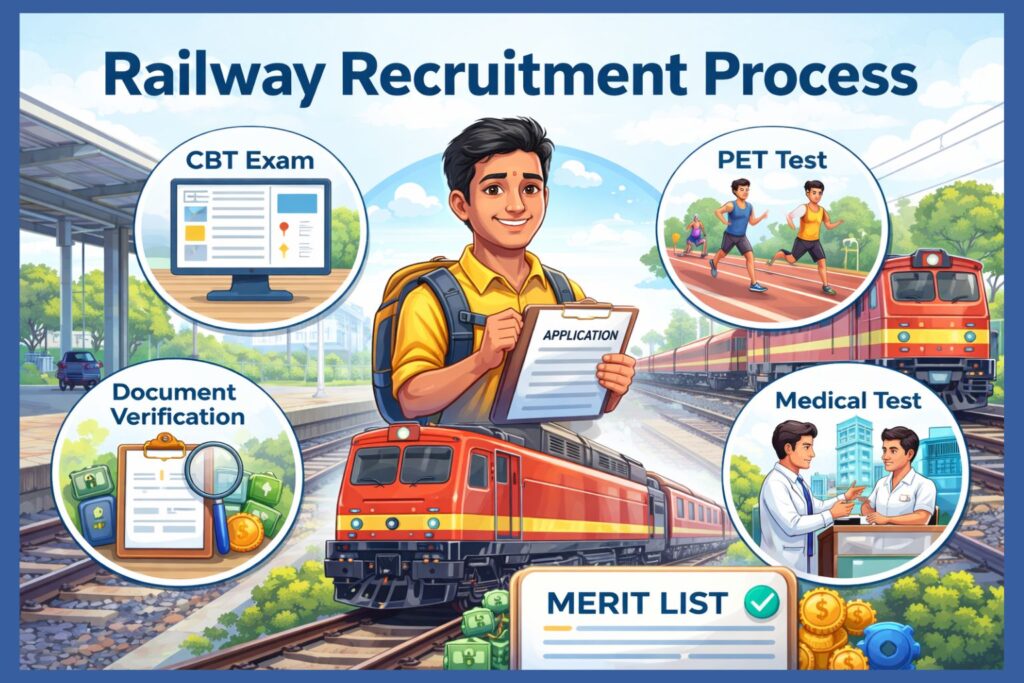
This guide explains the railway recruitment process including CBT, PET, document verification, and medical examination for Indian railway jobs.
How the Railway Recruitment Process Works in India
Indian Railways is one of the largest employers in the world and every year millions of candidates apply for different railway posts. Government jobs in the railway sector are highly popular because they offer job security, stable income, pension benefits, and long-term career growth. From technical positions to administrative roles, Indian Railways provides opportunities for candidates with different educational qualifications.
However, many aspirants focus only on exam preparation and do not fully understand the complete recruitment process. Knowing how the selection system works can help candidates prepare better and avoid confusion during different stages of recruitment. If you clearly understand each stage, you can plan your preparation strategy more effectively and stay confident throughout the selection journey.
Various railway exams in india are conducted by Railway Recruitment Boards (RRBs) and Railway Recruitment Cells (RRCs) to select suitable candidates for different posts. These exams follow a structured selection process designed to evaluate a candidate’s knowledge, physical ability (for some posts), and overall fitness for railway service.
In most railway recruitments, the selection process includes several important stages such as Computer Based Tests (CBT), Physical Efficiency Test (PET) for specific posts, Document Verification, and Medical Examination. Candidates who successfully clear all these stages are finally included in the merit list and receive their appointment.
In this guide, we will explain the complete railway recruitment process step by step, including CBT exams, PET standards, medical tests, and final selection procedures. Understanding these stages will help you prepare with confidence and increase your chances of securing a railway job.
Overview of the Railway Recruitment Process
The recruitment process for Indian Railways is designed to select capable and qualified candidates for various technical and non-technical positions. Because Indian Railways is one of the largest government employers, the selection procedure is carefully structured to ensure that only deserving candidates are selected.
Most railway recruitments are conducted through Railway Recruitment Boards (RRBs) and Railway Recruitment Cells (RRCs). These organizations release official notifications for different posts such as Group D, NTPC, ALP (Assistant Loco Pilot), Technician, Junior Engineer, and many others. Each notification clearly explains the eligibility criteria, exam pattern, selection stages, and application process.
Although the exact stages may vary slightly depending on the post, the overall recruitment process generally follows a standard sequence. Candidates must successfully clear each stage to move forward in the selection process.
Common Stages in the Railway Recruitment Process
- Online Application Submission
Candidates first apply through the official RRB or RRC website by filling out an online application form and submitting the required documents. - Computer Based Test (CBT)
This is the main written examination conducted online. Some recruitments include two stages such as CBT 1 and CBT 2. - Physical Efficiency Test (PET)
For certain posts like Group D, candidates must pass a physical test that checks their physical strength and endurance. - Document Verification (DV)
Candidates who qualify in the exam stages must present their original documents for verification. - Medical Examination
Railway jobs require specific medical fitness standards. Candidates must pass a medical test conducted by railway doctors. - Final Merit List and Selection
Based on exam performance and qualification of all stages, the final merit list is prepared and selected candidates receive appointment offers.
Understanding this process in advance helps candidates prepare properly for every stage of recruitment. When you know what to expect, it becomes easier to plan your study schedule, maintain confidence, and focus on clearing each stage step by step.

Upgrade Your Study Setup for Faster Career Growth!
Discover the Best Online Learning Gadgets for Career Growth (Must-Have Study Tools for Students & Professionals) and choose the right devices that improve focus, productivity, and learning efficiency.
Explore the Gadget Guide →Step 1 – Online Application Process
The first stage of the railway recruitment process is submitting the online application form. Every recruitment notification released by Railway Recruitment Boards (RRBs) or Railway Recruitment Cells (RRCs) includes detailed instructions about how candidates should apply. It is important to carefully read the official notification before filling out the application form.
Most railway applications are submitted through the official RRB websites. Candidates must register on the website, fill in their personal and educational details, upload required documents, and pay the application fee.
Registration Process
To apply for a railway exam, candidates usually need to follow these steps:
- Visit the official RRB or RRC website mentioned in the recruitment notification.
- Click on the “New Registration” option.
- Enter basic details such as name, date of birth, mobile number, and email ID.
- After registration, a registration number and password are generated.
- Use these login details to complete the application form.
It is very important to keep the registration number and password safe because they are required later for downloading admit cards and checking results.
Documents Required for Application
While filling the form, candidates may need to upload several documents. Commonly required documents include:
- Recent passport size photograph
- Candidate’s signature
- Educational qualification certificates
- Identity proof (such as Aadhaar card or other valid ID)
- Category certificate (for SC, ST, OBC, EWS candidates if applicable)
The documents must follow the size and format guidelines mentioned in the official notification.
Application Fee
Most railway recruitments require a small application fee. However, the fee amount may vary depending on the category.
Generally:
- General / OBC candidates pay the full application fee.
- SC, ST, PwBD, and female candidates often receive fee concessions or refunds after appearing in the CBT exam.
The payment is usually made through online methods such as debit card, credit card, net banking, or UPI.
Important Tips While Filling the Form
Many candidates make mistakes during the application process that can cause problems later. To avoid this, keep the following tips in mind:
- Always check the eligibility criteria before applying.
- Enter your name and date of birth exactly as mentioned in official documents.
- Upload clear and correct photographs and signatures.
- Double-check all details before submitting the form.
- Save a copy of the final submitted application form for future reference.
Completing the application process correctly is the first important step toward participating in the railway recruitment process. Once the application is successfully submitted, candidates can begin preparing seriously for the upcoming examination stages.
Step 2 – Computer Based Test (CBT)
After the application process is completed, the next stage in most railway recruitments is the Computer Based Test (CBT). This is the main written examination used to evaluate the knowledge, reasoning ability, and problem-solving skills of candidates.
The CBT exam is conducted online at designated exam centers across the country. Candidates must answer multiple-choice questions on a computer within a fixed time limit. Their performance in this exam plays a major role in determining whether they move to the next stage of the recruitment process.
CBT 1 and CBT 2
In many railway recruitments, the CBT exam is conducted in two stages.
CBT 1 (First Stage Test)
This is a screening exam conducted to shortlist candidates. Because a large number of people apply for railway jobs, CBT 1 helps reduce the number of candidates moving to the next stage.
CBT 2 (Second Stage Test)
Candidates who qualify in CBT 1 are allowed to appear for CBT 2. This stage is usually more focused on the specific knowledge required for the post. The marks obtained in CBT 2 often play a bigger role in the final merit list.
However, the exact structure may vary depending on the recruitment notification and the post applied for.
Subjects Asked in Railway CBT Exams
Although the syllabus may differ slightly for different posts, most railway CBT exams include questions from the following subjects:
- General Awareness
- Mathematics
- General Intelligence and Reasoning
- Basic Science and Technical Knowledge (for technical posts)
Candidates should carefully check the syllabus mentioned in the official notification for their specific exam.
If you want to understand the syllabus, exam pattern, and study strategy in detail, it is helpful to follow a complete railway exam preparation guide that explains how to prepare effectively for different railway exams.
Exam Pattern
The CBT exam usually consists of multiple-choice questions (MCQs) where candidates must select the correct answer from four options.
Common features of the CBT exam include:
- The exam is conducted online on a computer.
- Each question carries equal marks.
- Candidates must complete the exam within a limited time duration.
- The exam is conducted in multiple shifts depending on the number of candidates.
Negative Marking
Most railway CBT exams include negative marking. This means that if a candidate selects the wrong answer, a small portion of marks is deducted.
Typically, 1/3 mark is deducted for every incorrect answer. Because of this rule, candidates should avoid guessing randomly and focus on answering questions they are reasonably confident about.
Preparation Strategy for CBT
The CBT stage requires strong preparation and consistent practice. Some useful preparation tips include:
- Understand the exam syllabus and pattern clearly.
- Practice previous year railway exam papers.
- Attempt mock tests regularly to improve speed and accuracy.
- Focus on improving both concept clarity and time management.
- Maintain a daily study routine and revise important topics frequently.
A strong performance in the CBT exam significantly increases your chances of moving forward in the railway recruitment process and getting closer to your goal of securing a railway job.
Step 3 – Physical Efficiency Test (PET)
For certain railway posts, especially Group D positions, candidates must pass a Physical Efficiency Test (PET) after qualifying in the Computer Based Test (CBT). This stage is designed to check whether candidates have the physical strength and stamina required for railway duties.
It is important to understand that the PET is qualifying in nature. This means the marks obtained in PET are usually not added to the final merit list. However, candidates must successfully complete the required physical tasks to move forward to the next stage of the recruitment process.
Posts That Require PET
The Physical Efficiency Test is generally required for posts that involve physical work. These may include positions such as:
- Track Maintainer
- Helper in various departments
- Assistant in mechanical and electrical departments
- Other Group D level jobs
Since these roles may require lifting materials, working on railway tracks, and performing physically demanding tasks, candidates must demonstrate basic physical fitness.
PET Standards for Male Candidates
Male candidates are typically required to complete the following tasks:
- Lift and carry a weight of 35 kg for a distance of 100 meters within 2 minutes without putting the weight down.
- Run a distance of 1000 meters within 4 minutes and 15 seconds.
Candidates must complete both tasks successfully to qualify in the PET stage.
PET Standards for Female Candidates
The physical requirements for female candidates are slightly different. Generally, they must complete the following:
- Lift and carry a weight of 20 kg for a distance of 100 meters within 2 minutes without putting the weight down.
- Run a distance of 1000 meters within 5 minutes and 40 seconds.
These standards ensure that candidates have the minimum physical ability required for railway duties.
Tips to Prepare for PET
Many candidates ignore PET preparation and focus only on the written exam. However, preparing early can make this stage much easier.
Helpful tips include:
- Start light running or jogging regularly to improve stamina.
- Practice short-distance running to improve speed.
- Perform basic strength exercises such as squats and lifting light weights.
- Maintain a healthy lifestyle and proper diet.
- Practice lifting weights safely to avoid injury.
If candidates maintain regular physical activity during their exam preparation, they can easily meet the PET standards when the test is conducted.
Successfully clearing the Physical Efficiency Test moves candidates one step closer to the final stages of the railway recruitment process. The next stage usually involves verification of documents submitted during the application process.
tep 4 – Document Verification (DV)
After successfully clearing the written examination and the Physical Efficiency Test (if applicable), candidates are called for the Document Verification (DV) stage. This step is extremely important because it confirms whether the information provided by the candidate during the application process is correct and valid.
During document verification, candidates must present their original documents along with photocopies. Railway officials carefully check these documents to ensure that the candidate meets all eligibility criteria such as age, educational qualification, and category status.
If any information provided in the application form is found to be incorrect or if required documents are missing, the candidate may be disqualified from the recruitment process.
Important Documents Required
Candidates should bring all necessary documents in both original and photocopy form. Some commonly required documents include:
- Matriculation or 10th class certificate (for date of birth verification)
- Educational qualification certificates (10th, 12th, diploma, or degree depending on the post)
- Caste certificate (for SC, ST, OBC candidates if applicable)
- EWS certificate (for candidates applying under the EWS category)
- Disability certificate for PwBD candidates
- Aadhaar card or other valid identity proof
- Passport size photographs
- Printout of the online application form
- Admit card of the examination
The exact list of required documents may vary slightly depending on the recruitment notification.
Verification Process
During the document verification stage, railway officials will:
- Check the candidate’s identity using official ID proof.
- Verify educational qualifications and eligibility.
- Confirm category certificates if applicable.
- Match the details in the documents with the information submitted in the application form.
Candidates who successfully complete document verification are then sent for the medical examination, which is the next stage of the railway recruitment process.
Common Mistakes Candidates Should Avoid
Many candidates face problems during document verification because of small mistakes. To avoid such issues, candidates should keep the following points in mind:
- Ensure that all documents are genuine and valid.
- Check that the name and date of birth match across all documents.
- Bring both original documents and photocopies.
- Arrange documents properly to avoid confusion during verification.
- Carry extra passport-size photographs.
Completing the document verification stage successfully confirms that a candidate is eligible for the post and allows them to move to the final medical fitness examination conducted by the railway authorities.
Step 5 – Railway Medical Examination
The Railway Medical Examination is one of the final stages of the railway recruitment process. After clearing the written exam, Physical Efficiency Test (if required), and Document Verification, candidates must undergo a medical fitness test conducted by railway doctors.
This stage ensures that selected candidates are physically and medically fit to perform the duties of their assigned railway posts. Since many railway jobs involve safety responsibilities, technical work, or outdoor duties, maintaining proper health and physical fitness is very important.
Purpose of the Medical Test
The main purpose of the medical examination is to check whether candidates meet the medical standards defined by Indian Railways. These standards ensure that employees can safely perform their tasks without health risks.
The medical test generally checks the following:
- Vision and eyesight
- General physical fitness
- Hearing ability
- Blood pressure and overall health condition
Candidates who do not meet the required medical standards for their selected post may be declared medically unfit for that particular position.
Railway Medical Categories
Indian Railways uses different medical categories depending on the type of job. Each category has specific medical requirements.
Some commonly used medical categories include:
A1 Category
This is the highest medical standard. It is usually required for safety-related posts such as Loco Pilots where perfect vision and physical fitness are necessary.
A2 Category
This category also requires good vision and physical fitness but is slightly less strict than A1.
B1 Category
This standard is used for many technical and operational posts where good eyesight and physical condition are required.
B2 Category
This category is applicable for certain railway technical roles with moderate physical requirements.
C1 and C2 Categories
These categories apply to posts that involve less physical strain or safety responsibility.
The required medical category for each post is clearly mentioned in the recruitment notification.
Vision Standards
Eye vision is an important part of the railway medical test. Candidates must meet specific vision requirements depending on the post.
The medical examination may check:
- Distance vision
- Near vision
- Color vision
- Eye health
For some safety-related posts, candidates must have excellent eyesight without serious vision problems.
Tips to Pass the Railway Medical Test
Most candidates who maintain normal health can easily pass the medical examination. However, following a few simple tips can help:
- Maintain good physical fitness and regular exercise.
- Avoid unhealthy habits that can affect your health.
- Ensure your vision is clear and properly checked before the medical test.
- Get enough sleep and proper nutrition before the examination.
Once candidates successfully clear the medical examination, they move to the final stage of the recruitment process where the merit list is prepared and selected candidates are offered appointments.
Final Merit List and Selection Process
After completing all the previous stages such as the Computer Based Test (CBT), Physical Efficiency Test (if applicable), Document Verification, and Medical Examination, the railway recruitment process moves to the final merit list and selection stage.
At this stage, the railway authorities prepare a list of candidates who have successfully qualified in all required stages and meet the eligibility criteria for the post. The candidates included in this merit list are considered for final selection and appointment.
How the Merit List Is Prepared
The final merit list is mainly based on the performance of candidates in the written examination, especially the marks obtained in CBT. Candidates who score higher marks generally have better chances of being placed higher in the merit list.
Important factors considered while preparing the merit list include:
- Marks obtained in CBT examinations
- Qualification in PET (for posts where PET is required)
- Successful document verification
- Passing the medical examination
Since PET is usually qualifying in nature, the marks from this test are normally not added to the final score. However, candidates must pass it to remain eligible for selection.
Normalization of Marks
In many railway exams, the CBT is conducted in multiple shifts. Because the difficulty level of each shift may vary slightly, the railway authorities apply a normalization process to ensure fairness.
Normalization adjusts the marks of candidates based on the difficulty level of different exam sessions so that no candidate gets an unfair advantage.
Tie-Breaking Rules
Sometimes two or more candidates may obtain the same marks in the CBT exam. In such cases, specific tie-breaking rules are applied.
Common tie-breaking factors may include:
- Candidate with higher age may be given preference.
- Candidate with higher marks in specific subjects may be considered.
- Other rules mentioned in the official notification.
Final Selection
Once the merit list is finalized, candidates who are selected receive an official appointment offer from the railway authorities. The offer includes details about the post, department, training period, and joining instructions.
After receiving the appointment letter, candidates must complete the joining formalities and begin the training process, which prepares them for their duties in Indian Railways.
Being included in the final merit list is a major achievement for railway aspirants, as it marks the successful completion of the entire railway recruitment process and the beginning of a stable government career.
Training and Joining Process
After the final merit list is released and candidates receive their appointment letters, the next stage is the training and joining process. This stage prepares newly selected candidates for their roles in Indian Railways and helps them understand their job responsibilities.
Training is an important part of railway recruitment because it ensures that employees have the skills, knowledge, and discipline required to work in the railway system.
Appointment Letter
Candidates who are selected in the final merit list receive an official appointment letter from the railway authorities. This letter usually contains important information such as:
- Name of the post
- Department or division
- Place of posting
- Training details
- Date of joining
Candidates must carefully read the instructions mentioned in the appointment letter and complete the required joining formalities within the given time.
Training Period
Most railway posts require candidates to undergo a training program before starting their duties. The duration of training may vary depending on the type of job.
For example:
- Technical posts may require longer training periods.
- Non-technical posts may have shorter training programs.
During training, candidates learn about:
- Job responsibilities and work procedures
- Safety rules and railway regulations
- Technical skills related to their department
- Basic discipline and work culture in Indian Railways
Training is usually conducted at railway training centers or institutes.
Probation Period
After completing training, candidates may also go through a probation period. During this time, their performance and behavior are closely monitored by senior officials.
If the candidate performs well and follows all rules properly, they are confirmed as a permanent railway employee.
Posting and Career Growth
Once the training and probation period are completed, candidates begin their regular duties in their assigned railway division or department.
Indian Railways offers several opportunities for career growth and promotions. With experience and good performance, employees can move to higher positions and take on greater responsibilities.
Getting selected in Indian Railways not only provides a stable government job but also offers long-term career development, financial security, and various employee benefits.
Best Preparation Tips to Clear Railway Exams
Clearing a railway exam requires proper planning, disciplined study, and consistent practice. Every year millions of candidates apply for railway jobs, so having the right preparation strategy can significantly increase your chances of success.
Instead of studying randomly, candidates should follow a structured preparation plan that focuses on understanding the syllabus, practicing regularly, and improving time management.
Understand the Exam Pattern and Syllabus
The first step in preparation is to clearly understand the exam pattern and syllabus. Different railway exams may have slightly different patterns, but most of them include subjects like Mathematics, Reasoning, and General Awareness.
Once you know the syllabus, you can divide your study time effectively and focus on the most important topics.
Create a Daily Study Plan
A proper study schedule helps candidates stay disciplined and consistent. Instead of studying for long hours irregularly, it is better to study a few hours every day with full concentration.
Your study plan should include:
- Time for learning new topics
- Time for practicing questions
- Time for revision
Regular study with small daily goals can gradually build strong concepts.
Practice Previous Year Question Papers
Practicing previous railway exam papers helps candidates understand the type of questions asked in the exam. It also improves speed and accuracy.
By solving previous papers, candidates can identify important topics and learn how to manage time during the exam.
Attempt Mock Tests Regularly
Mock tests are extremely helpful for exam preparation. They simulate the real exam environment and help candidates evaluate their performance.
Benefits of mock tests include:
- Improving time management
- Identifying weak areas
- Increasing confidence before the actual exam
Choose the Right Study Material
Using the right study material is very important for effective preparation. Good books explain concepts clearly and provide enough practice questions.
Candidates should choose the best books for railway exam preparation that cover the complete syllabus and provide practice tests. The right resources can make preparation much more efficient and structured.
Stay Consistent and Motivated
Preparing for competitive exams requires patience and dedication. There may be times when preparation feels difficult, but staying consistent is the key to success.
Candidates should maintain a positive mindset, focus on their daily goals, and keep improving step by step. With proper preparation and determination, clearing a railway exam and securing a government job is definitely achievable.
Railway Jobs Based on Educational Qualification
One of the biggest advantages of railway recruitment is that it offers job opportunities for candidates with different educational qualifications. Whether you have completed 10th class, 12th class, or graduation, there are various railway posts available for each level of qualification.
Indian Railways regularly releases recruitment notifications for both technical and non-technical positions, allowing candidates from different educational backgrounds to apply.
If you want to explore the complete list of opportunities, you can check detailed information about railway jobs after 10th 12th and graduation to understand which posts are suitable for your qualification.
Railway Jobs After 10th Pass
Candidates who have completed 10th class (Matriculation) can apply for several entry-level railway jobs. These positions usually involve technical or physical work in different railway departments.
Common railway jobs for 10th pass candidates include:
- Track Maintainer
- Helper in electrical, mechanical, or engineering departments
- Assistant in workshops
- Pointsman in traffic department
These jobs are often recruited under Group D recruitment conducted by Railway Recruitment Cells (RRC).
Railway Jobs After 12th Pass
Candidates who have completed 12th class can apply for various clerical and operational posts in Indian Railways.
Some common posts for 12th pass candidates include:
- Junior Clerk cum Typist
- Accounts Clerk cum Typist
- Commercial cum Ticket Clerk
- Trains Clerk
These posts are generally recruited through RRB NTPC recruitment.
Railway Jobs After Graduation
Graduates can apply for several higher-level railway positions that involve administrative, technical, or supervisory responsibilities.
Popular railway jobs for graduates include:
- Station Master
- Goods Guard
- Traffic Assistant
- Senior Commercial cum Ticket Clerk
- Junior Engineer (for engineering graduates or diploma holders)
These positions usually offer better salary, higher responsibility, and stronger career growth opportunities.
Because Indian Railways is such a large organization, recruitment opportunities are available almost every year. Candidates should regularly check official notifications and prepare seriously to take advantage of these opportunities.
Common Mistakes Railway Aspirants Should Avoid
Many candidates prepare seriously for railway exams but still fail to clear the selection process because of avoidable mistakes. Understanding these common errors can help aspirants improve their preparation and increase their chances of success.
Avoiding these mistakes can make your preparation more effective and keep you focused on the right strategy.
Ignoring the Official Notification
One of the most common mistakes candidates make is not reading the official recruitment notification carefully. The notification contains important details about eligibility criteria, exam pattern, syllabus, and selection stages.
If candidates ignore these instructions, they may misunderstand the exam requirements or even apply for a post for which they are not eligible.
Studying Without a Proper Plan
Many aspirants start preparing without creating a clear study plan. This often leads to incomplete preparation and poor time management.
A well-structured study schedule helps candidates cover all subjects properly and allows enough time for revision and practice.
Ignoring Mock Tests and Practice
Some candidates focus only on reading theory and do not practice enough questions. However, railway exams require speed and accuracy, which can only be improved through regular practice.
Attempting mock tests and solving previous year question papers helps candidates understand the exam pattern and improve their confidence.
Guessing Too Many Answers
Because railway exams usually have negative marking, randomly guessing answers can reduce your overall score. Candidates should attempt questions carefully and avoid unnecessary risks.
It is better to answer fewer questions correctly than to guess many answers and lose marks due to negative marking.
Neglecting Physical Preparation for PET
For posts that require a Physical Efficiency Test, some candidates focus only on the written exam and ignore physical preparation. This can create problems during the PET stage.
Regular exercise, running, and maintaining good physical fitness can help candidates easily qualify for the physical test.
Losing Motivation During Preparation
Preparing for competitive exams can sometimes feel challenging, especially when the syllabus is large or the competition is high. Some candidates lose motivation and stop preparing consistently.
However, success in railway exams requires patience, dedication, and regular effort. Staying focused on your goal and maintaining a positive mindset can make a big difference in your preparation journey.
By avoiding these common mistakes and following a disciplined study strategy, railway aspirants can significantly improve their chances of clearing the recruitment process and securing a railway job.
Conclusion
The railway recruitment process is designed to carefully select capable and qualified candidates for various roles in Indian Railways. Although the process may seem complex at first, understanding each stage makes it much easier to prepare and stay confident throughout the journey.
From submitting the online application to clearing the Computer Based Test, Physical Efficiency Test, Document Verification, and Medical Examination, every step plays an important role in selecting the right candidates. Aspirants who prepare sincerely, stay disciplined, and follow the correct strategy can successfully clear these stages.
Railway jobs remain one of the most popular government career options in India because they offer job security, stable income, career growth, and valuable employee benefits. With the right preparation and consistent effort, achieving a railway job is definitely possible.
If you are planning to appear for a railway exam, start your preparation early, understand the recruitment process clearly, and focus on improving your knowledge and skills every day. With determination and hard work, you can move step by step toward your goal of building a successful career in Indian Railways.
Frequently Asked Questions (FAQs)
Q1. How many stages are there in the railway recruitment process?
The railway recruitment process usually includes several stages such as the online application, Computer Based Test (CBT), Physical Efficiency Test (for some posts), Document Verification, Medical Examination, and final merit list preparation.
Q2. What is CBT in railway exams?
CBT stands for Computer Based Test. It is an online examination where candidates answer multiple-choice questions on subjects like Mathematics, Reasoning, and General Awareness.
Q3. Is the Physical Efficiency Test required for all railway jobs?
No, the Physical Efficiency Test is mainly required for physically demanding posts such as Group D positions. Many other railway posts do not require PET.
Q4. What happens after clearing the railway medical test?
After passing the medical examination, candidates who meet all requirements are included in the final merit list and receive appointment letters for training and joining.
Q5. How long does it take to complete the railway recruitment process?
The complete recruitment process may take several months because it includes multiple stages such as exams, verification, and medical testing. The exact duration depends on the specific recruitment notification.

Government Job Preparation & Career Guidance for Indian Exams
Read helpful blogs and preparation guides for SSC, Banking, Railway, and State Government exams. Learn exam strategies, syllabus insights, paper patterns, and make confident career decisions.
Govt Job Preparation Guides →