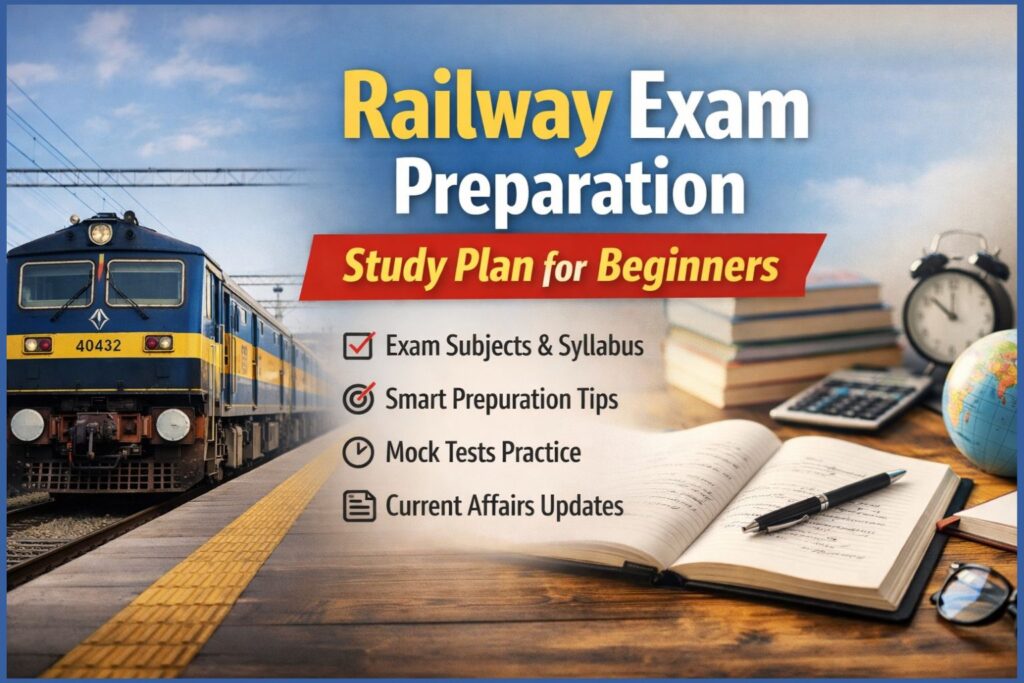
Learn how to prepare for railway exams with this beginner-friendly study plan covering subjects, preparation strategy, books, and smart tips to improve your chances of success.
Why Railway Exams Are a Great Career Opportunity
Railway jobs are among the most popular government job options in India. Every year, lakhs of students apply for railway recruitment because these jobs offer stability, good salary, job security, and additional government benefits. From technical posts to administrative roles, the Indian Railways provides opportunities for candidates with different educational qualifications such as 10th pass, 12th pass, and graduates.
Many beginners feel confused about where to start their preparation. Without a proper strategy, students often waste time studying the wrong topics or using too many study materials. The key to success in railway exams is having a clear study plan, understanding the exam pattern, and practicing regularly.
Before starting your preparation, it is also important to understand the different types of railway jobs available. If you want to explore various career options, you can read our detailed guide on railway jobs after 10th 12th and graduation, which explains eligibility, salary, and different posts in Indian Railways.
In this complete guide, you will learn how to prepare for railway exams from the beginning. We will cover the exam pattern, study plan, preparation tips, and the most effective strategy that beginners can follow to improve their chances of success.
Understand the Railway Exam System First
Before starting your preparation, it is important to understand how railway exams work. Many students start studying immediately without knowing the exam structure, which often leads to confusion later.
Railway recruitment in India is conducted by the Railway Recruitment Board (RRB) and Railway Recruitment Cell (RRC). These organizations are responsible for recruiting candidates for different posts in Indian Railways across the country.
If you want to clearly understand how the selection process works, you should first learn about the railway recruitment process, which includes stages like the computer-based test, physical test (for some posts), document verification, and medical examination.
Some of the most popular railway exams in India include:
RRB NTPC (Non-Technical Popular Categories)
This exam is conducted for posts like clerk, typist, station master, and goods guard. It is suitable for 12th pass and graduate candidates.
RRB Group D
This exam is conducted for entry-level posts such as track maintainer, helper, and assistant. Candidates who have passed class 10th can apply for these posts.
RRB ALP (Assistant Loco Pilot)
This exam is conducted for technical posts related to train operations. Candidates with ITI or diploma qualifications usually apply for this exam.
RRB JE (Junior Engineer)
This exam is designed for engineering diploma or degree holders who want technical positions in Indian Railways.
Understanding these exams helps students prepare according to the correct syllabus and difficulty level. If you want to explore all major railway exams in India, it is helpful to check detailed information about eligibility, exam pattern, and job roles before choosing the exam that matches your qualification.
Once you clearly understand the exam system, the next step is to learn about the subjects and exam pattern so that you can plan your preparation effectively.
Know the Railway Exam Pattern and Subjects
One of the most important steps in railway exam preparation is understanding the exam pattern and subjects. When you clearly know what topics will appear in the exam, it becomes easier to create a focused study plan and avoid wasting time on unnecessary material.
Most railway exams conducted by the Railway Recruitment Board follow a similar pattern. The first stage is usually a Computer Based Test (CBT) in which candidates must answer multiple-choice questions within a limited time. The questions are designed to test a candidate’s basic knowledge, logical thinking ability, and awareness of current events.
Although the exact pattern may vary depending on the post, the main subjects in most railway exams include the following.
Mathematics
Mathematics plays an important role in almost every railway exam. Questions are generally based on basic arithmetic concepts that students have studied in school. The goal of this section is to test a candidate’s numerical ability and problem-solving skills.
Common topics include:
- Number system
- Percentages
- Profit and loss
- Ratio and proportion
- Time and work
- Time, speed, and distance
- Simple and compound interest
- Average
- Simplification
The questions are usually moderate in difficulty, but speed and accuracy are very important. Regular practice helps improve both.
General Intelligence and Reasoning
The reasoning section tests your logical thinking and ability to analyze patterns. Many students find this section interesting because it involves puzzles and logical questions rather than theoretical knowledge.
Common topics include:
- Coding and decoding
- Analogy
- Classification
- Series completion
- Blood relation
- Direction sense
- Syllogism
- Puzzle-based questions
With consistent practice, this section can become one of the highest scoring parts of the exam.
General Awareness and Current Affairs
This section checks how aware you are about events happening in India and around the world. Questions may come from current affairs as well as basic general knowledge.
Important areas include:
- National and international news
- Indian history and geography
- Indian economy and polity
- Important government schemes
- Awards and honors
- Sports news
- Important days and events
Reading daily news and following monthly current affairs summaries can greatly help in this section.
General Science
In some railway exams, especially RRB Group D and ALP, questions from general science are also included. These questions are usually based on the science syllabus of classes 9th and 10th.
The main subjects include:
- Physics
- Chemistry
- Biology
Students who revise basic school-level science concepts usually perform well in this section.
Understanding these subjects helps you identify which areas require more practice. Once you know the exam pattern and syllabus, the next step is to create a practical and realistic study plan.

Upgrade Your Study Setup for Faster Career Growth!
Discover the Best Online Learning Gadgets for Career Growth (Must-Have Study Tools for Students & Professionals) and choose the right devices that improve focus, productivity, and learning efficiency.
Explore the Gadget Guide →Create a Simple Railway Study Plan for Beginners
A proper study plan is the foundation of successful railway exam preparation. Many students fail to clear competitive exams not because they lack ability, but because they study without a clear routine. A simple and consistent study plan helps you cover the syllabus systematically and improve your performance over time.
For beginners, the goal should be to build strong fundamentals first and then gradually increase the level of practice. Instead of studying randomly, divide your time between learning concepts, practicing questions, and revising important topics.
Below is a simple study plan that beginners can follow.
Step 1: Start With Basic Concepts
During the first stage of preparation, focus on understanding the basic concepts of each subject. Many railway exam questions are based on fundamental topics, so having a clear understanding of basics is extremely important.
For example:
- Learn arithmetic concepts for mathematics
- Understand common reasoning patterns
- Revise basic science concepts from school textbooks
- Start reading daily current affairs
When your concepts are clear, solving questions becomes much easier.
Step 2: Create a Daily Study Routine
Consistency is more important than studying for very long hours. Even 3–4 hours of focused study every day can produce excellent results if you follow a disciplined routine.
A simple daily study schedule may look like this:
Morning Study Session (1–2 hours)
Study a new topic such as mathematics formulas, reasoning concepts, or science chapters.
Afternoon Practice Session (1 hour)
Solve practice questions related to the topics you studied earlier.
Evening Revision (1 hour)
Revise important formulas, current affairs, and short notes.
This routine helps your brain absorb information gradually without feeling overwhelmed.
Step 3: Focus on One Subject at a Time
Many beginners try to study all subjects at the same time, which often leads to confusion. A better approach is to focus on one subject for a dedicated period and then move to another subject.
For example:
- Week 1–2: Focus more on mathematics basics
- Week 3–4: Strengthen reasoning concepts
- Continue revising general awareness and current affairs regularly
This approach allows you to build confidence in each subject step by step.
Step 4: Weekly Self-Assessment
At the end of every week, take a small test to evaluate your preparation. This helps you identify weak areas and improve them before the actual exam.
You can test yourself by:
- Solving previous year question papers
- Attempting mock tests
- Practicing timed quizzes
Regular self-assessment helps improve both speed and accuracy.
Step 5: Maintain Short Notes for Revision
While studying, make short notes of important formulas, facts, and concepts. These notes become extremely useful during revision because you can quickly review important information before the exam.
For example, you can maintain separate sections in your notebook for:
- Mathematics formulas
- Important reasoning patterns
- Current affairs highlights
- Important science facts
A well-organized notebook can save a lot of time during final revision.
Following a structured study plan helps beginners stay disciplined and motivated throughout their preparation. However, using the right study materials is equally important. Choosing the correct books can make your preparation much more effective.
Best Books for Railway Exam Preparation
Choosing the right study material is extremely important for success in railway exams. Many beginners make the mistake of collecting too many books, which often leads to confusion and incomplete preparation. Instead of studying from multiple sources, it is better to select a few reliable books and study them thoroughly.
Good books help you understand concepts clearly, provide enough practice questions, and prepare you for the actual exam pattern. If you want a complete list with detailed explanations, you can also check our guide on best books for railway exam preparation, where we have explained which books are most useful for different subjects.
Below are some commonly recommended types of books that railway aspirants find helpful.
Mathematics Preparation Books
Mathematics requires regular practice and strong conceptual understanding. A good mathematics book should cover all basic arithmetic topics and provide plenty of practice questions.
Look for books that include:
- Clear explanations of formulas
- Step-by-step solved examples
- Practice exercises with different difficulty levels
- Previous year railway exam questions
Practicing mathematics daily improves both speed and accuracy, which is essential during competitive exams.
Reasoning Preparation Books
The reasoning section can be one of the highest scoring parts of railway exams if you practice regularly. A good reasoning book helps you understand patterns, logical relationships, and shortcut techniques.
Important topics covered in reasoning books usually include:
- Coding and decoding
- Number and alphabet series
- Analogy and classification
- Direction sense
- Blood relation
- Puzzle-based questions
Solving a variety of reasoning questions improves your logical thinking ability and helps you answer questions quickly during the exam.
General Knowledge and Current Affairs Books
General awareness is another important section in railway exams. This section mainly tests your knowledge of current events and basic general knowledge.
A good general knowledge resource should include:
- Important national and international events
- Government schemes
- Economic developments
- Sports and awards
- Important historical and geographical facts
Many students also follow monthly current affairs magazines or reliable online sources to stay updated.
Previous Year Question Papers
Previous year question papers are one of the most valuable resources for railway exam preparation. They help you understand the actual exam pattern and the types of questions asked in the exam.
Benefits of solving previous papers include:
- Understanding the difficulty level of the exam
- Improving time management skills
- Identifying frequently asked topics
- Building confidence before the actual exam
When you combine good books with regular practice and revision, your preparation becomes much more effective.
Practice Previous Year Railway Question Papers
Practicing previous year question papers is one of the most effective ways to prepare for railway exams. Many successful candidates say that solving past exam papers helped them understand the real exam pattern and improve their confidence before the actual test.
Railway exams often repeat similar concepts and question types. When you solve previous papers regularly, you become familiar with the types of questions that are frequently asked. This helps you prepare more strategically instead of studying randomly.
Understand the Real Exam Pattern
Previous year papers give you a clear idea of how the actual exam is structured. You can see the number of questions from each subject, the difficulty level, and the types of topics that appear more frequently.
For example, you may notice that certain topics in mathematics or reasoning appear regularly in many exams. Identifying these patterns helps you focus more on important areas.
Improve Speed and Accuracy
Railway exams are time-bound, which means you must answer many questions within a limited time. Practicing previous papers helps you improve your speed while maintaining accuracy.
When you solve questions under timed conditions, you train your mind to think faster and manage time effectively during the real exam.
Identify Your Weak Areas
Another major advantage of solving past papers is that they help you identify your weak areas. For example, you might realize that you are making mistakes in certain mathematics topics or taking too much time to solve reasoning questions.
Once you identify these weaknesses, you can focus more on improving those specific areas.
Build Confidence for the Exam
Confidence plays a very important role in competitive exams. When you regularly solve previous year papers and perform well, it boosts your confidence and reduces exam fear.
You will enter the exam hall with a clear understanding of what to expect, which helps you stay calm and focused.
Many candidates combine previous year papers with mock tests to simulate the real exam environment. This approach greatly improves preparation and increases the chances of scoring well in railway recruitment exams.
However, along with practice questions, staying updated with current events is also important. The next step in preparation is developing the habit of following daily current affairs.
Importance of Daily Current Affairs
Current affairs play a very important role in many railway exams, especially in the General Awareness section. Questions related to recent events, government schemes, economic developments, and important national or international news are commonly asked in competitive exams.
Many students ignore current affairs during their preparation and focus only on mathematics or reasoning. However, this section can be one of the easiest ways to score extra marks because it mainly requires regular reading and awareness rather than complex problem solving.
Why Current Affairs Are Important
Current affairs questions usually test how aware a candidate is about events happening in India and around the world. These questions may come from areas such as:
- Government schemes and policies
- Important national and international news
- Sports events and awards
- Economic developments
- Scientific discoveries and innovations
- Important days and events
Since the questions are based on real-world events, students who follow daily news often find this section easier to attempt.
How to Prepare Current Affairs Easily
Preparing current affairs does not require long study hours. Even 20 to 30 minutes daily can be enough if you follow a consistent routine.
Some simple ways to stay updated include:
Read Daily News
Reading a reliable newspaper or news website helps you stay informed about important national and international developments.
Follow Monthly Current Affairs Summaries
Many competitive exam platforms provide monthly current affairs compilations that summarize important events. These are useful for quick revision.
Make Short Notes
While reading current affairs, write down important points in a notebook. These notes can help you revise quickly before the exam.
Use Educational YouTube Channels
Many educational channels provide daily current affairs analysis specifically for competitive exam preparation. Listening to these explanations can help you understand events more clearly.
Focus on Important Topics
Instead of trying to memorize every piece of news, focus mainly on topics that frequently appear in competitive exams, such as:
- Government schemes
- International organizations
- Awards and honors
- Sports tournaments
- Major national developments
Regularly studying current affairs improves your general awareness and helps you score better in railway exams.
However, along with studying the syllabus, it is also important to follow some smart preparation strategies that successful candidates use.
Smart Preparation Tips for Railway Exams
Preparing for railway exams requires more than just hard work. Students who succeed in competitive exams usually follow smart strategies that help them study efficiently and use their time wisely. By applying the right preparation techniques, even beginners can significantly improve their chances of clearing railway recruitment exams.
Below are some practical tips that can make your preparation more effective.
Focus on Strong Fundamentals
A strong foundation in basic concepts is essential for solving exam questions quickly and accurately. Instead of memorizing shortcuts at the beginning, first understand the basic concepts of mathematics, reasoning, and general science.
When your fundamentals are clear, you will find it easier to solve different types of questions and adapt to new patterns that may appear in the exam.
Maintain Consistency in Study
Consistency is one of the most important factors in competitive exam preparation. Studying for long hours occasionally is less effective than studying regularly for a few hours every day.
Try to maintain a daily study routine and follow it with discipline. Even 3–4 hours of focused study each day can produce excellent results if you stay consistent.
Practice Mock Tests Regularly
Mock tests help simulate the real exam environment. They allow you to practice answering questions within a fixed time limit, which improves your speed and time management skills.
Regular mock tests help you:
- Understand your performance level
- Identify weak areas
- Improve accuracy and speed
- Build confidence for the real exam
Many successful candidates start taking mock tests once they have covered a significant portion of the syllabus.
Revise Important Topics Frequently
Revision is just as important as learning new topics. Without regular revision, it becomes easy to forget important formulas, facts, and concepts.
Create a revision schedule where you review previously studied topics every week. Short notes and summary sheets can make revision faster and more effective.
Stay Positive and Motivated
Preparing for competitive exams can sometimes feel challenging, especially when results take time. However, maintaining a positive mindset is extremely important.
Remember that every small improvement in your preparation brings you closer to your goal. Stay patient, continue practicing, and focus on improving a little each day.
Students who remain disciplined and motivated throughout their preparation often perform better in the exam and move closer to securing a stable career in the railway sector.
Common Mistakes Beginners Should Avoid
Many students start preparing for railway exams with great enthusiasm, but some common mistakes can slow down their progress. Avoiding these mistakes can make your preparation more efficient and help you use your study time more effectively.
Understanding what not to do is just as important as knowing what to do during exam preparation.
Studying Without a Proper Plan
One of the biggest mistakes beginners make is studying without a clear plan. When students do not have a structured study schedule, they often jump from one topic to another without completing the syllabus properly.
A simple study plan helps you organize your preparation and ensures that every important subject gets enough attention.
Collecting Too Many Books
Many students believe that studying from many books will increase their chances of success. In reality, using too many study materials often creates confusion and makes revision difficult.
It is better to select a few reliable books and study them thoroughly instead of trying to read everything available.
Ignoring Regular Revision
Some students focus only on learning new topics and forget to revise what they studied earlier. Without revision, it becomes difficult to remember important formulas, facts, and concepts during the exam.
Regular revision helps strengthen your memory and keeps previously studied topics fresh in your mind.
Not Practicing Mock Tests
Mock tests are an essential part of railway exam preparation. Students who avoid mock tests may struggle with time management during the real exam.
Practicing mock tests helps you understand the exam environment and improves your ability to answer questions within the given time limit.
Losing Motivation Too Quickly
Competitive exam preparation requires patience and persistence. Many beginners feel discouraged if they do not see immediate results.
It is important to understand that success in competitive exams comes through consistent effort and gradual improvement. Staying motivated and disciplined throughout the preparation journey can make a significant difference.
Avoiding these common mistakes will help you prepare more effectively and increase your chances of performing well in railway exams.
How Many Months Are Enough to Prepare for Railway Exams?
One of the most common questions beginners ask is how much time is required to prepare for railway exams. The answer depends on several factors such as your current knowledge level, study routine, and dedication to preparation.
However, for most candidates, 3 to 6 months of focused preparation is generally enough to build a strong foundation and cover the important syllabus for many railway exams.
Preparation Time for Beginners
If you are starting from the beginning and need to build your basic concepts, it is advisable to prepare for at least 4 to 6 months. This time allows you to understand the subjects properly and practice enough questions.
During this period, you can divide your preparation into different stages.
First Stage – Understanding Concepts
Spend the first few weeks learning the basic concepts of mathematics, reasoning, and general science. This stage is important because clear concepts make it easier to solve exam questions.
Second Stage – Practice and Strengthening Topics
Once the fundamentals are clear, focus on solving practice questions and improving problem-solving speed.
Third Stage – Mock Tests and Revision
In the final stage, start taking regular mock tests and revise important topics frequently. This helps you become comfortable with the exam pattern.
Ideal Daily Study Time
The number of study hours may vary from person to person, but most beginners can start with 3 to 5 hours of focused study per day.
A simple daily routine may include:
- 1–2 hours for learning new concepts
- 1–2 hours for practicing questions
- 30–60 minutes for revision and current affairs
Consistency is more important than studying for extremely long hours. Regular daily practice gradually improves your speed, accuracy, and confidence.
Can You Prepare While Studying or Working?
Yes, many candidates successfully prepare for railway exams while studying in college or working part-time. The key is to use your available time effectively and maintain a consistent study schedule.
Even if you can study only a few hours daily, regular practice and proper planning can help you make steady progress toward your goal.
With the right preparation strategy and consistent effort, many candidates manage to clear railway exams within a few months of focused preparation.
Stay Motivated During Your Railway Exam Preparation
Preparing for railway exams can sometimes feel challenging, especially when the competition is high and the preparation process takes time. Many students start with great enthusiasm but lose motivation when they do not see immediate results. However, success in competitive exams depends on patience, discipline, and continuous effort.
It is important to remember that every successful candidate once started from the same point as a beginner. With consistent study, regular practice, and the right strategy, many aspirants gradually improve their performance and achieve their goals.
Believe in Your Preparation
Confidence plays a very important role in competitive exams. When you believe in your preparation and focus on improving every day, your chances of success increase significantly.
Even if you make mistakes during practice tests, treat them as learning opportunities. Each mistake helps you understand where you need to improve.
Stay Consistent With Your Study Routine
Consistency is more powerful than short bursts of intense study. Studying a little every day keeps your mind active and helps you retain information more effectively.
Instead of worrying about the entire syllabus at once, focus on completing small daily goals. Over time, these small efforts add up to significant progress.
Learn From Successful Candidates
Many candidates who clear railway exams share their preparation strategies online. Reading their experiences can provide valuable insights and keep you motivated during difficult phases of preparation.
You may learn useful tips about time management, subject prioritization, and effective revision techniques.
Focus on Progress, Not Perfection
It is normal to face difficulties while preparing for competitive exams. Instead of aiming for perfection, focus on improving gradually. Every practice test, every revision session, and every solved question helps you move one step closer to your goal.
With dedication, patience, and the right study plan, railway exams can become a realistic and achievable career opportunity for many students.
Frequently Asked Questions (FAQs)
Q1. Can beginners crack railway exams?
Yes, beginners can definitely crack railway exams with proper preparation and consistent practice. Understanding the exam pattern, following a structured study plan, and practicing previous year question papers can significantly improve a candidate’s chances of success.
Q2. How many hours should I study daily for railway exam preparation?
Most beginners can start with 3 to 5 hours of focused study every day. Consistency is more important than studying for very long hours occasionally.
Q3. Which railway exam is easiest for beginners?
RRB Group D is generally considered one of the more accessible railway exams for beginners because the syllabus is based on basic school-level subjects.
Q4. Is coaching necessary for railway exam preparation?
Coaching is not mandatory. Many candidates successfully clear railway exams through self-study by using good books, online resources, and regular practice tests.
Q5. What is the salary of railway jobs?
Railway job salaries vary depending on the post. Entry-level posts like Group D generally offer salaries starting around ₹18,000 per month, while technical and administrative posts can offer higher pay along with government benefits.
Conclusion
Preparing for railway exams may seem difficult at the beginning, but with the right strategy and consistent effort, it becomes much more manageable. Understanding the exam pattern, creating a clear study plan, practicing previous year papers, and staying updated with current affairs are some of the most effective ways to improve your preparation.
Instead of worrying about competition, focus on building strong concepts and practicing regularly. Every day of disciplined preparation brings you closer to achieving a stable and respected career in Indian Railways.
With patience, determination, and smart preparation, even beginners can successfully clear railway exams and secure a government job.

Government Job Preparation & Career Guidance for Indian Exams
Read helpful blogs and preparation guides for SSC, Banking, Railway, and State Government exams. Learn exam strategies, syllabus insights, paper patterns, and make confident career decisions.
Govt Job Preparation Guides →