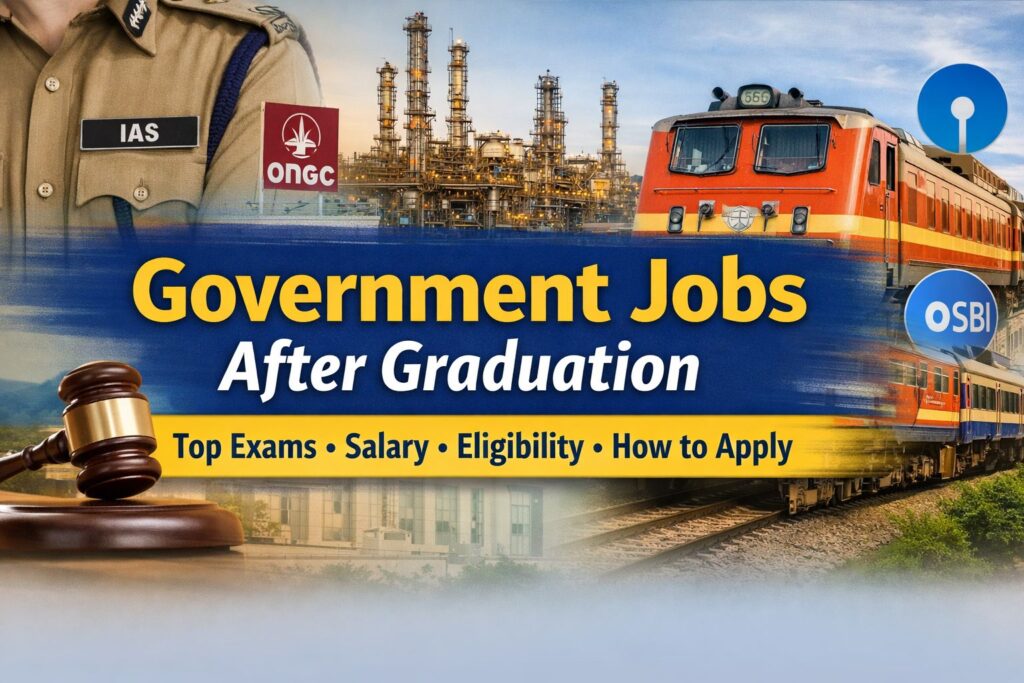
Explore the best government jobs after graduation in India, including top exams, eligibility, salary details, and step-by-step guidance to start a stable and respected career.
Why Government Jobs After Graduation Are a Great Career Choice in India
Completing graduation opens the door to many career opportunities, and government jobs are among the most popular choices for graduates in India. Every year, thousands of students finish their bachelor’s degrees and start looking for stable and rewarding career options. For many of them, government jobs become the first preference because they offer long-term security, good salary, and respectable positions in society.
One of the biggest advantages of government jobs is the wide variety of opportunities available for graduates. Many central and state government departments recruit candidates through competitive examinations. These exams provide access to positions in administration, banking, defence services, railways, public sector companies, and several other important sectors.
Government jobs are also known for their stability and structured career growth. Unlike many private sector jobs where employment can sometimes be uncertain, government employees usually enjoy long-term job security. They also receive regular promotions, salary increments, and additional benefits such as allowances, pension schemes, medical facilities, and paid leave.
Another important reason why many graduates choose government jobs is the sense of responsibility and service to the nation. Many roles allow employees to contribute directly to public administration, national development, and social welfare. This makes government jobs not only financially rewarding but also personally satisfying.
However, getting a government job requires dedication, proper planning, and consistent preparation. Competitive exams conducted by different government bodies test candidates on various subjects such as general knowledge, reasoning, mathematics, and current affairs. With the right strategy and regular practice, graduates can successfully clear these exams and secure a stable career.
In this guide, we will explore the best government jobs available after graduation in India, the top exams you can prepare for, expected salary, eligibility requirements, and the step-by-step process to apply. If you are planning to build a secure and respected career, understanding these opportunities can be the first step toward achieving your goal.
Why Government Jobs After Graduation Are So Popular
Government jobs continue to attract a large number of graduates every year. While the private sector offers many career options, government employment remains highly preferred due to the stability, benefits, and long-term security it provides. For many graduates and their families, a government job represents a reliable and respectable career path.
Job Security
One of the biggest advantages of government jobs is job security. Once selected through the proper recruitment process, employees generally enjoy long-term employment without the fear of sudden job loss. This stability allows individuals to focus on their career growth without worrying about frequent job changes.
Stable Salary and Regular Increments
Government employees receive a fixed salary structure based on official pay scales. Salaries are revised periodically according to government pay commissions, ensuring that employees receive fair compensation over time. In addition, regular increments and promotions help increase earnings as experience grows.
Attractive Allowances and Benefits
Apart from the basic salary, government employees receive various allowances such as house rent allowance (HRA), travel allowance (TA), and dearness allowance (DA). Many positions also provide medical benefits, pension schemes, and retirement benefits, making government employment financially secure in the long run.
Work-Life Balance
Compared to many demanding private sector jobs, government positions often provide better work-life balance. Fixed working hours, paid leave, and public holidays allow employees to maintain a healthy balance between professional responsibilities and personal life.
Social Respect and Prestige
In many parts of India, government jobs are highly respected. Positions in administration, banking, defence, and other government departments often bring social recognition and a sense of pride for both the employee and their family.
Opportunities for Career Growth
Government employees can grow through promotions and departmental exams. Over time, they can move into higher positions with greater responsibilities, better salaries, and leadership roles within their departments.
Because of these advantages, government jobs remain one of the most sought-after career options for graduates across India.
Still Confused About Your Career Choice?
Choosing between passion and practicality can be difficult. These expert-recommended career guidance books can help you make a clear, confident, and practical career decision.
Explore Must-Read Career Guidance BooksTop Government Exams After Graduation in India
After completing graduation, a wide range of government exams become available for candidates across different sectors. These exams are conducted by various central and state government organizations to recruit qualified graduates for administrative, banking, defence, railway, and public sector positions. Each exam opens the door to different types of government jobs, offering stable careers, good salaries, and long-term growth opportunities.
Understanding the major government exams after graduation is important because it helps candidates choose the right career path and prepare in a focused way. Some exams are conducted at the national level and allow candidates to work anywhere in India, while others are conducted by state governments for positions within a particular state.
Below are some of the most popular and important government exams that graduates in India can prepare for.
UPSC Civil Services Examination
The Civil Services Examination conducted by the Union Public Service Commission (UPSC) is considered one of the most prestigious and competitive exams in India. Through this exam, candidates can become officers in the Indian Administrative Service (IAS), Indian Police Service (IPS), Indian Foreign Service (IFS), and several other central services.
These positions involve important responsibilities in administration, law enforcement, policy implementation, and public service. Because of the high level of responsibility and career growth opportunities, many graduates aim to clear this examination.
SSC CGL (Combined Graduate Level Examination)
The Staff Selection Commission conducts the Combined Graduate Level (SSC CGL) examination to recruit graduates for various central government departments and ministries. This exam is one of the most popular choices among graduates preparing for government jobs.
Through SSC CGL, candidates can get positions such as Income Tax Inspector, Assistant Section Officer, Central Excise Inspector, Auditor, and several other administrative roles in government offices.
Banking Exams (IBPS, SBI, RBI)
Banking is another major sector that offers excellent government job opportunities for graduates. Several exams are conducted every year for recruitment in public sector banks.
Common banking exams include IBPS PO, IBPS Clerk, SBI PO, SBI Clerk, and RBI Grade B. These positions provide good salaries, career growth, and opportunities to work in the financial sector.
State Public Service Commission (State PSC) Exams
Every state in India conducts its own Public Service Commission examinations to recruit candidates for administrative positions in state government departments. These exams are similar in structure to the UPSC exam but focus on positions within the state government.
Through State PSC exams, candidates can become officers such as Deputy Collector, Deputy Superintendent of Police (DSP), Block Development Officer (BDO), and other administrative officials.
Defence Exams for Officer Positions
Graduates who are interested in serving the country through the armed forces can appear for defence officer recruitment exams. One of the most well-known exams for graduates is the Combined Defence Services (CDS) examination.
Through this exam, candidates can join the Indian Army, Indian Navy, or Indian Air Force as officers after completing training at the respective academies.
Railway Recruitment Exams
The Indian Railways is one of the largest government employers in the country and regularly conducts recruitment exams for various positions. Graduates can apply for several administrative and operational roles within the railway system.
These positions offer stable employment, good salary structures, and opportunities for promotion within the railway department.
Public Sector Undertaking (PSU) Recruitment
Public Sector Undertakings such as energy companies, oil companies, and heavy industries also recruit graduates through competitive exams and recruitment processes. Some PSU jobs require candidates to appear for exams like GATE, while others conduct their own recruitment procedures.
PSU jobs are known for offering attractive salaries, benefits, and career growth opportunities similar to many high-level government positions.
Understanding these exams helps graduates plan their preparation effectively and choose the sector that best matches their interests and career goals.
UPSC Civil Services Jobs After Graduation
The Civil Services Examination conducted by the Union Public Service Commission (UPSC) is widely considered one of the most prestigious government examinations in India. This exam provides graduates the opportunity to serve in some of the highest administrative positions in the country. Every year, thousands of graduates prepare for this examination with the goal of becoming officers who play an important role in governance, administration, and public service.
Clearing the UPSC Civil Services Examination allows candidates to join several elite services of the Government of India. These positions come with significant responsibility, authority, and the opportunity to contribute directly to national development.
Major Civil Services Through UPSC
Some of the most well-known services that candidates can join through this examination include:
Indian Administrative Service (IAS)
IAS officers handle important administrative responsibilities at district, state, and central government levels. They are involved in policy implementation, development programs, and overall governance.
Indian Police Service (IPS)
IPS officers are responsible for maintaining law and order, preventing crime, and managing police departments. They play a crucial role in internal security and public safety.
Indian Foreign Service (IFS)
IFS officers represent India in foreign countries and handle diplomatic relations, international negotiations, and global cooperation.
Apart from these, there are several other central services such as the Indian Revenue Service (IRS), Indian Audit and Accounts Service (IAAS), and other Group A services.
Eligibility for UPSC Civil Services Exam
To appear for the UPSC Civil Services Examination, candidates must meet certain basic eligibility requirements:
- A bachelor’s degree from a recognized university is required.
- Candidates from any academic stream such as arts, science, commerce, or engineering can apply.
- The minimum age is generally 21 years, and the upper age limit is usually 32 years for general category candidates, with relaxations for reserved categories according to government rules.
Salary and Benefits
Civil services officers receive attractive salaries along with many additional benefits. The basic salary of an entry-level IAS officer generally starts according to the government pay structure, along with allowances such as house rent allowance, travel allowance, and dearness allowance.
Apart from salary, officers also receive various benefits such as government accommodation, official vehicles in certain roles, medical facilities, and pension benefits after retirement.
Career Growth and Opportunities
A career in civil services offers long-term growth and leadership opportunities. Officers can be promoted to higher administrative positions over time and may eventually hold senior roles in government departments, ministries, and policy-making bodies.
For graduates who aspire to serve the nation, work on important administrative decisions, and build a respected career, the UPSC Civil Services Examination remains one of the most rewarding career paths available.
SSC Government Jobs After Graduation
The Staff Selection Commission (SSC) conducts several recruitment examinations every year to fill vacancies in various ministries, departments, and organizations of the Government of India. Among these exams, the Combined Graduate Level (SSC CGL) Examination is one of the most popular choices for graduates who want to secure a stable government job.
SSC government jobs are attractive because they offer good salaries, job security, regular promotions, and opportunities to work in important government offices. Many graduates prefer SSC exams because the recruitment process is transparent and the syllabus is well defined.
SSC CGL Examination
The SSC Combined Graduate Level (CGL) Examination is conducted to recruit graduates for Group B and Group C posts in central government departments. Candidates from any discipline such as arts, commerce, science, or engineering can apply for this exam.
The examination is conducted in multiple stages, including computer-based tests and sometimes a skill or descriptive test depending on the post. Candidates who perform well in these stages are selected for various government positions.
Popular Jobs Through SSC CGL
The SSC CGL exam offers a variety of respected government positions. Some of the most well-known posts include:
Income Tax Inspector
This role involves assisting in the administration of income tax laws, conducting investigations, and ensuring proper tax collection.
Assistant Section Officer (ASO)
Assistant Section Officers work in various ministries and departments where they handle administrative tasks, file management, and coordination between different sections.
Central Excise Inspector / GST Inspector
These officers work in departments responsible for tax collection and enforcement related to goods and services.
Sub-Inspector (CBI)
This position involves investigative responsibilities in the Central Bureau of Investigation and may include handling important criminal investigations.
Auditor and Accountant
These roles involve financial record checking, auditing government accounts, and ensuring proper financial management within departments.
Eligibility for SSC CGL
The main eligibility requirement for SSC CGL is a bachelor’s degree from a recognized university. Candidates from any academic background can apply, although some specific posts may require particular subjects such as statistics or economics.
The minimum age requirement generally starts from 18 or 20 years depending on the post, while the upper age limit is usually around 27 to 32 years, with relaxation for reserved categories as per government rules.
Salary and Career Growth
SSC jobs offer competitive salaries based on government pay levels. Entry-level salaries can be quite attractive when allowances such as house rent allowance, travel allowance, and dearness allowance are included.
With experience and promotions, employees can move to higher positions within their departments. Many officers who start their careers through SSC exams eventually reach senior administrative roles after several years of service.
Because of the wide variety of posts, transparent recruitment process, and stable career prospects, SSC government jobs remain one of the most preferred options for graduates across India.
Banking Jobs After Graduation
The banking sector offers some of the most popular government job opportunities for graduates in India. Public sector banks recruit thousands of candidates every year through national-level competitive examinations. These jobs are known for offering good salaries, stable careers, and opportunities for professional growth in the financial sector.
Banking jobs are especially attractive to graduates because they provide a structured career path. Employees can start at entry-level positions and gradually move to higher managerial roles through experience, internal exams, and promotions.
Major Banking Exams for Graduates
Several banking examinations are conducted every year to recruit candidates for different positions in public sector banks and financial institutions. Some of the most important exams include:
IBPS PO (Institute of Banking Personnel Selection – Probationary Officer)
The IBPS PO exam is conducted to recruit probationary officers in multiple public sector banks. This role is considered one of the most respected positions in the banking sector. Probationary officers handle tasks such as customer service, loan processing, financial operations, and branch management.
SBI PO (State Bank of India – Probationary Officer)
The SBI PO examination is conducted by the State Bank of India to recruit officers for its branches across the country. This position offers good career growth opportunities and attractive salary packages.
IBPS Clerk
The IBPS Clerk exam recruits candidates for clerical positions in public sector banks. Clerks handle customer transactions, account maintenance, documentation, and other banking operations.
SBI Clerk
This exam is conducted by the State Bank of India to recruit junior associates for clerical roles in bank branches.
RBI Grade B Officer
The Reserve Bank of India conducts the Grade B examination to recruit officers responsible for important functions such as financial regulation, monetary policy implementation, and banking supervision.
Eligibility Criteria
To apply for most banking exams, candidates must have a bachelor’s degree from a recognized university. Graduates from any stream such as arts, commerce, science, or engineering can apply.
The minimum age requirement is generally 20 or 21 years, while the upper age limit is usually 28 to 30 years, depending on the specific exam. Age relaxation is provided for reserved categories according to government rules.
Salary and Benefits
Banking jobs offer attractive salaries along with several additional benefits. Employees receive allowances such as house rent allowance, travel allowance, and medical benefits. Many banks also provide opportunities for transfers, promotions, and professional training programs.
Career Growth in Banking
A banking career provides strong long-term growth opportunities. Employees who start as probationary officers or clerks can gradually move into higher positions such as branch manager, regional manager, or senior administrative roles within the banking system.
Because of the stable work environment, professional growth opportunities, and financial benefits, banking jobs remain one of the most preferred government career options for graduates in India.
Defence Jobs After Graduation
For graduates who dream of serving the nation while building a disciplined and respected career, defence jobs offer excellent opportunities. The Indian Armed Forces recruit graduates for officer-level positions in the Indian Army, Indian Navy, and Indian Air Force through various competitive examinations and selection processes.
Defence careers are not only about employment; they represent leadership, courage, and national service. Officers in the armed forces receive professional training, competitive salaries, and a strong sense of pride in protecting the country.
Combined Defence Services (CDS) Examination
One of the most well-known exams for graduates who want to become defence officers is the Combined Defence Services (CDS) Examination. This exam is conducted twice a year to recruit officers for the Indian Military Academy, Officers Training Academy, Indian Naval Academy, and Air Force Academy.
Candidates who successfully clear the written examination and the Services Selection Board (SSB) interview undergo training at the respective academies before being commissioned as officers in the armed forces.
Indian Army Officer
Graduates can join the Indian Army as commissioned officers through the CDS examination or other entry schemes. Army officers are responsible for leading troops, managing operations, and ensuring national security. This role requires strong leadership skills, physical fitness, and the ability to handle challenging situations.
Indian Navy Officer
The Indian Navy offers opportunities for graduates to serve as officers responsible for naval operations, maritime security, and technical management of naval equipment. Officers may work on ships, submarines, or shore-based establishments depending on their specialization.
Indian Air Force Officer
Graduates can also join the Indian Air Force as officers in different branches such as flying, ground duty technical, or ground duty non-technical roles. Air Force officers handle important responsibilities related to air defence, aircraft operations, and technical maintenance.
Eligibility Requirements
To apply for most defence officer positions, candidates must have a bachelor’s degree from a recognized university. Some roles may require specific subjects such as physics or mathematics, especially in technical or aviation-related branches.
Candidates must also meet certain physical and medical standards, as defence services require good health and fitness.
Salary and Benefits
Defence officers receive competitive salaries along with several allowances and facilities. These may include accommodation, medical services, travel benefits, and pension schemes after retirement. In addition to financial benefits, officers gain valuable leadership experience and professional training.
Career Growth and Prestige
A career in the armed forces provides excellent opportunities for growth and leadership. Officers can rise through ranks over time and take on higher responsibilities within the defence system. Defence jobs also carry great respect in society because they involve serving and protecting the nation.
For graduates who are passionate about discipline, leadership, and national service, joining the defence forces can be a highly rewarding and honorable career choice.
Railway Jobs After Graduation
The Indian Railways is one of the largest government employers in India and offers a wide range of job opportunities for graduates. Every year, recruitment is conducted through various Railway Recruitment Boards (RRBs) and Railway Recruitment Cells (RRCs) to fill positions across different departments.
Railway jobs are highly preferred because they provide stable employment, good salary structures, and several government benefits. Employees also receive allowances, travel benefits, and opportunities for promotion within the railway system. For many graduates, a career in the railways offers both financial stability and long-term job security.
Popular Railway Jobs for Graduates
Graduates can apply for several administrative and operational roles in the railway sector. Some of the commonly known positions include:
Station Master
Station Masters are responsible for managing railway station operations. Their duties include ensuring the smooth movement of trains, coordinating with railway staff, maintaining safety standards, and handling passenger-related issues.
Goods Guard
Goods Guards supervise freight trains and ensure that goods are transported safely and according to railway regulations. They play an important role in managing logistics and freight operations.
Traffic Apprentice
Traffic Apprentices receive training in railway operations and management. After training, they may be assigned responsibilities related to train operations, traffic control, and coordination within the railway network.
Commercial Apprentice
Commercial Apprentices work in areas related to passenger services, ticketing systems, revenue management, and customer service in railway departments.
Eligibility Criteria
To apply for most graduate-level railway jobs, candidates must have a bachelor’s degree from a recognized university. The degree can be from any discipline unless a specific post requires a particular qualification.
The typical age limit for many railway recruitment exams is between 18 and 32 years, although the exact limit may vary depending on the recruitment notification. Age relaxation is provided for reserved categories according to government rules.
Salary and Benefits
Railway employees receive salaries based on government pay levels along with several allowances. These may include house rent allowance, travel allowance, and other benefits. Railway employees and their families may also receive travel concessions on trains.
Career Growth Opportunities
The railway system offers good career progression through departmental promotions and experience-based advancements. Employees who perform well in their roles can move into higher administrative or supervisory positions over time.
Because of its large workforce, stable employment structure, and nationwide presence, the Indian Railways continues to be one of the most attractive government career options for graduates in India.
Public Sector Undertaking (PSU) Jobs After Graduation
Public Sector Undertakings (PSUs) are government-owned companies that operate in important sectors such as energy, oil and gas, heavy industries, engineering, and infrastructure. These organizations play a major role in the development of the country and offer excellent career opportunities for graduates.
PSU jobs are highly respected because they provide competitive salaries, strong job security, and professional work environments similar to large corporate organizations. Many graduates aim to work in PSUs because these companies combine the stability of government jobs with the growth opportunities of the corporate sector.
Major Public Sector Companies in India
Some of the well-known Public Sector Undertakings that recruit graduates include:
BHEL (Bharat Heavy Electricals Limited)
BHEL is one of India’s largest engineering and manufacturing companies. It recruits graduates for various technical and management roles.
ONGC (Oil and Natural Gas Corporation)
ONGC is one of the largest oil and gas exploration companies in India and offers excellent career opportunities for engineering and management graduates.
NTPC (National Thermal Power Corporation)
NTPC is a major public sector company involved in electricity generation. It recruits graduates for technical, management, and administrative roles.
GAIL (Gas Authority of India Limited)
GAIL is a leading natural gas company in India and offers career opportunities in engineering, management, and operations.
Recruitment Process for PSU Jobs
PSU recruitment methods may vary depending on the company and the position. Some organizations recruit candidates through national-level examinations such as GATE, while others conduct their own recruitment tests, interviews, and selection procedures.
Candidates who perform well in these recruitment processes are selected for various roles such as engineers, management trainees, project managers, and administrative officers.
Eligibility Criteria
To apply for PSU jobs, candidates must generally have a bachelor’s degree from a recognized university. Technical roles often require specific degrees such as engineering, while management and administrative positions may accept graduates from different academic backgrounds.
Each company releases its own recruitment notification specifying the exact eligibility requirements, age limits, and selection process.
Salary and Benefits
PSU jobs are known for offering attractive salary packages along with additional benefits. Employees may receive allowances, performance bonuses, medical facilities, housing support, and retirement benefits.
Because these companies operate in important industries, employees also gain valuable professional experience and opportunities to work on large national projects.
Career Growth and Stability
Working in a PSU provides strong long-term career growth. Employees can move to higher managerial positions through promotions and experience. Many PSU organizations also provide training programs to help employees develop technical and leadership skills.
For graduates who want a stable career with excellent financial benefits and professional growth, PSU jobs remain one of the most rewarding government career options in India.
Salary of Government Jobs After Graduation
One of the main reasons why many graduates prefer government jobs is the stable and attractive salary structure. Government employees receive a fixed salary based on official pay levels along with several allowances and benefits. Over time, regular increments and promotions help increase overall earnings.
The salary of government jobs after graduation can vary depending on the department, job position, and level of responsibility. However, most entry-level government jobs provide a comfortable starting salary along with long-term financial security.
Entry-Level Salary Range
For many graduate-level government jobs, the starting salary generally falls within the range of ₹30,000 to ₹60,000 per month depending on the role and department. Positions in administration, banking, railways, and government departments usually fall within this range.
Some high-level positions such as civil services officers or officers in financial institutions may offer even higher starting salaries along with additional benefits.
Common Allowances Provided
Apart from the basic salary, government employees also receive several allowances that increase their overall income. Some of the common allowances include:
Dearness Allowance (DA)
This allowance helps employees manage the impact of inflation and is revised periodically.
House Rent Allowance (HRA)
Employees who do not receive government accommodation are given house rent allowance to support housing expenses.
Travel Allowance (TA)
This allowance helps cover travel-related expenses for official duties.
Medical Benefits
Many government employees receive health insurance coverage or medical facilities for themselves and their families.
Salary Growth Through Promotions
One of the biggest advantages of government jobs is long-term salary growth. Employees receive regular increments and may also be promoted to higher positions based on experience, performance, and departmental examinations.
For example, a candidate who starts as an entry-level officer or inspector may eventually move into senior administrative roles after several years of service.
Additional Long-Term Benefits
Government jobs also provide several long-term financial benefits such as retirement pension schemes, provident fund contributions, gratuity, and other post-retirement support systems. These benefits make government employment financially secure even after retirement.
Because of the stable income, additional allowances, and long-term financial benefits, government jobs remain one of the most attractive career choices for graduates in India.
Eligibility Criteria for Government Jobs After Graduation
Before applying for government jobs after graduation, it is important for candidates to understand the basic eligibility requirements. Different government departments and recruitment bodies may have slightly different rules, but most graduate-level government jobs follow some common eligibility criteria related to education, age, nationality, and other requirements.
Knowing these conditions in advance helps candidates prepare properly and avoid mistakes during the application process.
Educational Qualification
The most important requirement for graduate-level government jobs is a bachelor’s degree from a recognized university. Candidates who have completed graduation in fields such as arts, science, commerce, engineering, management, or other disciplines can apply for many government examinations.
Most exams like UPSC, SSC CGL, banking exams, and state PSC exams accept candidates from any academic stream. However, some specialized roles may require specific subjects or professional qualifications depending on the nature of the job.
Age Limit
The age limit for government jobs after graduation generally varies depending on the exam and the position. In many cases, the minimum age requirement is around 20 or 21 years, while the maximum age limit is usually between 30 and 32 years for general category candidates.
However, age relaxation is provided for candidates belonging to reserved categories according to government rules.
Typical relaxations may include:
- OBC candidates: usually up to 3 years
- SC/ST candidates: usually up to 5 years
- PwD candidates: additional relaxation depending on the category
The exact age limits are always mentioned in the official recruitment notification of each exam.
Nationality Requirement
For most central government jobs, candidates must be citizens of India. Some exams may also allow certain categories of candidates from neighboring regions under specific government guidelines.
Number of Attempts
Some competitive exams have limits on the number of attempts a candidate can make. For example, certain high-level exams may allow a limited number of attempts for general category candidates, while reserved categories may receive additional attempts.
Because these rules can vary from exam to exam, candidates should carefully read the official notification before applying.
Physical and Medical Requirements
For certain government jobs such as defence services, police positions, and some railway roles, candidates must meet specific physical and medical standards. These may include requirements related to height, vision, physical fitness, and overall health.
Importance of Checking Official Notifications
Although the general eligibility conditions remain similar for many exams, the exact requirements can vary depending on the recruiting organization. Therefore, candidates should always read the official recruitment notification carefully before applying for any government exam.
Understanding these eligibility criteria helps graduates choose suitable exams and start their preparation with confidence.
How to Apply for Government Jobs After Graduation
Applying for government jobs after graduation usually involves a structured online process. Most government departments and recruitment organizations now accept applications through official websites, making it easier for candidates across the country to apply for various positions.
Although the exact procedure may vary depending on the exam or department, the general application process for most government jobs follows a similar set of steps.
1. Check the Official Recruitment Notification
The first step is to carefully read the official recruitment notification released by the government department or examination authority. This notification contains important details such as eligibility criteria, age limits, number of vacancies, exam pattern, important dates, and the application process.
Understanding these details helps candidates confirm whether they meet the requirements before applying.
2. Visit the Official Website
Most government job applications are submitted through the official website of the recruiting organization. Candidates should always apply through the official portal to avoid incorrect information or fraud.
For example, exams conducted by different organizations have their own official websites where applications are accepted.
3. Complete the Registration Process
Before filling the application form, candidates usually need to create an account on the official website. This process may require basic details such as name, date of birth, email address, and mobile number.
After successful registration, candidates receive login credentials that allow them to access the application form.
4. Fill the Application Form Carefully
Once logged in, candidates must fill in the application form with accurate personal, educational, and contact details. It is important to double-check all information before submitting the form to avoid mistakes that could lead to application rejection.
5. Upload Required Documents
Applicants may need to upload scanned copies of certain documents such as:
- Passport-size photograph
- Signature
- Educational certificates
- Identity proof
These documents must usually follow the size and format guidelines mentioned in the application instructions.
6. Pay the Application Fee
Some government exams require candidates to pay an application fee. The payment can typically be made online using debit cards, credit cards, net banking, or other digital payment methods. In some cases, candidates from certain categories may receive fee exemptions according to government rules.
7. Submit the Application and Save Confirmation
After completing all steps, candidates should review the form carefully and submit it. It is advisable to download or print the confirmation page for future reference.
8. Download Admit Card and Prepare for the Exam
After the application process is complete, candidates can later download their admit cards from the official website when they are released. The admit card contains important details about the exam date, center, and instructions.
Following these steps carefully ensures that candidates can successfully apply for government jobs and focus on preparing for the competitive examination.
Preparation Tips for Government Exams After Graduation
Preparing for government exams after graduation requires dedication, proper planning, and consistent effort. Since many competitive exams attract a large number of candidates every year, having a clear preparation strategy can greatly improve your chances of success. With the right approach and disciplined study habits, graduates can effectively prepare for these exams and achieve their career goals.
Understand the Exam Pattern and Syllabus
The first step in preparation is to understand the exam pattern and syllabus of the exam you are planning to appear for. Most government exams test candidates on subjects such as general knowledge, reasoning ability, quantitative aptitude, and English language skills.
Carefully reviewing the syllabus helps you focus on the most important topics and plan your studies more efficiently.
Create a Study Plan
A well-structured study plan helps maintain consistency during preparation. Candidates should create a daily or weekly schedule that covers all important subjects. Setting realistic study goals and allocating sufficient time for each topic can help maintain steady progress.
It is also helpful to revise previously studied topics regularly to strengthen understanding.
Practice with Previous Year Question Papers
Solving previous year question papers is one of the most effective ways to prepare for government exams. These papers help candidates understand the type of questions asked, the difficulty level of the exam, and the time required to complete the test.
Regular practice also improves problem-solving speed and accuracy.
Take Mock Tests
Mock tests simulate the real exam environment and help candidates evaluate their preparation level. By taking regular mock tests, candidates can identify weak areas and work on improving them before the actual exam.
Time management skills also improve significantly through consistent mock test practice.
Stay Updated with Current Affairs
Many government exams include questions related to current events, national developments, and international affairs. Reading newspapers, following reliable news sources, and reviewing monthly current affairs summaries can help candidates stay informed.
Maintaining awareness of important events also improves general knowledge performance in exams.
Focus on Consistency and Discipline
Consistency is one of the most important factors in exam preparation. Studying regularly, maintaining a positive mindset, and avoiding distractions can help candidates stay focused on their goals.
Even small daily progress can lead to significant improvement over time.
Maintain a Healthy Lifestyle
Preparing for competitive exams can be demanding, so it is important to maintain good physical and mental health. Getting enough sleep, eating healthy food, and taking short breaks during study sessions can improve concentration and productivity.
Regular exercise or relaxation activities can also help reduce stress during preparation.
Stay Motivated and Believe in Your Goal
Government exam preparation often requires patience and persistence. Results may take time, but consistent effort and determination can eventually lead to success. Staying motivated and believing in your abilities can help you overcome challenges during the preparation journey.
For graduates who remain focused and committed to their goals, government exams can open the door to stable, respected, and rewarding careers.
Best Books for Graduation Government Job Preparation
Affiliate Disclosure: Some of the links in this section may be affiliate links. This means that if you purchase a book through these links, we may earn a small commission at no extra cost to you. These recommendations are based on commonly used study resources that many aspirants find helpful while preparing for government exams.
Preparing for government exams after graduation becomes much easier when you use the right study materials. Good books help you understand important concepts, practice exam-level questions, and build a strong foundation for competitive exams.
Most government exams such as SSC, banking exams, railway exams, state PSC, and even UPSC include subjects like quantitative aptitude, reasoning, English, general knowledge, and current affairs. The books listed below are widely recommended by many aspirants because they cover these topics in a clear and structured way.
If you are serious about preparing for government jobs, these books can be useful resources for strengthening your preparation.
1. Quantitative Aptitude – R.S. Aggarwal
Quantitative aptitude is an important section in many competitive exams. This book explains mathematical concepts in a simple and beginner-friendly manner. It covers topics such as percentages, averages, profit and loss, time and work, ratio and proportion, and many other numerical concepts that frequently appear in government exams.
The book also includes a large number of practice questions that help improve calculation speed and problem-solving ability.
✔ Useful for: SSC, Banking, Railway, and other government exams
👉 Check this book
2. A Modern Approach to Verbal & Non-Verbal Reasoning – R.S. Aggarwal
Reasoning ability is another key section in most government examinations. This book provides clear explanations of logical reasoning concepts along with many practice questions.
It covers important topics such as puzzles, coding-decoding, analogies, number series, and pattern recognition. Regular practice with this book can help candidates improve their analytical thinking and logical reasoning skills.
✔ Useful for: SSC, Banking, Railway, and many competitive exams
👉 Check this book
3. Objective General English – S.P. Bakshi
English language skills are tested in many government exams, especially in SSC and banking recruitment tests. This book focuses on grammar, vocabulary, comprehension, and sentence correction.
It includes detailed explanations and practice exercises that help candidates improve their understanding of English language concepts commonly asked in competitive exams.
✔ Useful for: SSC, Banking, and other competitive exams
👉 Check this book
4. Lucent’s General Knowledge
Lucent’s General Knowledge is one of the most widely used books for general awareness preparation. It covers a broad range of topics including Indian history, geography, polity, economics, science, and important general knowledge facts.
Many aspirants prefer this book because it provides concise explanations that are useful for quick revision before exams.
✔ Useful for: SSC, Railway, Defence, and other government exams
👉 Check this book
5. Indian Polity – M. Laxmikanth
For candidates preparing for higher-level government exams, understanding the Indian political system is very important. This book explains the structure of the Indian Constitution, fundamental rights, parliament, judiciary, and many other important topics.
It is considered one of the most trusted books for learning about Indian polity in a detailed yet easy-to-understand way.
✔ Useful for: UPSC, State PSC, and other administrative exams
👉 Check this book here
6. Fast Track Objective Arithmetic – Rajesh Verma
This book is helpful for candidates who want to improve their speed and accuracy in solving arithmetic questions. It provides shortcuts, tricks, and practice exercises that help candidates solve numerical problems more efficiently during exams.
Practicing regularly with this book can help improve time management in competitive exams.
✔ Useful for: SSC, Banking, and Railway exams
👉 Check this book here

Upgrade Your Study Setup for Faster Career Growth!
Discover the Best Online Learning Gadgets for Career Growth (Must-Have Study Tools for Students & Professionals) and choose the right devices that improve focus, productivity, and learning efficiency.
Explore the Gadget Guide →Advantages of Government Jobs for Graduates
Government jobs offer several advantages that make them one of the most attractive career choices for graduates in India. While many private sector careers also provide good opportunities, government employment is often preferred because of its stability, structured growth, and long-term benefits.
For many graduates and their families, a government job represents financial security, professional respect, and a stable future.
Long-Term Job Security
One of the biggest benefits of government jobs is job security. Once selected through the official recruitment process, employees generally enjoy stable employment for many years. Unlike some private sector jobs where layoffs may occur during economic challenges, government positions are usually more secure.
This stability allows employees to focus on building their careers without worrying about sudden job loss.
Stable Income and Regular Salary
Government employees receive a fixed salary based on official pay scales. In addition to the basic salary, they also receive allowances such as dearness allowance, house rent allowance, and travel allowance. Salaries are periodically revised according to government pay commissions, ensuring that employees receive fair compensation.
Regular salary payments make financial planning easier for employees and their families.
Attractive Benefits and Allowances
Apart from salary, government employees receive various benefits such as medical facilities, paid leave, retirement pension schemes, and provident fund contributions. These benefits provide long-term financial protection and support.
Some positions may also include additional facilities such as government accommodation or travel concessions.
Opportunities for Career Growth
Government departments provide clear promotion paths for employees. With experience and good performance, employees can move into higher positions with increased responsibilities and better salaries.
Many departments also conduct internal exams or training programs that help employees develop new skills and qualify for promotions.
Work-Life Balance
Government jobs often offer better work-life balance compared to many demanding private sector roles. Fixed working hours, weekly holidays, and official leave policies allow employees to manage both their professional and personal responsibilities effectively.
This balance helps maintain long-term productivity and personal well-being.
Social Respect and Prestige
In many parts of India, government jobs are highly respected. Positions in administration, banking, defence, and other government departments often bring social recognition and pride for the employee and their family.
The combination of responsibility, public service, and stability contributes to the high regard that government employees receive in society.
Because of these advantages, government jobs remain a preferred career path for many graduates who want a stable, secure, and respected professional life.
Conclusion
Government jobs after graduation offer a wide range of career opportunities for candidates who are looking for stability, professional growth, and long-term financial security. From administrative services and banking to defence, railways, and public sector companies, graduates have many paths to build a respected and rewarding career in the government sector.
One of the biggest advantages of these jobs is the combination of job security, structured promotions, attractive benefits, and social respect. Government employees also have the opportunity to contribute to national development and public service, which makes these roles both meaningful and impactful.
However, securing a government job requires dedication, proper planning, and consistent preparation. Competitive exams can be challenging, but with the right study strategy, regular practice, and determination, many candidates successfully achieve their goals every year.
Graduation is an important step that opens the door to many government career opportunities. By understanding the available exams, eligibility requirements, and preparation strategies, candidates can choose the right path and begin preparing with confidence.
With patience, hard work, and a clear focus on your goal, a stable and respected government career can become a reality.
Explore Government Jobs Based on Your Education Level
Government job opportunities are available for candidates with different educational qualifications. If you are planning your career step by step, it is helpful to explore opportunities based on your current level of education.
If you are still studying or looking for jobs with lower educational qualifications, you can also explore these detailed guides:
- 8th Pass Government Jobs: Learn about job opportunities, salary, eligibility, and how to apply for government jobs available for candidates who have completed 8th class.
- 10th Pass Government Jobs: Discover various government job options available for 10th pass candidates in sectors such as railways, defence, and public services.
- 12th Pass Government Jobs: Explore some of the most popular government job opportunities available for 12th pass candidates along with eligibility details and application guidance.
These guides can help you understand the career path and government job opportunities available at different stages of education.
Frequently Asked Questions (FAQs)
Q1. Which government jobs are best after graduation in India?
Several government jobs are available for graduates in India. Some of the most popular options include civil services through UPSC, SSC CGL jobs, banking jobs such as IBPS PO and SBI PO, defence officer positions through CDS, railway jobs, and positions in public sector companies.
Q2. What is the salary of government jobs after graduation?
The salary of government jobs after graduation depends on the department and position. Many entry-level government jobs offer starting salaries ranging from ₹30,000 to ₹60,000 per month, along with allowances and other benefits.
Q3. Can final-year students apply for government exams?
In many cases, final-year students can apply for certain government exams if they complete their graduation before the final stage of the selection process. However, candidates should always check the official recruitment notification for specific eligibility conditions.
Q4. Which government exam is easiest after graduation?
The difficulty level of exams can vary depending on preparation and competition. Exams such as SSC CGL, banking exams, and certain railway recruitment exams are often considered manageable for candidates who prepare regularly and understand the syllabus well.
Q5. How can I start preparing for government jobs after graduation?
Candidates can start by choosing the exam they want to appear for, understanding the syllabus, creating a study plan, practicing previous year question papers, and taking regular mock tests. Consistent preparation and staying updated with current affairs are also important for success.

Government Job Preparation & Career Guidance for Indian Exams
Read helpful blogs and preparation guides for SSC, Banking, Railway, and State Government exams. Learn exam strategies, syllabus insights, paper patterns, and make confident career decisions.
Govt Job Preparation Guides →