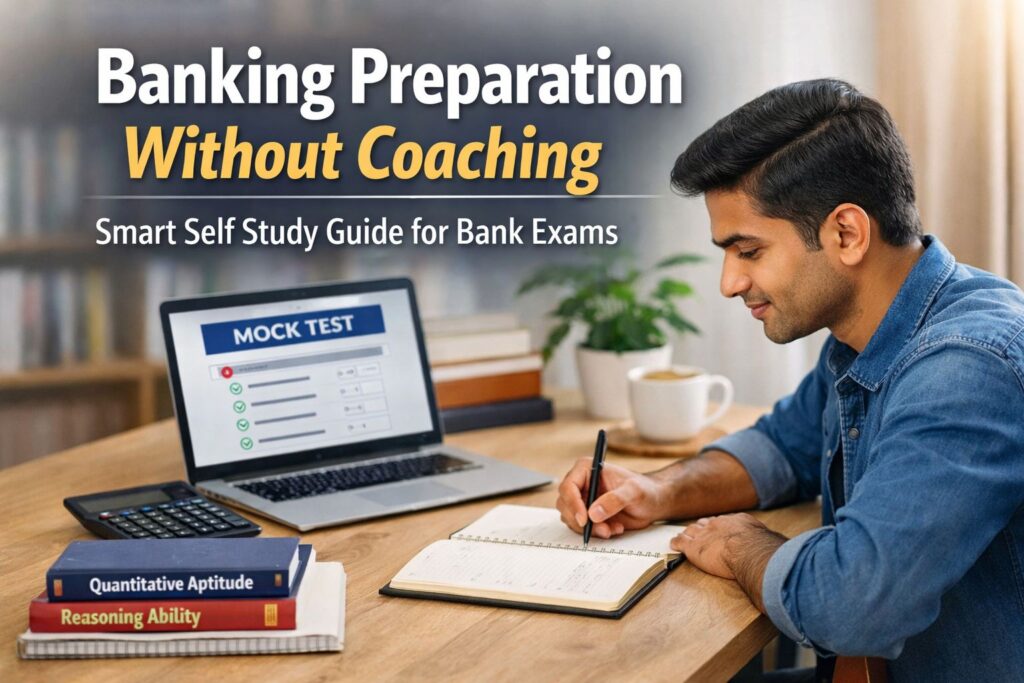
Learn how to crack banking exams without coaching using a smart self study strategy, effective banking study plan, and the best books for banking exams.
Banking Preparation Without Coaching: Is Self Study Really Possible?
Every year, lakhs of students in India apply for various banking exams such as IBPS PO, IBPS Clerk, SBI PO, and RBI Assistant with the dream of securing a stable government job in the banking sector. While many candidates choose to join coaching institutes for preparation, a large number of successful aspirants have proven that it is absolutely possible to crack banking exams through self study alone.
In today’s digital era, access to quality study material, online mock tests, previous year question papers, and video lectures has made self preparation more practical than ever before. You no longer need to depend entirely on expensive coaching classes when the right resources and strategies are available at your fingertips.
However, preparing without coaching also comes with its own challenges. Students often feel confused about where to start, which books to follow, how much time to dedicate daily, and whether their preparation strategy is actually effective. Without proper guidance, many aspirants end up wasting time on unnecessary study material or switching between multiple books without completing even one.
This self study guide is specially designed for students who want to prepare for banking exams without joining any coaching institute. Whether you are a full-time student, a working professional, or someone preparing from home, this guide will help you understand the right preparation approach, study plan, and book selection strategy required to succeed in banking exams through self study.
In the upcoming sections, you will learn how to create an effective preparation routine, choose the right number of books, and follow a smart study plan that focuses on concept clarity, regular practice, and performance analysis.
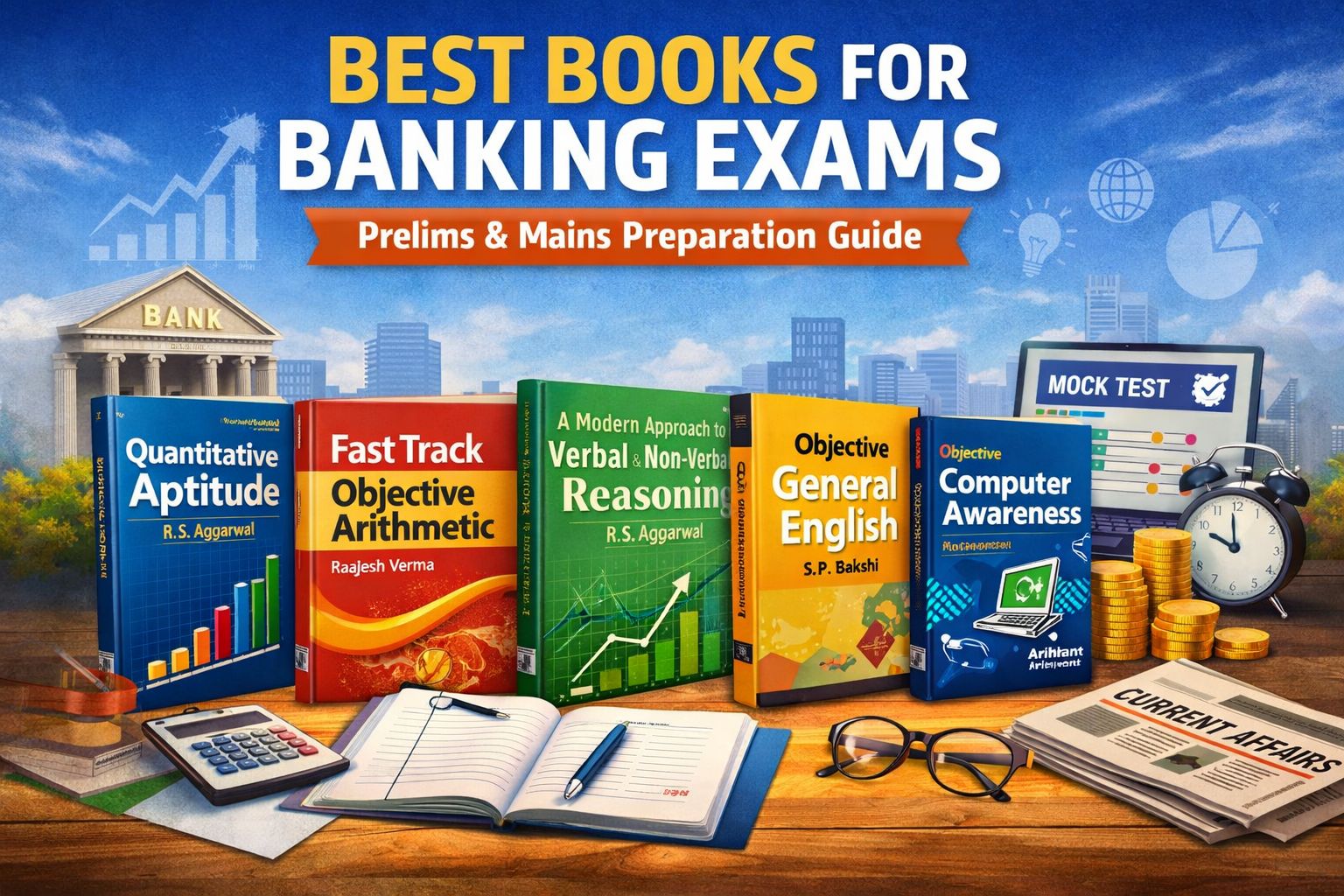
Start Your Banking Exam Preparation with the Right Books
Boost your chances of success with expert-recommended books for SBI, IBPS & RBI exams — Prelims + Mains preparation.
View Best Banking Exam BooksCan You Crack Banking Exams Without Coaching?
Many banking aspirants believe that joining a coaching institute is necessary to clear competitive exams like IBPS PO, SBI Clerk, or RBI Assistant. However, this is one of the most common myths in the preparation journey. The truth is that thousands of candidates clear banking exams every year through self study by following a proper banking study plan and consistent practice strategy.
Coaching institutes can provide guidance, but they are not a guarantee of success. Ultimately, your selection depends on how well you understand the concepts, how regularly you practice questions, and how effectively you analyze your mock test performance. Self study allows you to prepare at your own pace and focus more on your weak areas without feeling pressured by classroom speed.
One of the biggest advantages of preparing without coaching is flexibility. You can create your own timetable, choose the most suitable study resources, and revise topics as many times as required. It also saves a significant amount of money that would otherwise be spent on coaching fees.
However, self preparation requires discipline and the right direction. Many students make the mistake of collecting too many books or following multiple online sources at the same time, which leads to confusion instead of clarity. Without a structured banking study plan, preparation can easily become unorganized and ineffective.
If you follow a focused strategy that includes concept building, daily practice, and regular mock test analysis, cracking banking exams without coaching is not only possible but also practical for serious aspirants.
Understanding Banking Exam Structure (Prelims & Mains Overview)
Before starting your preparation, it is very important to understand the actual structure of banking exams. Many students begin studying without knowing the exam pattern in detail, which often leads to an unbalanced preparation strategy. When you know what the exam demands, you can prepare more efficiently without wasting time on less important topics.
Most banking exams such as IBPS PO, IBPS Clerk, SBI PO, and SBI Clerk are conducted in two main stages:
Preliminary Examination (Prelims)
The Preliminary exam is the first stage and acts as a screening test. It usually consists of three sections:
- Quantitative Aptitude
- Reasoning Ability
- English Language
This stage is time-bound and focuses on speed and accuracy. Since there is sectional timing in most exams, candidates must manage their time wisely. The marks obtained in Prelims are generally not counted in the final merit list, but clearing this stage is necessary to qualify for the Mains exam.
Main Examination (Mains)
Candidates who clear the Prelims exam are eligible to appear for the Mains exam. This stage is more difficult and tests both knowledge and analytical ability. The Mains exam usually includes:
- Reasoning & Computer Aptitude
- Data Analysis & Interpretation
- English Language
- General Awareness (Banking Awareness)
Some exams may also include a descriptive English test involving letter or essay writing.
Unlike Prelims, the marks obtained in the Mains exam play a crucial role in the final selection. This is why your preparation should not be limited to speed-based practice only. Concept clarity, current affairs preparation, and regular revision are equally important.
Understanding the exam structure helps you create a balanced preparation strategy where you can divide your time between concept learning, question practice, and mock test analysis instead of studying randomly.
Step-by-Step Self Study Strategy for Banking Exams
Preparing without coaching does not mean preparing without direction. The key to success is following a structured and practical approach instead of studying randomly. Below is a clear step-by-step strategy that serious aspirants can follow.
Phase 1: Concept Building (Foundation Stage)
This is the most important stage of your preparation. Before solving high-level questions, you must understand the basics of each subject clearly.
Focus on:
- Number system, percentages, ratio, profit & loss (Quantitative Aptitude)
- Basic puzzles, seating arrangement, syllogism (Reasoning)
- Grammar rules, vocabulary, reading comprehension basics (English)
During this phase:
- Study from limited and reliable books
- Make short notes for formulas and important rules
- Practice topic-wise questions daily
- Avoid jumping to mock tests too early
Spend around 30–40% of your total preparation time in this stage if you are a beginner.
Phase 2: Practice & Speed Improvement
Once your concepts are clear, the next goal is speed and accuracy. Banking exams are highly time-bound, so knowing the concept is not enough—you must solve questions quickly.
Focus on:
- Mixed practice sets
- Sectional tests
- Previous year questions
- Timed practice sessions
At this stage:
- Track your accuracy percentage
- Identify weak areas
- Improve question selection skills
Remember, attempting more questions with low accuracy will reduce your score due to negative marking. Smart attempts matter more than maximum attempts.
Phase 3: Mock Tests & Analysis
This stage separates average candidates from selected candidates.
Mock tests simulate the real exam environment. However, simply giving mocks is not enough. Proper analysis is the real game changer.
After every mock test:
- Check which sections consumed more time
- Identify repeated mistakes
- Note down new patterns or tricky questions
- Revise weak topics again
Ideally, in the last 1–2 months before the exam:
- Give 2–3 full mocks per week
- Analyze each mock carefully
- Focus more on Mains-level preparation
If you follow these three phases seriously, you do not need coaching. A disciplined strategy, regular revision, and honest self-analysis are more powerful than classroom lectures.
Smart Banking Study Plan (3–6 Month Structure)
One of the biggest reasons why students fail in self preparation is the absence of a clear timetable. Studying daily without a defined routine often leads to incomplete syllabus and poor revision. A well-structured banking study plan helps you stay focused, track your progress, and prepare systematically for both Prelims and Mains exams.
Below is a practical study plan structure that can be followed by beginners as well as repeat aspirants.
Daily Study Routine (For Full-Time Aspirants)
You should ideally study for 6–8 hours daily with proper subject distribution:
- 2 hours – Quantitative Aptitude
- 2 hours – Reasoning Ability
- 1–1.5 hours – English Language
- 1–1.5 hours – General Awareness / Current Affairs
- 30 minutes – Revision
Try to divide your study sessions into smaller time blocks to maintain concentration and avoid burnout.
Daily Study Routine (For Working Candidates)
If you are working or studying full-time elsewhere, even 4–5 hours of focused study can be effective:
- 1.5 hours – Quantitative Aptitude
- 1.5 hours – Reasoning Ability
- 1 hour – English Language
- 30–45 minutes – Current Affairs
- 15–20 minutes – Revision
Consistency is more important than long study hours. Studying regularly every day will give better results than studying occasionally for long durations.
Weekly Study Targets
At the end of each week:
- Complete at least 2–3 topics from each subject
- Attempt one sectional mock test per subject
- Revise previously studied topics
- Solve previous year questions related to completed topics
Monthly Preparation Strategy
Every month, you should:
- Revise all important formulas and concepts
- Attempt 3–5 full-length mock tests
- Analyze your performance carefully
- Focus more on weak sections
In the last two months before the exam, increase your mock test frequency and shift your focus from learning new topics to revision and practice.
Following a realistic banking study plan will help you manage time effectively and cover the entire syllabus without unnecessary pressure.
How Many Books Are Enough for Banking Preparation?
One of the most common mistakes that self-study aspirants make is collecting too many books for preparation. Many students believe that studying from multiple sources will improve their chances of selection. In reality, this approach often creates confusion and leads to incomplete preparation.
So, how many books are enough for banking exam preparation?
The ideal strategy is to follow one standard book per subject along with regular practice from mock tests and previous year question papers. Studying from too many books can waste your time because each book may explain the same concept differently, making it difficult to build clarity.
Ideal Number of Books Per Subject
For effective preparation:
- Quantitative Aptitude – 1 Concept Book + Practice Questions
- Reasoning Ability – 1 Concept Book + Puzzle Practice
- English Language – 1 Grammar/Vocabulary Book
- General Awareness – 1 Monthly Current Affairs Source
Instead of switching between different books, complete one book thoroughly. Revise the important formulas, shortcuts, and tricks regularly before moving to the next level of practice.
Why Too Many Books Can Harm Your Preparation
- Increases confusion between different methods
- Wastes time in repeating the same concepts
- Reduces revision time
- Leads to incomplete syllabus coverage
Banking exams test your speed and accuracy more than theoretical knowledge. Therefore, solving questions multiple times from a limited number of reliable sources is more beneficial than reading from several books once.
A focused approach with limited study material will help you strengthen your concepts and improve your performance in both Prelims and Mains exams.
Best Books for Banking Exams (Subject Wise List)
Choosing the right study material is an important part of self preparation. Instead of using multiple sources, it is always better to follow a limited number of reliable and exam-oriented books. The following list includes some of the best books for banking exams that are widely recommended by successful candidates.
Note: Some of the links below are affiliate links. This means we may earn a small commission if you purchase through them, at no additional cost to you. This helps us maintain and update our free educational content regularly.
Quantitative Aptitude
For building concepts and improving problem-solving skills:
- Quantitative Aptitude for Competitive Examinations – R.S. Aggarwal
- Fast Track Objective Arithmetic – Rajesh Verma
These books are useful for understanding basic concepts like percentages, ratio, time & work, profit & loss, and simplification.
Reasoning Ability
To improve logical thinking and puzzle-solving ability:
- A Modern Approach to Verbal & Non-Verbal Reasoning – R.S. Aggarwal
- Analytical Reasoning – M.K. Pandey
These books cover topics such as syllogism, coding-decoding, blood relations, seating arrangement, and logical puzzles.
English Language
For grammar, vocabulary, and comprehension:
These books help improve sentence correction, reading comprehension, error detection, and vocabulary.
General Awareness (Banking Awareness)
For current affairs and banking knowledge:
- Monthly Current Affairs PDFs (Reliable Online Sources)
- Banking Awareness by Arihant Experts
Regularly reading current affairs is essential for scoring well in the Mains examination.
Remember, using the best books for banking exams does not guarantee success unless you practice consistently and revise regularly. Completing one book thoroughly is far more effective than partially studying from several different sources.
Free Resources vs Coaching Institutes
In the past, coaching institutes were considered the only reliable source of preparation for competitive exams. However, today’s digital environment has completely changed the way students prepare for banking exams. With the availability of free online resources, many aspirants successfully prepare without joining any paid coaching program.
Let us compare both approaches realistically.
Advantages of Free Online Resources
Self-study candidates can access:
- Free YouTube lectures for concept clarity
- Free mock tests (limited attempts)
- Current affairs PDFs
- Previous year question papers
- Practice quizzes and topic-wise tests
The biggest benefit is flexibility. You can study anytime, revise difficult topics multiple times, and focus more on your weak areas. It also reduces financial burden, especially for students who cannot afford expensive coaching fees.
Limitations of Free Resources
- Too many sources can cause confusion
- Lack of structured guidance
- No personal mentor for doubt solving
- Risk of following outdated or low-quality material
This is why discipline and careful selection of resources are very important when preparing without coaching.
Coaching Institutes: Are They Necessary?
Coaching institutes provide:
- Structured classroom environment
- Fixed timetable
- Study materials
- Peer competition
However, coaching cannot replace self effort. Many students attend classes daily but fail because they do not revise or practice properly at home. Ultimately, success depends on individual dedication.
If you are disciplined and follow a clear preparation roadmap, free resources combined with mock test practice can be more than enough to clear banking exams.
Daily Routine of Successful Self Study Candidates
A well-planned daily routine plays a major role in banking exam preparation, especially when you are preparing without coaching. Many successful candidates follow a simple yet consistent timetable that allows them to cover all subjects without feeling overwhelmed.
Below are two practical routines based on your availability.
Study Routine for Full-Time Aspirants (6–8 Hours Daily)
If you are preparing full-time at home, you can divide your day into focused study sessions:
- Morning Session (2–3 Hours)
Quantitative Aptitude – Learn new concepts and solve practice questions - Afternoon Session (2 Hours)
Reasoning Ability – Practice puzzles, seating arrangement, and logical questions - Evening Session (1–1.5 Hours)
English Language – Reading comprehension, grammar, and vocabulary - Night Session (1–1.5 Hours)
Current Affairs and Banking Awareness - Daily Revision (30 Minutes)
Revise formulas, shortcuts, and important notes
Study Routine for Working Candidates (4–5 Hours Daily)
If you are managing preparation with a job or college:
- Morning (1–1.5 Hours)
Quantitative Aptitude or Reasoning - Evening (1.5–2 Hours)
English Language + Practice Questions - Night (45–60 Minutes)
Current Affairs - Weekend Plan
Attempt one full-length mock test
Analyze mistakes and revise weak topics
Consistency matters more than long study hours. Even 4–5 hours of focused daily study can give excellent results if you follow a fixed routine and revise regularly.
Common Mistakes in Self Preparation
Preparing for banking exams without coaching can be highly effective, but only if you avoid certain common mistakes. Many serious aspirants fail not because of lack of intelligence, but because of poor planning and inconsistent execution.
Below are some common mistakes you should consciously avoid.
1. Collecting Too Many Books
Many students keep searching for new materials instead of completing the ones they already have. Switching between multiple books creates confusion and reduces revision time. Stick to limited resources and revise them thoroughly.
2. Ignoring Revision
Revision is the backbone of competitive exam preparation. Without regular revision, you will forget formulas, shortcuts, and important rules. Set aside at least 20–30 minutes daily for revision and dedicate one day per week for complete recap.
3. Giving Mock Tests Without Analysis
Attempting mock tests is important, but analyzing them is even more important. Many students give several mocks but never check where they are losing marks. After every test:
- Identify weak sections
- Note repeated mistakes
- Improve time management
Mock analysis improves performance faster than simply increasing the number of tests.
4. Studying Without Time Limits
Banking exams are highly time-bound. If you practice questions without tracking time, you may struggle during the actual exam. Always practice with a timer to improve speed and accuracy.
5. Ignoring General Awareness Preparation
Many aspirants focus only on Quant and Reasoning and leave current affairs for the last month. This is a serious mistake. General Awareness requires daily reading and monthly revision, especially for the Mains examination.
Avoiding these mistakes will strengthen your preparation and increase your chances of clearing the exam through self study.
Motivation & Discipline Without Coaching
When you prepare without coaching, the biggest challenge is not the syllabus — it is maintaining motivation and discipline for months. Without classroom pressure or a teacher monitoring your progress, it becomes easy to procrastinate or skip study sessions. This is where self-control and clarity of purpose become important.
1. Set a Clear Goal
Do not prepare casually. Fix a target exam and timeline. Whether you are aiming for IBPS PO, SBI Clerk, or any other banking exam, having a clear goal will keep you focused. Write your target exam and expected attempt date somewhere visible in your study area.
2. Track Your Daily Progress
Keep a simple notebook or digital tracker where you record:
- Topics completed
- Mock test scores
- Weak areas
- Revision status
When you see measurable progress, your confidence increases automatically.
3. Avoid Burnout
Studying for long hours without breaks can reduce productivity. Follow the 50–60 minute study rule:
- Study with full focus for 50–60 minutes
- Take a short 5–10 minute break
- Resume with the next topic
Also, take one light study day per week to refresh your mind.
4. Stay Away from Comparison
Avoid comparing your preparation with others, especially on social media. Every aspirant has a different learning speed. Focus on improving your own mock scores instead of worrying about others.
5. Maintain Consistency Over Intensity
You do not need to study 10–12 hours daily to succeed. Even 5–6 focused hours every day for several months are enough if you follow a structured plan. Consistency builds momentum, and momentum builds results.
Remember, coaching institutes can provide guidance, but discipline comes from within. If you stay consistent, analyze your mistakes, and revise regularly, self study can lead you to success in banking exams.
Start Your Banking Exam Preparation with the Right Books
Boost your chances of success with expert-recommended books for SBI, IBPS & RBI exams — Prelims + Mains preparation.
View Best Banking Exam BooksFinal Conclusion
Preparing for banking exams without coaching is completely possible if you follow a structured and disciplined approach. Success in these exams does not depend on expensive classroom programs but on clarity of concepts, regular practice, smart revision, and consistent mock test analysis.
A well-organized strategy, a realistic timetable, and limited but reliable study material are more powerful than attending long classroom sessions without self-effort. If you focus on completing one book per subject thoroughly, practice previous year questions, and regularly evaluate your performance, you can compete confidently with coached candidates.
Remember, banking exams reward speed, accuracy, and smart decision-making. These skills develop only through continuous practice and self-analysis. Whether you study for 4 hours or 8 hours daily, consistency matters more than intensity.
If you stay disciplined, follow a proper study plan, and avoid common preparation mistakes, clearing banking exams through self study is not just possible — it is practical and achievable.
FAQs
Q1. Can I crack banking exams without joining coaching classes?
Yes, it is absolutely possible to crack banking exams without coaching if you follow a proper study strategy, practice regularly, and analyze your mock test performance. Many candidates clear exams like IBPS PO and SBI Clerk through disciplined self study.
Q2. How many hours should I study daily for banking exam preparation?
Full-time aspirants should aim to study for 6–8 hours daily, while working candidates can prepare effectively with 4–5 hours of focused study. Consistency and regular revision are more important than long study hours.
Q3. How many books are enough for banking exam preparation?
Ideally, one standard book per subject along with mock tests and previous year questions is enough for preparation. Using too many books can create confusion and reduce revision time.
Q4. Which subjects are important for banking exams?
The main subjects included in banking exams are Quantitative Aptitude, Reasoning Ability, English Language, and General Awareness (Banking Awareness). Some exams may also include Computer Knowledge and a descriptive English test.
Q5. Are mock tests necessary for banking exam preparation?
Yes, mock tests are essential because they help you understand the real exam environment, improve speed and accuracy, and identify weak areas through performance analysis.
Q6. Is self study better than coaching for banking exams?
Self study can be more effective than coaching if you follow a structured banking study plan, choose the right books, and revise regularly. Coaching provides guidance, but success depends on individual practice and discipline.