Understanding the complete banking exam syllabus for Prelims and Mains is the first step toward building an effective preparation strategy for IBPS, SBI, and RRB exams.
Introduction to Banking Exam Syllabus
Banking exams such as IBPS PO, IBPS Clerk, SBI PO, SBI Clerk, and RRB Officer/Assistant are among the most competitive government job examinations in India. Every year, lakhs of candidates appear for these exams with the aim of securing a stable and respectable career in the banking sector. However, one of the most common reasons why many candidates fail to clear these exams is the lack of a clear understanding of the complete banking exam syllabus.
Before starting your preparation, it is extremely important to know what to study and what to skip. The banking exam syllabus acts as a roadmap that helps you stay focused on important topics and avoid wasting time on irrelevant subjects. A well-structured understanding of the syllabus allows you to create an effective study plan and improves your chances of performing well in the examination.
Most banking exams in India are conducted in two main stages:
- Preliminary Examination (Prelims)
- Main Examination (Mains)
The Prelims exam is the first stage of the selection process and is qualifying in nature. It is designed to test the candidate’s basic aptitude skills such as numerical ability, logical reasoning, and English language proficiency. Candidates who successfully clear the Prelims exam become eligible to appear for the Mains examination.
The Mains exam is comparatively more comprehensive and challenging. It not only tests advanced aptitude skills but also evaluates a candidate’s knowledge of banking awareness, financial awareness, computer aptitude, and data interpretation. The marks obtained in the Mains exam play a crucial role in the final selection of candidates for most banking posts.
Understanding the difference between the Prelims and Mains syllabus helps candidates prepare more strategically. While the Prelims exam focuses on speed and accuracy, the Mains exam emphasizes conceptual clarity and in-depth knowledge of topics.
Therefore, having a clear idea of the banking exam syllabus for both Prelims and Mains is the first and most important step toward effective preparation and success in any banking recruitment examination.
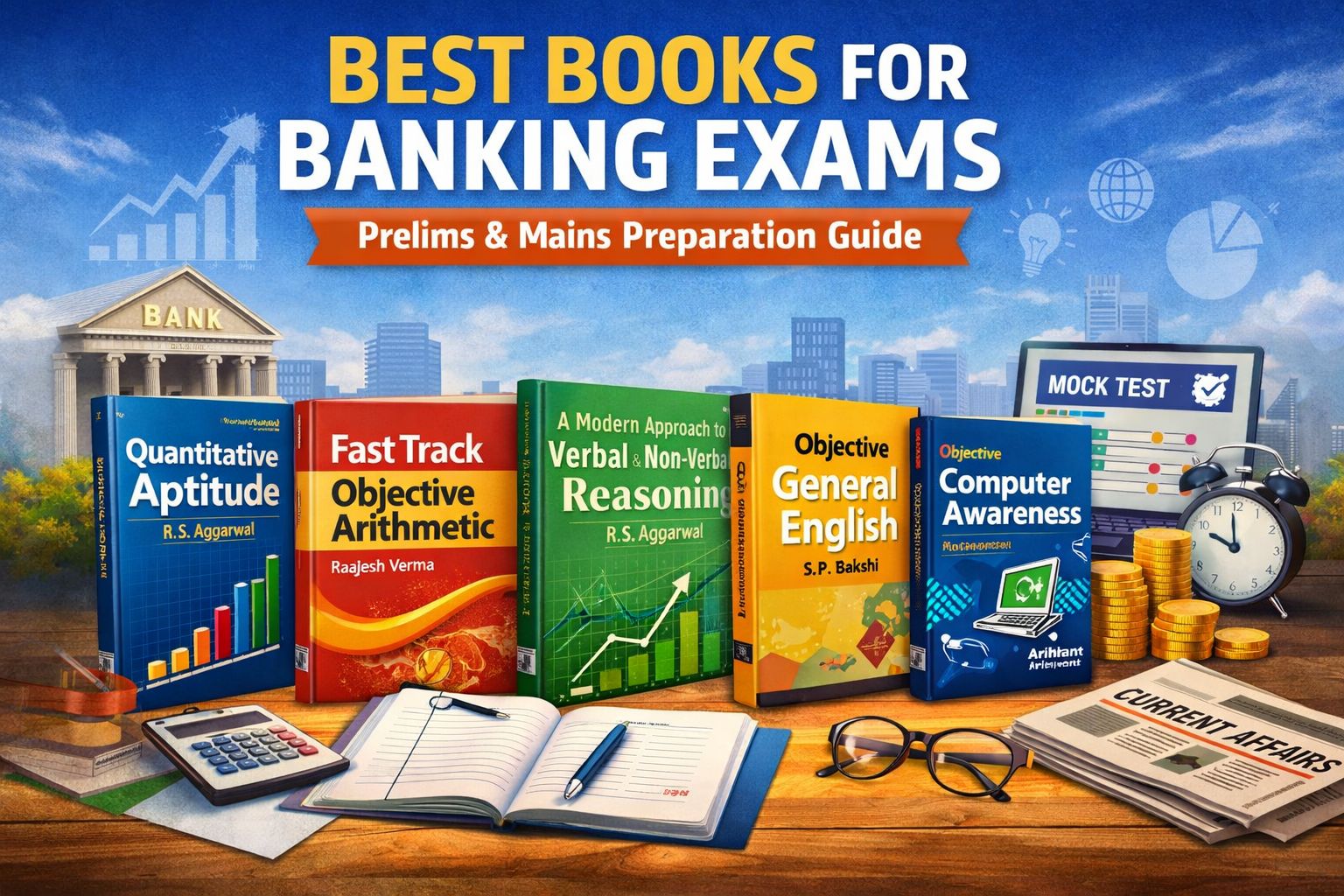
Start Your Banking Exam Preparation with the Right Books
Boost your chances of success with expert-recommended books for SBI, IBPS & RBI exams — Prelims + Mains preparation.
View Best Banking Exam BooksBanking Exam Pattern Overview
To prepare effectively for any banking recruitment examination, candidates must first understand the complete banking exam pattern followed by major organizations such as IBPS, SBI, and RRB. The exam pattern provides clarity regarding the number of sections, total marks, duration of the exam, and the marking scheme used for evaluation.
Most banking exams are conducted in two stages — Preliminary Examination (Prelims) and Main Examination (Mains). Each stage has a different structure and level of difficulty.
Prelims Exam Structure
The Preliminary Examination is the first stage of the banking exam selection process. It is conducted online and is qualifying in nature, which means that the marks obtained in this stage are not considered for final merit but are important for shortlisting candidates for the Mains exam.
The Prelims exam usually consists of three sections:
| Section Name | Number of Questions | Maximum Marks | Time Duration |
|---|---|---|---|
| English Language | 30 | 30 | 20 Minutes |
| Quantitative Aptitude | 35 | 35 | 20 Minutes |
| Reasoning Ability | 35 | 35 | 20 Minutes |
| Total | 100 Questions | 100 Marks | 60 Minutes |
Each section has a separate time limit, and candidates must attempt the questions within the allotted time for each section.
Negative Marking:
For every incorrect answer, one-fourth (0.25) of the marks assigned to that question is deducted as a penalty.
Mains Exam Structure
Candidates who qualify for the Prelims exam are eligible to appear for the Mains examination. The Mains exam is more detailed and tests a candidate’s analytical ability, awareness of banking and financial concepts, and overall aptitude.
The Mains exam generally includes the following sections:
| Section Name | Number of Questions | Maximum Marks | Time Duration |
|---|---|---|---|
| Reasoning Ability & Computer Aptitude | 45 | 60 | 60 Minutes |
| Data Analysis & Interpretation | 35 | 60 | 45 Minutes |
| General / Economy / Banking Awareness | 40 | 40 | 35 Minutes |
| English Language | 35 | 40 | 40 Minutes |
| Total | 155 Questions | 200 Marks | 180 Minutes |
Some banking exams like SBI PO may also include a descriptive test (Essay and Letter Writing) after the objective test.
Understanding this exam pattern helps candidates manage their time efficiently during the examination and allows them to prepare section-wise according to the marks distribution and difficulty level.
Banking Exam Prelims Syllabus
The Preliminary Examination is the first stage of the banking recruitment process and is designed to evaluate a candidate’s basic aptitude skills. The Prelims syllabus is common across most major banking exams such as IBPS PO, IBPS Clerk, SBI PO, SBI Clerk, and RRB Assistant. This stage focuses on testing speed, accuracy, and fundamental problem-solving ability.
The Prelims exam consists of three major sections:
- Quantitative Aptitude
- Reasoning Ability
- English Language
A clear understanding of the section-wise syllabus helps candidates prepare systematically and improve their performance in this qualifying stage.
1. Quantitative Aptitude
The Quantitative Aptitude section tests a candidate’s numerical ability and mathematical problem-solving skills. Questions are generally based on basic arithmetic concepts and require both speed and accuracy.
Important Topics Covered:
- Simplification and Approximation
- Number Series (Missing and Wrong Number Series)
- Quadratic Equations
- Data Interpretation (Table, Bar Graph, Pie Chart, Line Graph)
- Ratio and Proportion
- Percentage
- Profit and Loss
- Simple Interest and Compound Interest
- Time and Work
- Time, Speed and Distance
- Average
- Mixture and Allegation
- Partnership
- Problems on Ages
- Probability
- Permutation and Combination (Basic Level)
Candidates are advised to practice calculation-based questions regularly to improve their accuracy and reduce the time taken to solve problems.
2. Reasoning Ability
The Reasoning Ability section evaluates logical thinking, decision-making skills, and analytical ability. This section usually includes both verbal and non-verbal reasoning questions.
Important Topics Covered:
- Puzzles (Floor-based, Box-based, Scheduling, Seating Arrangement)
- Seating Arrangement (Circular and Linear)
- Syllogism
- Coding-Decoding
- Blood Relations
- Direction Sense Test
- Inequality
- Order and Ranking
- Alphabet and Number Series
- Data Sufficiency
- Input-Output (Basic Level)
- Logical Reasoning Questions
Regular practice of puzzles and seating arrangement questions is essential, as they carry significant weightage in the exam.
3. English Language
The English Language section tests a candidate’s understanding of grammar, vocabulary, and reading comprehension skills.
Important Topics Covered:
- Reading Comprehension
- Cloze Test
- Fill in the Blanks
- Error Detection
- Sentence Improvement
- Sentence Rearrangement (Para Jumbles)
- Vocabulary-based Questions
- Synonyms and Antonyms
- Sentence Completion
- Phrase Replacement
Developing a habit of reading newspapers and practicing grammar exercises can help candidates perform better in this section.
Banking Exam Mains Syllabus
The Main Examination is the most important stage of the banking recruitment process, as the marks obtained in this exam are considered for final selection in most banking posts such as Probationary Officer (PO) and Clerk. The Mains syllabus is more advanced than the Prelims and is designed to test a candidate’s analytical thinking, conceptual clarity, and awareness of banking and financial concepts.
The Mains exam generally includes the following sections:
- Data Analysis and Interpretation
- General / Economy / Banking Awareness
- Reasoning Ability and Computer Aptitude
- English Language
A detailed understanding of each section is essential for scoring well in the Mains examination.
1. Data Analysis and Interpretation
This section evaluates a candidate’s ability to analyze complex data and solve numerical problems based on graphical and tabular information. The questions are generally calculation-intensive and require strong conceptual understanding.
Important Topics Covered:
- Data Interpretation (Table, Pie Chart, Bar Graph, Line Graph, Caselet DI)
- Data Sufficiency
- Probability
- Permutation and Combination
- Quantity Comparison
- Missing Data Interpretation
- Arithmetic-based Data Interpretation
- Simplification and Approximation
- Ratio and Proportion
- Percentage
- Profit and Loss
- Time and Work
- Simple and Compound Interest
2. General / Financial Awareness
This section tests the candidate’s knowledge of current affairs related to banking, finance, and the economy. Questions are generally based on recent developments in the financial sector as well as basic banking concepts.
Important Topics Covered:
- Current Affairs related to Banking and Economy
- Indian Financial System
- Banking Terminology
- Monetary Policy
- Important Government Schemes
- National and International Financial Institutions
- Reserve Bank of India (RBI) and its Functions
- Budget and Economic Survey
- Static Banking Awareness
- Financial Market Concepts
Regular reading of financial news and monthly current affairs updates is recommended for this section.
3. Reasoning Ability and Computer Aptitude
This section combines logical reasoning skills with basic knowledge of computer fundamentals.
Important Topics Covered (Reasoning):
- Advanced Seating Arrangement
- Puzzles (High-Level)
- Logical Reasoning
- Input-Output
- Data Sufficiency
- Statement and Assumption
- Statement and Conclusion
- Course of Action
- Critical Reasoning
- Inequality
- Order and Ranking
Important Topics Covered (Computer Aptitude):
- Basic Computer Fundamentals
- Input and Output Devices
- Operating Systems
- Computer Memory
- Internet Basics
- Networking
- MS Office (Word, Excel, PowerPoint)
- Computer Abbreviations
- Cyber Security Basics
4. English Language
The English Language section in the Mains exam is more advanced and focuses on comprehension and communication skills.
Important Topics Covered:
- Reading Comprehension (Advanced Level)
- Cloze Test
- Para Jumbles
- Sentence Correction
- Vocabulary-based Questions
- Error Detection
- Fill in the Blanks
- Match the Following
- Word Usage
- Sentence Connectors
Strong reading habits and consistent grammar practice are necessary to perform well in this section.
Detailed Section-Wise Topics for Banking Exams
To score well in banking exams, it is important to go beyond the basic syllabus and understand the most frequently asked topics from each section. Knowing the high-weightage topics helps candidates prioritize their preparation and allocate time more efficiently.
Below is a detailed breakdown of important topics from each major section of banking exams.
Important Topics from Quantitative Aptitude
The Quantitative Aptitude section focuses on numerical problem-solving and data interpretation skills. Questions are usually based on real-life mathematical applications.
High-Weightage Topics:
- Simplification and Approximation
- Number Series (Missing and Wrong Pattern)
- Quadratic Equations
- Data Interpretation (Bar Graph, Pie Chart, Line Graph, Caselet)
- Percentage
- Ratio and Proportion
- Profit and Loss
- Simple Interest and Compound Interest
- Time and Work
- Time, Speed and Distance
- Average
- Partnership
- Mixture and Allegation
- Problems on Ages
- Probability
- Permutation and Combination
Candidates should focus on improving calculation speed and accuracy while practicing these topics.
Important Topics from Reasoning Ability
The Reasoning section tests logical thinking and analytical skills. Puzzle-based questions form a major portion of this section.
High-Weightage Topics:
- Seating Arrangement (Circular and Linear)
- Floor-based Puzzles
- Scheduling Puzzles
- Coding-Decoding
- Syllogism
- Blood Relations
- Direction Sense Test
- Inequality
- Order and Ranking
- Alphabet and Number Series
- Input-Output
- Data Sufficiency
- Statement and Conclusion
- Statement and Assumption
- Logical Reasoning Questions
Regular practice of puzzles is highly recommended, as they are frequently asked in both Prelims and Mains exams.
Important Topics from English Language
The English Language section evaluates comprehension, grammar, and vocabulary skills.
High-Weightage Topics:
- Reading Comprehension
- Cloze Test
- Error Detection
- Sentence Improvement
- Fill in the Blanks
- Para Jumbles
- Sentence Rearrangement
- Vocabulary-based Questions
- Synonyms and Antonyms
- Phrase Replacement
- Sentence Completion
Reading newspapers, editorials, and practicing grammar exercises daily can improve performance in this section.
Important Topics from General Awareness
This section mainly focuses on current affairs related to banking, finance, and the economy.
High-Weightage Topics:
- Current Affairs (Last 4–6 Months)
- Banking and Financial Awareness
- RBI Policies and Functions
- Government Schemes
- Budget and Economic Survey
- Static Banking Awareness
- National and International Financial Institutions
- Important Appointments
- Financial Market Terms
- Banking Abbreviations
Keeping track of financial news and monthly current affairs updates is essential for this section.
Banking Preparation Strategy Based on Syllabus
Once you understand the complete syllabus, the next step is to create an effective banking preparation strategy that allows you to cover all sections systematically. A well-planned preparation strategy helps candidates manage their time efficiently and focus on improving weak areas without neglecting their strengths.
Below are some practical preparation strategies based on the banking exam syllabus.
How to Divide Your Study Time
Candidates should divide their daily study schedule according to the difficulty level of each section.
Suggested Time Allocation:
- Quantitative Aptitude – 2 to 3 Hours
- Reasoning Ability – 2 to 3 Hours
- English Language – 1 to 2 Hours
- General Awareness – 1 Hour
- Mock Test Practice – 1 Hour
Regular revision should also be included in the study schedule to retain previously learned concepts.
Section-Wise Preparation Tips
Quantitative Aptitude:
- Focus on basic concepts before solving advanced problems
- Practice Data Interpretation questions daily
- Learn shortcut methods to save time
- Work on improving calculation speed
Reasoning Ability:
- Start with basic puzzles and gradually move to high-level puzzles
- Practice seating arrangement questions regularly
- Improve logical thinking through daily practice
- Solve previous year questions to understand the exam pattern
English Language:
- Read newspapers and editorials daily
- Practice grammar exercises regularly
- Improve vocabulary through word lists
- Attempt reading comprehension passages frequently
General Awareness:
- Follow banking and financial news updates
- Read monthly current affairs magazines
- Revise static banking awareness topics
- Focus on RBI-related updates and government schemes
Study Planning Method
- Create a weekly and monthly study plan
- Identify strong and weak subjects
- Spend more time improving weaker sections
- Attempt full-length mock tests regularly
- Analyze mock test performance to track progress
- Revise important formulas and concepts weekly
Consistency and regular practice are the key factors for success in banking examinations. Candidates who follow a structured preparation strategy based on the syllabus are more likely to clear both Prelims and Mains exams successfully.
Best Books for Banking Exams Preparation
Choosing the right study material is an important part of your preparation journey. Referring to reliable and exam-oriented study resources can help you understand concepts clearly and improve your problem-solving skills. Candidates should always select the best books for banking exams that cover the complete syllabus for both Prelims and Mains stages.
Below are some commonly recommended books for different sections of banking exams.
Recommended Books for Quantitative Aptitude
- Quantitative Aptitude for Competitive Examinations
- Fast Track Objective Arithmetic
- Magical Book on Quicker Maths
- Data Interpretation Practice Sets
These books help in building strong mathematical fundamentals and improving calculation speed for solving numerical problems.
Recommended Books for Reasoning Ability
- A Modern Approach to Verbal and Non-Verbal Reasoning
- Analytical Reasoning Practice Book
- Puzzle and Seating Arrangement Practice Sets
Regular practice from these books can improve logical thinking and help in solving high-level puzzles asked in banking exams.
Recommended Books for English Language
- Objective General English
- High School English Grammar and Composition
- English Vocabulary Practice Book
These books are useful for strengthening grammar, comprehension, and vocabulary skills required for both Prelims and Mains exams.
Recommended Books for General Awareness
- Banking Awareness Guide
- Monthly Current Affairs Magazine
- Financial Awareness Practice Book
Candidates should also stay updated with banking and financial news to perform well in the General Awareness section.
Referring to the right books along with regular mock test practice can significantly improve your chances of clearing banking exams.
Common Mistakes to Avoid While Preparing for Banking Exams
Many banking exam aspirants prepare for months but still fail to clear the examination due to avoidable mistakes in their preparation approach. Being aware of these common errors can help candidates improve their study strategy and increase their chances of success in both Prelims and Mains exams.
Below are some of the most common mistakes that candidates should avoid during banking exam preparation:
Not Understanding the Complete Syllabus
One of the biggest mistakes is starting preparation without having a clear understanding of the complete syllabus. This often leads to studying irrelevant topics and wasting valuable time. Candidates should always go through the official syllabus before beginning their preparation.
Ignoring the Exam Pattern
Many candidates focus only on studying topics and ignore the exam pattern, including sectional timing and marking scheme. Understanding the structure of the exam helps in time management and improves performance during the actual test.
Lack of Proper Study Plan
Preparing without a structured study plan can result in incomplete syllabus coverage. Candidates should create a realistic daily and weekly study schedule and follow it consistently.
Avoiding Mock Tests
Mock tests play a crucial role in banking exam preparation. Candidates who do not attempt regular mock tests often struggle with time management and accuracy in the real exam. Attempting and analyzing mock tests helps in identifying weak areas.
Not Revising Regularly
Many aspirants focus on learning new topics but neglect revision. Regular revision is essential to retain formulas, concepts, and important facts.
Ignoring Weak Sections
Some candidates spend most of their time practicing their favorite subjects while ignoring weaker sections. This can be risky, as banking exams have sectional cut-offs. Equal attention should be given to all subjects.
Depending Only on Theory
Banking exams require speed and accuracy, which can only be developed through practice. Candidates should solve practice questions daily instead of relying only on theoretical knowledge.
Avoiding these common mistakes can help candidates prepare more effectively and improve their chances of clearing banking exams successfully.
Frequently Asked Questions (FAQs)
Q1. Is the banking exam syllabus the same for IBPS, SBI, and RRB exams?
Yes, the basic banking exam syllabus is almost the same for IBPS, SBI, and RRB exams. The topics covered in Quantitative Aptitude, Reasoning Ability, English Language, and General Awareness remain similar. However, the level of difficulty and exam pattern may vary slightly depending on the specific exam.
Q2. What is the difference between Prelims and Mains syllabus in banking exams?
The Prelims syllabus focuses on basic aptitude skills such as numerical ability, reasoning, and English language. On the other hand, the Mains syllabus includes advanced topics along with sections like Data Interpretation, Banking Awareness, Financial Awareness, and Computer Aptitude.
Q3. Are marks of the Prelims exam considered in the final selection?
In most banking exams, the Prelims exam is qualifying in nature. The marks obtained in this stage are not counted in the final merit list. Only the marks obtained in the Mains exam (and interview for certain posts like PO) are considered for final selection.
Q4. How much time is required to complete the banking exam syllabus?
The time required to complete the banking exam syllabus depends on the candidate’s existing knowledge and daily study routine. On average, it may take around 3 to 6 months of consistent preparation to cover the entire syllabus effectively.
Q5. Is computer knowledge compulsory for banking exams?
Yes, basic computer knowledge is important for banking exams, especially for the Mains stage where Computer Aptitude is included as a separate section or combined with Reasoning Ability.
Start Your Banking Exam Preparation with the Right Books
Boost your chances of success with expert-recommended books for SBI, IBPS & RBI exams — Prelims + Mains preparation.
View Best Banking Exam BooksConclusion
Understanding the complete banking exam syllabus for both Prelims and Mains is essential for effective preparation. A clear knowledge of the subjects, important topics, and exam structure helps candidates plan their studies in a systematic manner and avoid unnecessary confusion during preparation.
By following the latest banking exam pattern and preparing according to the detailed syllabus, candidates can improve their speed, accuracy, and overall performance in the examination. Creating a well-planned banking preparation strategy based on section-wise strengths and weaknesses can further increase the chances of clearing both Prelims and Mains exams.
In addition, referring to the best books for banking exams along with regular mock test practice and revision can help candidates build strong conceptual clarity and confidence before the examination.
Consistent practice, proper time management, and a focused preparation approach are the key factors for success in any banking recruitment examination.