
Banking exams in India are popular government job tests that offer stable careers, good salaries, and long-term growth for graduates from any stream.
Introduction to Banking Exams in India
Banking exams in India are competitive examinations conducted to recruit candidates for various posts in government and public sector banks. These exams are organized by different authorities such as the Institute of Banking Personnel Selection (IBPS), State Bank of India (SBI), and the Reserve Bank of India (RBI). Every year, lakhs of students appear for these exams to secure stable and respected jobs in the banking sector.
A banking exam is the primary selection method used by banks to recruit candidates for positions like Probationary Officer (PO), Clerk, Specialist Officer (SO), and Assistant. These exams test a candidate’s aptitude, reasoning ability, English language skills, general awareness, and basic computer knowledge.
Banking jobs are among the most popular government job options in India. Many students prefer banking careers because of job security, fixed working hours, good salary, and career growth opportunities. Unlike some other government jobs, banking exams are conducted regularly every year, which gives candidates multiple opportunities to succeed.
In India, banks are broadly divided into three main categories:
1. Public Sector Banks (PSBs)
These banks are owned and operated by the Government of India. Most banking exams, such as IBPS and SBI exams, recruit candidates for these banks.
2. Private Sector Banks
These banks are owned by private companies or shareholders. They usually conduct their own recruitment process instead of common competitive exams.
3. Regional Rural Banks (RRBs)
These banks focus on providing banking services in rural and semi-urban areas. Recruitment for RRBs is mainly conducted through IBPS.
Banking exams provide opportunities for graduates from any stream to enter the financial sector. With proper preparation and a clear strategy, candidates can secure a stable and rewarding career in banking.
Start Your Banking Exam Preparation with the Right Books
Boost your chances of success with expert-recommended books for SBI, IBPS & RBI exams — Prelims + Mains preparation.
View Best Banking Exam BooksWhy Choose a Banking Career
A banking career is one of the most preferred career options among graduates in India. Every year, a large number of candidates prepare for banking exams because these jobs offer stability, good income, and long-term growth. For many aspirants, a banking job is not just employment but a secure and respected career path.
Job Security
Public sector bank jobs are considered highly secure. Once selected, employees enjoy long-term stability with very low risk of sudden job loss. This is one of the biggest reasons why banking exams attract millions of candidates every year.
Attractive Salary and Allowances
Bank employees receive a decent starting salary along with multiple allowances. These may include:
- Dearness Allowance (DA)
- House Rent Allowance (HRA)
- Travel Allowance
- Medical benefits
- Pension and retirement benefits
The salary increases regularly through increments and promotions, making banking a financially stable career option.
Work–Life Balance
Compared to many private sector jobs, banking jobs usually have fixed working hours. Most public sector banks follow a five-day working week, which gives employees time for family, personal growth, and relaxation.
Promotion and Career Growth
Banking offers clear promotion paths. An employee who joins as a Clerk or Probationary Officer can rise to higher positions such as:
- Assistant Manager
- Branch Manager
- Regional Manager
- General Manager
Promotions are based on experience, performance, and internal exams.
Social Respect and Stability
Bank jobs are highly respected in society. Employees are seen as financially stable and responsible professionals. This makes banking a preferred career choice, especially for candidates who want a secure and respected position.
Opportunities for All Streams
One of the biggest advantages of banking exams is that candidates from any graduation stream—Arts, Commerce, or Science—can apply. There is no requirement for a specific subject background in most banking exams.
Overall, a banking career offers the perfect combination of job security, steady income, career growth, and work–life balance. This makes banking exams one of the top choices for government job aspirants in India.
List of Banking Exams in India (Major Exams)
There are several banking exams conducted in India every year for different posts such as Probationary Officer, Clerk, Assistant, and Specialist Officer. These exams are organized by national-level banking authorities and provide opportunities in public sector banks, regional rural banks, and financial institutions.
Below is a list of banking exams that are considered the most important and popular among candidates.
1. IBPS Exams
The Institute of Banking Personnel Selection (IBPS) conducts recruitment exams for most public sector banks in India (except SBI). These exams are conducted annually.
Major IBPS exams include:
IBPS PO (Probationary Officer)
This exam is conducted to recruit officers in public sector banks. It is one of the most popular banking exams and offers good salary, growth, and responsibilities.
IBPS Clerk
This exam is conducted to recruit clerical staff in public sector banks. Clerks handle customer services, account management, and day-to-day banking operations.
IBPS RRB (Regional Rural Banks)
IBPS conducts this exam to recruit candidates for rural banks across India. It includes:
- RRB Office Assistant (Clerk)
- RRB Officer Scale I (PO)
IBPS Specialist Officer (SO)
This exam is for candidates with professional qualifications in specific fields such as:
- IT Officer
- Marketing Officer
- HR Officer
- Law Officer
- Agriculture Officer
2. SBI Exams
The State Bank of India (SBI) conducts its own recruitment exams separately from IBPS.
SBI PO
This exam is conducted to recruit Probationary Officers in SBI. It is considered one of the most competitive banking exams in India.
SBI Clerk
This exam is conducted to recruit Junior Associates (Clerks) in SBI branches across the country.
3. RBI Exams
The Reserve Bank of India (RBI) conducts exams for recruitment in the central banking institution of the country. These are among the most prestigious banking exams.
RBI Grade B
This exam recruits officers in the RBI. It offers excellent salary, benefits, and career growth.
RBI Assistant
This exam is conducted to recruit assistants for clerical-level work in RBI offices.
4. Other Banking and Financial Exams
Apart from IBPS, SBI, and RBI, some other institutions also conduct banking-related exams.
NABARD Exams
The National Bank for Agriculture and Rural Development conducts exams for Grade A and Grade B officers.
SIDBI Exams
The Small Industries Development Bank of India conducts exams to recruit officers for development banking roles.
Cooperative Bank Exams
Various state cooperative banks conduct their own recruitment exams for clerks and officers.
These exams are conducted regularly throughout the year, giving candidates multiple opportunities to enter the banking sector. Each exam has its own eligibility criteria, exam pattern, and syllabus, but the core subjects remain almost the same.
Banking Exam Eligibility Criteria
Before applying for any banking exam, candidates must check the banking exam eligibility conditions. Although the exact requirements may vary slightly depending on the exam and the organization, the basic eligibility criteria are almost the same for most major banking exams like IBPS, SBI, and RBI.
1. Educational Qualification
For most banking exams, the minimum educational qualification is:
- A graduate degree in any discipline from a recognized university.
- Candidates from Arts, Commerce, or Science streams can apply.
- There is no minimum percentage requirement in most exams.
Final-year students:
In some exams, final-year students can apply, but they must produce their graduation certificate before the final selection or joining date.
2. Age Limit
The age limit varies depending on the exam and the post.
Common age limits:
- Clerk exams: 20 to 28 years
- PO exams: 20 to 30 years
- RBI Grade B: 21 to 30 years
Age relaxation is provided for reserved categories:
- OBC: 3 years
- SC/ST: 5 years
- PwD: 10 years
- Ex-servicemen: As per government rules
The exact age criteria should always be checked in the official notification of the specific exam.
3. Nationality
To apply for most banking exams, a candidate must be:
- A citizen of India, or
- A subject of Nepal or Bhutan, or
- A Tibetan refugee who came to India before January 1, 1962, with the intention of permanent settlement, or
- A person of Indian origin who migrated from certain countries with the intention of permanently settling in India (as per official rules).
Candidates belonging to these categories must have the required eligibility certificate issued by the Government of India.
These are the basic eligibility conditions for most banking exams. However, candidates should always read the official notification carefully, as specific exams may have additional requirements.
Banking Exam Selection Process
The banking selection process usually follows a multi-stage system designed to test a candidate’s aptitude, knowledge, and personality. Although the exact process may vary slightly between exams, the general structure is similar for most major banking exams like IBPS, SBI, and RBI.
The selection process usually includes three main stages.
1. Preliminary Examination (Prelims)
The Preliminary Exam is the first stage of the selection process. It is a screening test used to shortlist candidates for the next stage.
Common features of the Prelims:
- Objective-type questions (multiple choice)
- Conducted online
- Short duration, usually around 1 hour
- Sections typically include:
- English Language
- Reasoning Ability
- Quantitative Aptitude
The marks obtained in the prelims are usually not counted in the final merit list. This stage only decides whether a candidate qualifies for the mains exam.
2. Main Examination (Mains)
Candidates who clear the prelims appear for the Main Examination. This is the most important stage of the selection process.
Common features of the Mains exam:
- Higher difficulty level than prelims
- Multiple sections with sectional timing
- Includes subjects such as:
- Reasoning Ability
- Quantitative Aptitude or Data Analysis
- English Language
- General/Banking Awareness
- Computer Knowledge
In most exams, mains marks are counted in the final selection.
3. Interview or Language Test
This stage applies mainly to officer-level posts such as PO or Specialist Officer.
Interview:
- Conducted for PO, SO, and some officer-level exams
- Tests communication skills, personality, and banking awareness
- Usually carries a specific weightage in the final merit
Language Proficiency Test (LPT):
- Mostly for clerk-level posts
- Tests knowledge of the local language of the state
- Required to ensure the candidate can interact with customers
4. Final Merit List
The final selection is based on the combined performance of the candidate.
Typical final selection method:
- For PO: Mains marks + Interview marks
- For Clerk: Mains marks only (in most cases)
Candidates who rank high in the final merit list are allotted banks and joining locations based on their preferences and vacancies.
Banking Exam Syllabus (Common Subjects)
The banking exam syllabus is mostly similar across major exams such as IBPS, SBI, and RBI. Although the exam pattern may vary slightly, the core subjects remain almost the same. These exams are designed to test a candidate’s aptitude, reasoning ability, language skills, and awareness of current events and banking concepts.
Below are the main subjects included in the banking exam syllabus.
1. Quantitative Aptitude
This section tests a candidate’s numerical ability and problem-solving skills. Questions are usually based on basic mathematics and data interpretation.
Important topics:
- Simplification and approximation
- Number series
- Percentage
- Profit and loss
- Ratio and proportion
- Simple and compound interest
- Time and work
- Time, speed, and distance
- Average
- Data interpretation (tables, graphs, charts)
2. Reasoning Ability
The reasoning section checks logical thinking and analytical skills. It is considered one of the most scoring sections if practiced regularly.
Important topics:
- Puzzles and seating arrangement
- Syllogism
- Coding–decoding
- Blood relations
- Direction sense
- Inequality
- Alphabet and number series
- Input–output
- Logical reasoning
3. English Language
This section evaluates a candidate’s understanding of English grammar, vocabulary, and comprehension.
Important topics:
- Reading comprehension
- Cloze test
- Error detection
- Sentence improvement
- Fill in the blanks
- Para jumbles
- Vocabulary-based questions
4. General Awareness (Banking and Current Affairs)
This section tests knowledge of current events and basic banking concepts. It is especially important for the mains exam.
Important topics:
- Current affairs (last 4–6 months)
- Banking and financial awareness
- Important government schemes
- Static general knowledge
- National and international events
- RBI policies and updates
5. Computer Knowledge
This section checks basic computer awareness. It is usually easy and scoring for candidates who know the fundamentals.
Important topics:
- Basics of computers
- Input and output devices
- MS Office (Word, Excel, PowerPoint)
- Internet and email
- Computer shortcuts
- Basic hardware and software concepts
The syllabus remains largely the same across different banking exams, but the difficulty level and weightage of sections may vary. Candidates should always check the official notification of the exam they are targeting.
Banking Exam Pattern (Prelims & Mains Overview)
The banking exam pattern for most banking exams is similar across IBPS, SBI, and other major recruitment bodies. Although the exact structure may vary depending on the post and organization, the general pattern of Prelims and Mains remains almost the same.
Understanding the exam pattern helps candidates manage time properly and prepare each section according to its weightage.
1. Preliminary Exam Pattern (Typical Structure)
The Preliminary Exam is the first stage and is mainly a screening test. It consists of objective-type questions.
| Section | No. of Questions | Marks | Time |
|---|---|---|---|
| English Language | 30 | 30 | 20 minutes |
| Reasoning Ability | 35 | 35 | 20 minutes |
| Quantitative Aptitude | 35 | 35 | 20 minutes |
| Total | 100 | 100 | 60 minutes |
Key points:
- The exam is conducted online.
- Each section has a fixed time limit.
- There is negative marking (usually 0.25 marks deducted for each wrong answer).
- Candidates must clear sectional as well as overall cut-offs.
2. Main Exam Pattern (Typical Structure for PO)
The Main Exam is more detailed and difficult than the prelims. It tests deeper understanding and problem-solving ability.
| Section | No. of Questions | Marks | Time |
|---|---|---|---|
| Reasoning & Computer Aptitude | 45 | 60 | 60 minutes |
| Data Analysis & Interpretation | 35 | 60 | 45 minutes |
| General/Economy/Banking Awareness | 40 | 40 | 35 minutes |
| English Language | 35 | 40 | 40 minutes |
| Total | 155 | 200 | 180 minutes |
In many exams, there is also a descriptive English paper that includes:
- Essay writing
- Letter writing
3. Main Exam Pattern for Clerk (General Idea)
For clerk-level posts, the mains exam usually includes:
| Section | Questions | Marks |
|---|---|---|
| Reasoning | 50 | 60 |
| Quantitative Aptitude | 50 | 50 |
| English/Hindi Language | 40 | 40 |
| General Awareness | 50 | 50 |
| Computer Knowledge | 20 | 20 |
| Total | 190 | 200 |
4. Negative Marking
Most banking exams follow a standard negative marking system:
- 0.25 marks are deducted for every wrong answer.
- No penalty for unanswered questions.
The exam pattern may differ slightly depending on the exam and year, but the overall structure remains similar. Candidates should always check the official notification for the exact pattern.
Salary and Job Profile in Banking
Banking jobs are popular not only because of job security but also due to attractive salaries, allowances, and promotion opportunities. The exact salary may vary depending on the post, bank, and location, but overall, banking jobs offer stable and respectable income.
1. Probationary Officer (PO) Salary
A Probationary Officer is an entry-level officer in a bank. It is one of the most sought-after posts in banking exams.
Basic salary of a PO:
- Approximately ₹36,000 to ₹41,000 per month (basic pay)
Gross monthly salary:
- Around ₹52,000 to ₹60,000 (including allowances)
Major allowances include:
- Dearness Allowance (DA)
- House Rent Allowance (HRA)
- Special Allowance
- Travel Allowance
- Medical benefits
The salary may vary depending on the city and bank policies.
2. Clerk Salary
A bank clerk handles customer-related tasks and daily banking operations. It is considered a stable and less stressful job compared to officer-level posts.
Basic salary of a Clerk:
- Around ₹19,000 to ₹21,000 per month (basic pay)
Gross monthly salary:
- Approximately ₹28,000 to ₹32,000 (including allowances)
Clerks also receive benefits such as:
- DA and HRA
- Medical facilities
- Travel concessions
- Pension benefits (as per rules)
3. Job Profile of a PO
A Probationary Officer performs various administrative and financial tasks in the bank.
Main responsibilities:
- Managing customer accounts
- Approving loans and advances
- Supervising clerical staff
- Handling cash and transactions
- Solving customer issues
- Learning different banking operations during probation
After the probation period, the PO is confirmed as an Assistant Manager.
4. Job Profile of a Clerk
A clerk is mainly responsible for front-desk operations and customer service.
Main responsibilities:
- Opening new accounts
- Updating passbooks
- Handling cash deposits and withdrawals
- Assisting customers with banking services
- Maintaining records and documents
Clerks usually work directly with customers on a daily basis.
5. Career Growth in Banking
Banking jobs offer clear promotion paths.
Typical promotion path for a Clerk:
- Clerk
- Officer (through internal exam)
- Assistant Manager
- Branch Manager
Typical promotion path for a PO:
- Probationary Officer
- Assistant Manager
- Branch Manager
- Regional Manager
- General Manager
Promotions are based on experience, performance, and internal exams.
Banking Preparation Strategy for Beginners
A clear banking preparation strategy is essential for success in competitive exams. Many candidates fail not because they are weak in studies, but because they do not follow a proper plan. A smart and consistent strategy can help even an average student crack banking exams.
Below is a simple and effective preparation strategy for beginners.
1. Understand the Exam First
Before starting preparation, candidates should understand:
- The exam pattern
- The subjects and syllabus
- The difficulty level
- The previous year cut-offs
This helps in setting realistic goals and avoiding unnecessary confusion during preparation.
2. Make a Practical Study Plan
A proper study plan keeps preparation organized and consistent.
Tips for making a study plan:
- Study at least 4–6 hours daily
- Divide time among all subjects
- Keep extra time for weak areas
- Set weekly and monthly targets
Consistency is more important than studying for long hours irregularly.
3. Choose the Right Books and Resources
Using too many books creates confusion. It is better to follow a limited number of trusted books and resources.
Basic approach:
- One book per subject
- One monthly current affairs source
- One mock test platform
Quality matters more than quantity.
4. Start with Basics, Then Move to Practice
Beginners should first focus on understanding concepts.
Step-by-step approach:
- Learn basic concepts of each topic
- Solve simple practice questions
- Move to moderate-level questions
- Attempt full-length mock tests
This gradual approach builds confidence and accuracy.
5. Practice Mock Tests Regularly
Mock tests are the most important part of banking preparation.
Benefits of mock tests:
- Improve speed and accuracy
- Help in time management
- Show weak areas
- Build exam confidence
Candidates should start with topic-wise tests and later move to full-length mocks.
6. Focus on Current Affairs Daily
General awareness is a scoring section in banking mains exams.
Simple strategy:
- Study current affairs daily for 20–30 minutes
- Focus on the last 4–6 months before the exam
- Revise weekly and monthly
7. Revise Regularly
Revision is the key to long-term retention.
Effective revision tips:
- Revise formulas and shortcuts daily
- Maintain a small notebook for important points
- Revise current affairs weekly
Without revision, even good preparation becomes weak over time.
8. Maintain Consistency and Discipline
Success in banking exams depends more on consistency than intelligence.
Golden rules for success:
- Study daily without long breaks
- Avoid changing books frequently
- Track your progress
- Stay patient and focused
Even average students can crack banking exams with disciplined and consistent preparation.
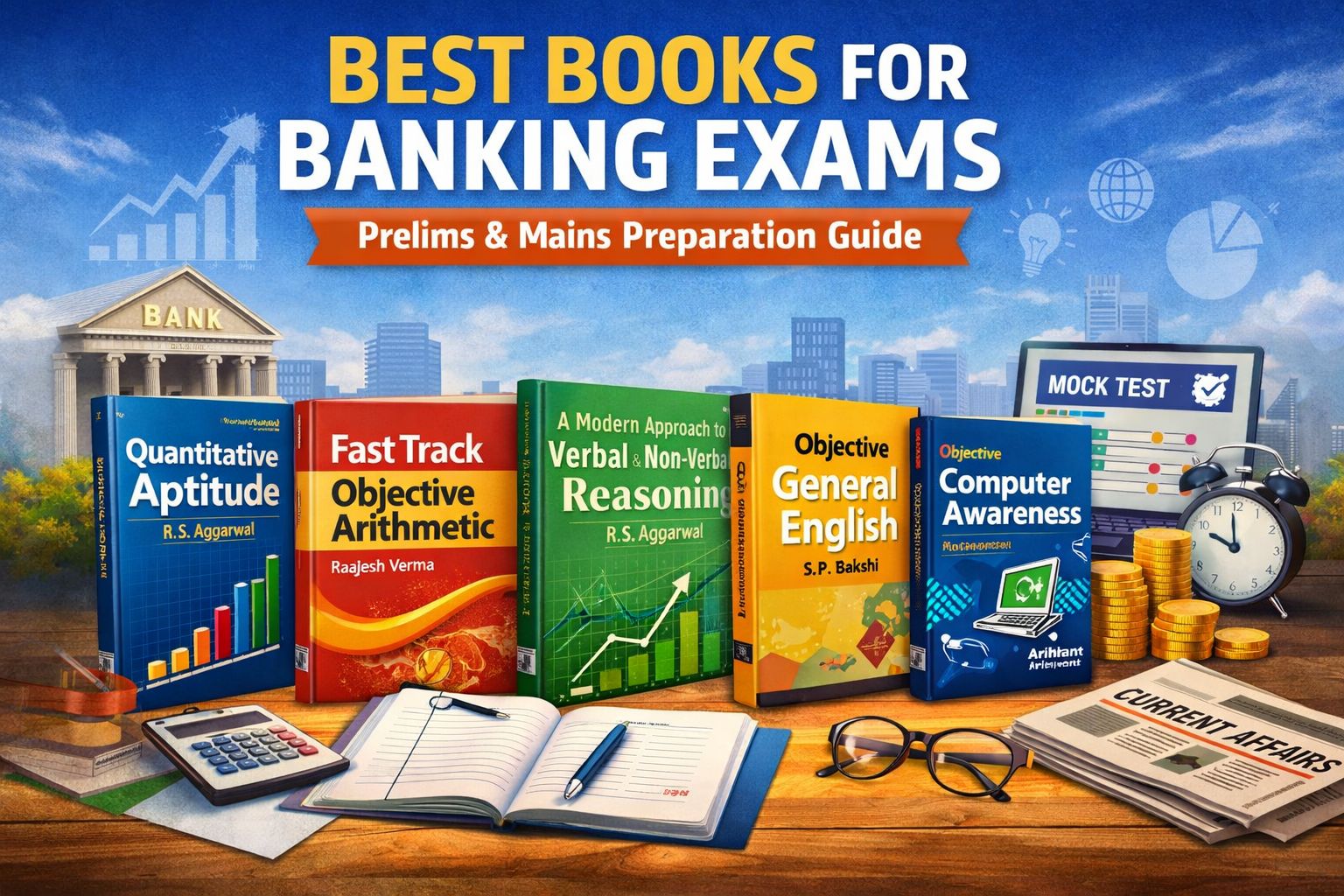
Best Books for Banking Exams
Choosing the right books is an important part of banking exam preparation. Many beginners make the mistake of using too many books, which creates confusion and slows down progress. It is always better to follow a limited number of trusted books and revise them properly.
Below are some of the most recommended books for different subjects in banking exams.
Note: Some of the links below are affiliate links. This means we may earn a small commission if you purchase through them, at no additional cost to you. This helps us maintain and update our free educational content regularly.
1. Quantitative Aptitude
Recommended books:
- Quantitative Aptitude for Competitive Examinations by R.S. Aggarwal
- Fast Track Objective Arithmetic by Rajesh Verma
Why these books:
- Clear explanation of basic concepts
- Large number of practice questions
- Suitable for beginners
2. Reasoning Ability
Recommended books:
- A Modern Approach to Verbal and Non-Verbal Reasoning by R.S. Aggarwal
- Analytical Reasoning by M.K. Pandey
Why these books:
- Covers all important reasoning topics
- Useful for both prelims and mains
- Good for building logical thinking
3. English Language
Recommended books:
Why these books:
- Helps in grammar and vocabulary
- Improves reading and comprehension skills
- Suitable for competitive exams
4. General Awareness (Banking & Current Affairs)
Recommended sources:
- Monthly current affairs magazines (any reliable source)
- Daily news from trusted websites or apps
- Banking awareness PDFs or notes
Tip:
Focus more on the last 4–6 months’ current affairs before the exam.
5. Computer Knowledge
Recommended book:
Why this book:
- Covers basic computer concepts
- Simple and exam-oriented content
- Good for beginners
Book Selection Tips
- Follow one main book per subject.
- Avoid collecting too many books.
- Revise the same book multiple times.
- Focus more on practice and mock tests.
The right combination of books, mock tests, and consistent practice can help candidates build strong concepts and improve their exam performance.
11. Common Mistakes to Avoid in Banking Preparation
Many candidates prepare for banking exams every year, but only a small percentage succeed. In most cases, failure is not due to lack of intelligence, but because of common preparation mistakes. Avoiding these mistakes can significantly increase your chances of success.
Below are some of the most common mistakes that banking aspirants should avoid.
1. Studying Without a Proper Plan
Many beginners start preparing without understanding the exam pattern or syllabus. They study randomly without a clear direction.
Why this is a problem:
- Wastes time on less important topics
- Creates confusion
- Leads to incomplete preparation
Better approach:
- Understand the exam first
- Make a realistic study plan
- Follow a fixed daily routine
2. Using Too Many Books and Resources
Some candidates collect multiple books, PDFs, and online courses for the same subject.
Why this is a mistake:
- Creates confusion
- Reduces revision time
- Slows down progress
Better approach:
- Use one main book per subject
- Follow one current affairs source
- Focus on revision instead of collecting material
3. Ignoring Mock Tests
Many students keep studying theory but avoid mock tests because they fear low scores.
Why this is a mistake:
- No practice under exam conditions
- Poor time management
- Lack of speed and accuracy
Better approach:
- Start with topic-wise tests
- Move to full-length mocks
- Analyze every test carefully
4. Weak Time Management
Some candidates spend too much time on one subject and ignore others.
Why this is a problem:
- Unbalanced preparation
- Weak performance in neglected sections
- Difficulty clearing sectional cut-offs
Better approach:
- Divide time among all subjects
- Give extra time to weak areas
- Follow a balanced study schedule
5. Not Revising Regularly
Many aspirants study new topics daily but forget to revise old ones.
Why this is a mistake:
- Concepts are forgotten over time
- Low accuracy in the exam
- Lack of confidence
Better approach:
- Revise formulas and shortcuts daily
- Keep a revision notebook
- Do weekly revision sessions
6. Ignoring Current Affairs
Some candidates focus only on maths and reasoning and ignore general awareness.
Why this is risky:
- GA is a scoring section in mains
- Can significantly increase total marks
Better approach:
- Study current affairs daily for 20–30 minutes
- Revise monthly capsules
- Focus on the last 4–6 months before the exam
7. Lack of Consistency
Many candidates study seriously for a few days and then take long breaks.
Why this is harmful:
- Breaks the study rhythm
- Reduces retention
- Delays progress
Better approach:
- Study daily, even if for fewer hours
- Maintain a fixed routine
- Stay disciplined
Avoiding these common mistakes can make your preparation more effective and increase your chances of clearing banking exams on the first attempt.
Banking Exams vs SSC Exams (Quick Comparison)
Many government job aspirants in India often get confused between banking exams and SSC exams. Both offer stable government jobs, good salaries, and long-term career growth. However, there are several differences in job nature, exam pattern, and work environment.
Below is a simple comparison to help candidates understand which option may suit them better.
1. Nature of Work
Banking Jobs:
- Customer-facing roles
- Daily interaction with account holders
- Handling cash, loans, and banking services
- Office-based work
SSC Jobs:
- Mostly administrative or clerical work
- Limited public interaction (depends on the post)
- File work, data handling, and office management
2. Work Pressure
Banking Jobs:
- Higher work pressure in many branches
- Monthly targets and deadlines
- Busy environment, especially at quarter-end
SSC Jobs:
- Generally lower work pressure
- Fixed tasks and routine office work
- More relaxed environment in many departments
3. Salary Comparison
Banking:
- PO: Higher starting salary
- Clerk: Moderate salary
SSC:
- Salary depends on post and pay level
- Some SSC posts offer better salary than banking clerks
4. Promotion and Career Growth
Banking:
- Faster promotion opportunities
- Internal exams for career growth
- Clear promotion hierarchy
SSC:
- Promotions may take longer
- Depends on department and post
- Some posts have limited growth
5. Transfer Policy
Banking:
- Frequent transfers, especially for officers
- Posting may be anywhere in India
SSC:
- Transfers depend on department
- Some posts offer stable locations
6. Exam Frequency
Banking Exams:
- Conducted almost every year
- Multiple exams (IBPS, SBI, RRB, etc.)
SSC Exams:
- Major exams conducted yearly or as per schedule
- Recruitment cycles may be longer
Quick Summary
| Factor | Banking Exams | SSC Exams |
|---|---|---|
| Work Nature | Customer-facing | Administrative |
| Work Pressure | Moderate to high | Low to moderate |
| Salary (Entry) | Good | Varies by post |
| Promotion | Faster | Slower in many posts |
| Transfers | Frequent | Depends on post |
| Exam Frequency | Regular | Yearly or irregular |
Both banking and SSC jobs are good career options. Candidates should choose based on their interest, work preference, and long-term career goals.
FAQs About Banking Exams
Q1. What is the easiest banking exam for beginners?
The difficulty level of banking exams depends on the preparation and strengths of the candidate. However, many beginners consider IBPS Clerk and RRB Clerk to be relatively easier compared to officer-level exams like IBPS PO or SBI PO.
Q2. Can a 12th pass student apply for banking exams?
No. For most major banking exams such as IBPS, SBI, and RBI, the minimum qualification is graduation from a recognized university. Candidates must complete their degree before the final selection.
Q3. How many attempts are allowed in banking exams?
There is usually no fixed limit on attempts in most banking exams. Candidates can apply as many times as they want, as long as they meet the age limit and other eligibility conditions.
Q4. Is mathematics compulsory for banking exams?
Yes, basic mathematics is an important part of banking exams. However, the level of maths is usually based on school-level concepts. With regular practice, even weak students can improve their performance.
Q5. How much time is required to prepare for banking exams?
Preparation time depends on the candidate’s current level. On average:
- Beginners may need 6 to 12 months of preparation.
- Candidates with basic knowledge may be ready in 3 to 6 months with focused study.
Q6. Are banking exams conducted every year?
Yes. Major exams like IBPS PO, IBPS Clerk, SBI PO, SBI Clerk, and IBPS RRB are conducted almost every year, giving candidates multiple chances to succeed.
Q7. Which is better: Banking or SSC jobs?
Both are good government job options. Banking offers faster promotions and higher starting salaries for officers, while SSC jobs usually offer lower work pressure and more stable postings.
Start Your Banking Exam Preparation with the Right Books
Boost your chances of success with expert-recommended books for SBI, IBPS & RBI exams — Prelims + Mains preparation.
View Best Banking Exam BooksConclusion
Banking exams in India provide one of the best career opportunities for graduates who are looking for a stable, respected, and financially secure job. With regular recruitment, clear promotion paths, and attractive salaries, the banking sector continues to be a top choice among government job aspirants.
These exams are open to candidates from all educational backgrounds, and the syllabus mainly focuses on aptitude, reasoning, English, and general awareness. With the right strategy, consistent practice, and proper time management, even beginners can crack banking exams successfully.
A candidate who prefers a professional office environment, regular income, and long-term career growth should seriously consider preparing for banking exams. The key to success is understanding the exam, following a structured preparation plan, and staying consistent throughout the journey.
If you start your preparation with the right mindset and discipline, a banking job can become a strong and secure foundation for your future career.