
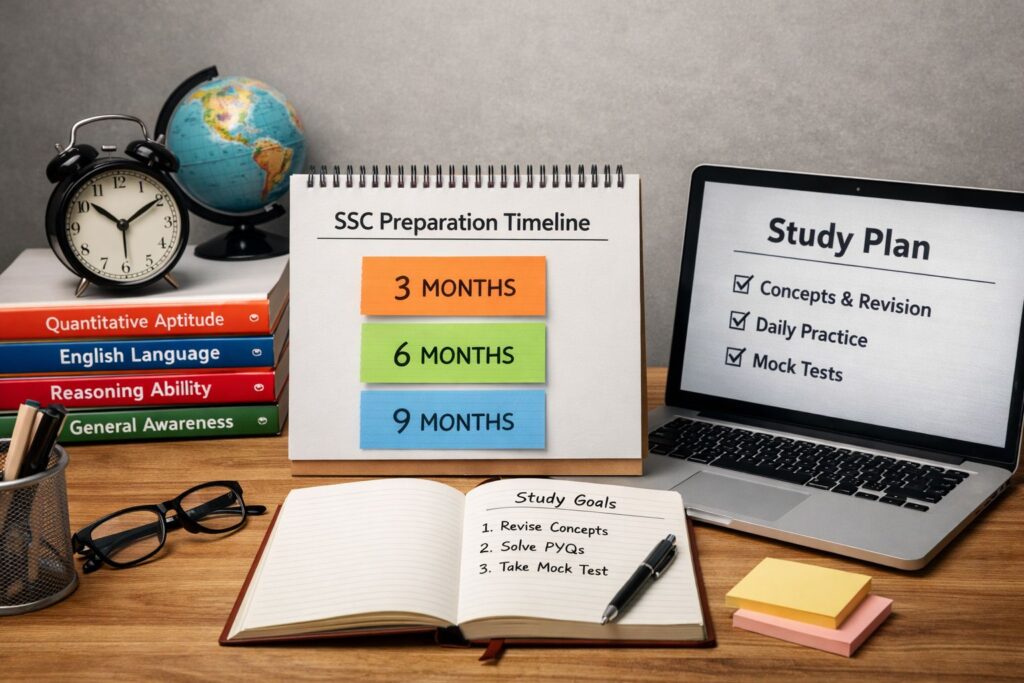
Plan your SSC exam preparation effectively with this complete 3, 6, and 9 month timeline designed for beginners, repeaters, and working aspirants.
How Much Time Do You Need to Prepare for SSC Exams? 3, 6 or 9 Months
The Staff Selection Commission (SSC) conducts some of the most popular government exams in India. Every year, lakhs of candidates apply for exams like SSC CGL, CHSL, MTS, and CPO to secure stable and respected government jobs. However, one of the biggest challenges aspirants face is how to plan their preparation time effectively.
Many students start studying without a clear timeline. Some study randomly for months, while others try to rush the entire syllabus in a few weeks. Both approaches usually lead to confusion, incomplete preparation, and low confidence during the exam.
This is where a proper SSC preparation timeline becomes very important.
A timeline helps you:
- Divide the syllabus into manageable parts
- Focus on concepts, practice, and revision at the right time
- Avoid last-minute stress
- Track your progress regularly
Not every aspirant has the same amount of time. Some candidates start preparation a year in advance, while others may only have a few months before the exam. That is why SSC preparation plans are commonly divided into three practical timelines:
3-Month Plan
- Best for repeaters or candidates with strong basics
- Suitable for those who have already studied the syllabus once
- Focuses on revision, practice, and mock tests
6-Month Plan
- Ideal for average-level students
- Provides enough time for concept building and practice
- Balanced approach between learning and testing
9-Month Plan
- Perfect for beginners starting from zero
- Allows slow and strong concept building
- Includes proper practice and multiple revision cycles
In this guide, you will find complete 3, 6, and 9 month SSC preparation timelines, along with daily routines, study strategies, and book suggestions. You can choose the plan that matches your current level and available time.
The key idea is simple:
A clear timeline with consistent effort is more powerful than long but unplanned study hours.
Choosing the Wrong SSC Books Can Ruin Your Preparation!
Don’t waste months studying from outdated or ineffective material. Check this expert-recommended list of SSC books before you start your preparation journey.
View Best Books for SSC ExamsHow to Choose the Right SSC Preparation Timeline
Before starting SSC preparation, it is important to choose a timeline that matches your current level and daily routine. Many candidates make the mistake of copying someone else’s plan without checking whether it suits their own situation. This often leads to stress, incomplete syllabus, and loss of confidence.
Your preparation timeline should depend on three main factors: your current knowledge level, available study time, and target exam.
1. Beginners vs Repeaters
Beginners
- Candidates who are starting SSC preparation for the first time
- Weak or average basics in maths, reasoning, or English
- Need more time to understand concepts
Best timeline:
A 9-month preparation plan is ideal for beginners. It gives enough time to:
- Build strong fundamentals
- Practice each topic properly
- Revise the syllabus more than once
Repeaters
- Candidates who have already prepared once
- Have basic understanding of all subjects
- Need more practice and speed improvement
Best timeline:
A 3-month or 6-month plan is usually enough for repeaters because:
- They only need revision and practice
- Concepts are already clear
- Focus can shift to mock tests and accuracy
2. Working Professionals vs Full-Time Students
Your daily routine also plays a major role in choosing the right timeline.
Working professionals
- Limited study hours (2–4 hours daily)
- Need longer preparation period
- Require a flexible and realistic plan
Best timeline:
A 6-month or 9-month plan is more practical because it:
- Reduces pressure
- Allows slow but consistent progress
- Prevents burnout
Full-time students or aspirants
- Can study 6–8 hours daily
- Faster syllabus coverage possible
- More time for practice and mock tests
Best timeline:
They can choose:
- 6 months if basics are average
- 3 months if concepts are already clear
3. Assess Your Current Preparation Level
Before choosing a timeline, ask yourself these questions:
- Do I understand basic maths concepts like percentages, ratios, and averages?
- Am I comfortable with English grammar rules?
- Have I solved SSC previous year questions before?
- Can I solve questions within time limits?
If most answers are “No”
→ Choose a 9-month plan
If answers are mixed
→ Choose a 6-month plan
If most answers are “Yes”
→ Choose a 3-month plan
4. Understand Your Target SSC Exam
Different SSC exams have different difficulty levels:
- SSC MTS: Easier level, basic preparation needed
- SSC CHSL: Moderate level
- SSC CGL: Moderate to high level
- SSC CPO: Higher competition and difficulty
If you are targeting:
- SSC CGL or CPO: Prefer 6–9 months preparation
- SSC CHSL or MTS: 3–6 months may be enough
Final Tip for Choosing the Right Timeline
Do not choose a short timeline just because it sounds impressive.
A realistic plan with consistent study is always better than an aggressive plan that you cannot follow.
Right timeline = Comfortable pace + Complete syllabus + Regular revision
Common SSC Preparation Strategy for All Timelines
No matter whether you choose a 3-month, 6-month, or 9-month plan, the core preparation method remains the same. The timeline only changes the speed of study, not the strategy itself. Many candidates fail because they keep changing their approach instead of following a clear and consistent plan.
A strong SSC preparation strategy should be simple, practical, and easy to follow every day.
The Golden Rule: Concept + Practice + Revision
Every subject in SSC should be prepared using this three-step formula:
- Concept Learning
- Understand the topic from a reliable book or class.
- Focus on basics first.
- Do not skip foundational topics.
- Practice
- Solve topic-wise questions.
- Start with easy questions, then move to moderate and difficult levels.
- Practice previous year questions regularly.
- Revision
- Revise the same topic within a few days.
- Make short notes or formulas.
- Focus on weak areas during revision.
This cycle should continue throughout your preparation.
Subject-Wise Approach
Quantitative Aptitude (Maths)
- Start with basic arithmetic topics:
- Percentages
- Ratio and proportion
- Profit and loss
- Simple and compound interest
- Practice daily to build speed and accuracy.
- Focus more on calculation techniques.
Reasoning Ability
- Start with simple topics:
- Analogy
- Series
- Coding-decoding
- Then move to:
- Puzzles
- Blood relations
- Direction sense
- Reasoning improves mainly through practice.
English Language
- Focus on:
- Grammar rules
- Vocabulary
- Reading comprehension
- Learn a few new words daily.
- Practice error detection and sentence improvement.
General Awareness
- Divide into two parts:
- Static GK (history, geography, polity, science)
- Current affairs
- Study static GK from one reliable source.
- Revise regularly instead of reading too many sources.
Ideal Daily Study Structure
A simple daily structure works best for most candidates.
For full-time students (6–8 hours daily):
- Maths: 2 hours
- Reasoning: 1.5 hours
- English: 1.5 hours
- General Awareness: 1 hour
- Revision or practice: 1–2 hours
For working candidates (3–4 hours daily):
- Maths: 1 hour
- English or Reasoning: 1 hour
- General Awareness: 30–45 minutes
- Practice or revision: remaining time
Consistency matters more than long study hours.
Weekly Revision System
At the end of every week:
- Revise all topics studied during the week.
- Solve a mixed practice set.
- Analyze mistakes carefully.
- Update your short notes.
This prevents syllabus overload and improves retention.
Importance of Mock Tests
Mock tests are the most important part of SSC preparation.
They help you:
- Improve speed and accuracy
- Understand the exam pattern
- Build confidence
- Identify weak areas
Mock test frequency:
- Early stage: 1 test every two weeks
- Mid stage: 1 test per week
- Final stage: 2–3 tests per week
Always analyze your mock test after attempting it.
Without analysis, mock tests lose most of their value.
One Important Rule: Avoid Too Many Resources
Many candidates keep changing books, teachers, and strategies. This creates confusion and slows down preparation.
Follow this rule:
- One book per subject
- One strategy
- Regular revision
- Continuous practice
Simple and consistent preparation is the real key to SSC success.
9-Month SSC Preparation Timeline (Ideal for Beginners)
The 9-month timeline is the most comfortable and effective plan for candidates who are starting from zero. It allows enough time to understand concepts, practice questions, and revise the syllabus properly.
This plan is especially suitable for:
- Complete beginners
- Candidates weak in maths or English
- Working professionals with limited study hours
- Students preparing for SSC CGL or CHSL for the first time
The 9-month timeline is divided into three clear phases.
Phase 1 (Months 1–3): Concept Building
This phase is all about building strong fundamentals. Do not rush during this stage. Focus on understanding concepts clearly.
Goals of Phase 1
- Complete basic concepts of all subjects
- Build calculation speed in maths
- Learn grammar rules in English
- Cover important static GK topics
Subject-Wise Focus
Maths
- Percentages
- Ratio and proportion
- Average
- Profit and loss
- Simple and compound interest
- Time and work
Reasoning
- Analogy
- Series
- Coding-decoding
- Classification
- Direction sense
- Blood relations
English
- Parts of speech
- Tenses
- Articles and prepositions
- Subject-verb agreement
- Basic vocabulary
General Awareness
- Basic science
- Indian history (ancient and medieval)
- Geography basics
- Polity fundamentals
Study Approach
- Study slowly and clearly.
- Do topic-wise practice after every concept.
- Avoid mock tests in this phase.
- Make short notes for revision.
Phase 2 (Months 4–6): Practice and Strengthening
In this phase, your focus should shift from concept learning to intensive practice and speed improvement.
Goals of Phase 2
- Complete remaining syllabus
- Start solving mixed practice sets
- Improve accuracy and time management
- Begin mock tests
What to Do in This Phase
- Solve topic-wise practice questions daily.
- Start solving previous year questions (PYQs).
- Attempt one mock test every week.
- Revise formulas, grammar rules, and GK notes regularly.
Subject-Wise Strategy
Maths
- Time, speed, and distance
- Time and work advanced questions
- Algebra basics
- Geometry basics
- Data interpretation
Reasoning
- Puzzles
- Seating arrangement (basic level)
- Syllogism
- Statement and conclusion
English
- Error detection
- Sentence improvement
- Cloze test
- Reading comprehension
General Awareness
- Modern history
- Indian constitution
- Economy basics
- Monthly current affairs revision
Phase 3 (Months 7–9): Revision and Mock Tests
This is the most important phase. By now, your syllabus should be complete. The main focus should be on revision, mock tests, and weak area improvement.
Goals of Phase 3
- Complete full syllabus revision
- Improve speed and accuracy
- Build exam temperament
- Strengthen weak topics
What to Do in This Phase
- Attempt 2–3 mock tests per week.
- Analyze every mock test carefully.
- Revise short notes daily.
- Focus more on weak areas.
Weekly Structure in Final Phase
- 3 days: Mock tests and analysis
- 3 days: Subject-wise revision
- 1 day: Full syllabus revision
Daily Study Time Recommendation
Full-time aspirants:
- 6–8 hours daily
Working candidates:
- 3–4 hours daily
- Extend study time on weekends
Key Tip for the 9-Month Plan
Do not try to finish the syllabus too quickly.
A slow and strong foundation is much better than fast but weak preparation.
Concept clarity in the first three months decides your final result.
6-Month SSC Preparation Timeline (Balanced Plan)
The 6-month timeline is a balanced preparation plan suitable for candidates who have average basics and can study consistently. It provides enough time to cover concepts, practice questions, and take mock tests without excessive pressure.
This plan is ideal for:
- Students who already know basic maths and English
- Repeaters who want structured preparation
- Full-time aspirants who can study 6–8 hours daily
- Working candidates who can study at least 3–4 hours daily
The 6-month timeline is divided into three focused phases.
Phase 1 (Months 1–2): Fast Concept Coverage
In this phase, you will cover all major concepts quickly but clearly. The goal is to complete the full syllabus once.
Goals of Phase 1
- Cover all important topics from every subject
- Build basic speed in calculations
- Understand grammar rules
- Start light practice
Subject-Wise Focus
Maths
- Percentages
- Ratio and proportion
- Average
- Profit and loss
- Time and work
- Time, speed, and distance
- Simple algebra
- Geometry basics
Reasoning
- Analogy
- Series
- Coding-decoding
- Direction sense
- Blood relations
- Syllogism
- Statement-based questions
English
- Parts of speech
- Tenses
- Articles and prepositions
- Subject-verb agreement
- Basic vocabulary
- Error detection
General Awareness
- Basic science
- History (ancient to modern)
- Geography
- Polity basics
- Monthly current affairs
Study Approach
- Study each topic and solve practice questions immediately.
- Do not spend too many days on one topic.
- Keep short notes for formulas, grammar rules, and facts.
Phase 2 (Months 3–4): Intensive Practice
Once the syllabus is covered, the focus should shift to practice, speed, and accuracy.
Goals of Phase 2
- Strengthen weak areas
- Improve calculation speed
- Solve mixed practice sets
- Start regular mock tests
What to Do in This Phase
- Solve topic-wise practice daily.
- Start solving previous year questions (PYQs).
- Attempt one mock test every week.
- Analyze mistakes and revise weak topics.
Key Focus Areas
Maths
- Data interpretation
- Algebra practice
- Geometry questions
- Mixed arithmetic sets
Reasoning
- Puzzles
- Seating arrangement (basic level)
- Mixed reasoning sets
English
- Cloze test
- Reading comprehension
- Sentence improvement
- Error correction
General Awareness
- Static GK revision
- Current affairs of last 4–6 months
Phase 3 (Months 5–6): Mock Tests and Revision
This is the final stage where your main focus should be on full-length mock tests and complete syllabus revision.
Goals of Phase 3
- Increase mock test frequency
- Improve time management
- Build exam confidence
- Eliminate weak areas
What to Do in This Phase
- Attempt 2–3 mock tests per week.
- Analyze every mock test carefully.
- Revise formulas, grammar rules, and GK notes daily.
- Focus more on accuracy than speed.
Weekly Structure in Final Phase
- 2–3 days: Mock tests and analysis
- 3 days: Subject-wise revision
- 1–2 days: Mixed practice sets
Daily Study Time Recommendation
Full-time aspirants:
- 6–8 hours daily
Working candidates:
- 3–4 hours daily
- Extra study on weekends
Key Tip for the 6-Month Plan
In this timeline, speed and discipline are very important.
You cannot afford long breaks or irregular study.
Complete the syllabus early, and use the last two months only for mock tests and revision.
3-Month SSC Preparation Timeline (Crash Plan)
The 3-month timeline is a fast-track preparation plan. It is suitable for candidates who already have basic knowledge of all subjects and only need revision, practice, and mock tests.
This plan is best for:
- Repeaters who have studied the syllabus before
- Candidates with strong fundamentals
- Aspirants who can study 6–8 hours daily
- Students preparing after another similar exam
In a 3-month plan, there is no time for slow concept building. The focus must be on important topics, practice, and full-length mock tests.
Month 1: Important Concepts and Core Topics
The first month should focus on quick revision of high-weightage topics. Do not try to learn everything from the beginning. Concentrate on the most scoring areas.
Goals of Month 1
- Revise core concepts of all subjects
- Cover high-weightage topics
- Start daily practice
- Build speed and accuracy
Subject-Wise Focus
Maths
- Percentages
- Ratio and proportion
- Average
- Profit and loss
- Time and work
- Time, speed, and distance
- Simplification and arithmetic questions
Reasoning
- Analogy
- Series
- Coding-decoding
- Direction sense
- Blood relations
- Classification
English
- Basic grammar rules
- Error detection
- Sentence improvement
- Synonyms and antonyms
General Awareness
- Important static GK topics
- Last 6 months current affairs
Study Approach
- Revise concepts quickly.
- Solve topic-wise questions daily.
- Do not spend too much time on difficult topics.
Month 2: Practice and Previous Year Questions
In the second month, the focus should shift to intensive practice and previous year questions (PYQs).
Goals of Month 2
- Solve mixed practice sets
- Improve speed and accuracy
- Identify weak areas
- Start regular mock tests
What to Do in This Month
- Solve previous year questions daily.
- Attempt 2 mock tests per week.
- Analyze mistakes after every test.
- Revise weak topics immediately.
Month 3: Full Mock Tests and Final Revision
The last month should be dedicated completely to mock tests and revision. This phase builds exam confidence and improves time management.
Goals of Month 3
- Attempt full-length mock tests regularly
- Improve accuracy
- Strengthen weak areas
- Revise full syllabus
What to Do in This Month
- Attempt 3–4 mock tests per week.
- Analyze every mock test carefully.
- Revise formulas, grammar rules, and GK notes daily.
- Focus on accuracy rather than speed.
Weekly Structure in the Final Month
- 3 days: Mock tests and analysis
- 3 days: Subject-wise revision
- 1 day: Full syllabus revision
Daily Study Time Recommendation
Full-time aspirants:
- 6–8 hours daily
Working candidates:
- 3–4 hours daily (if basics are strong)
Key Tip for the 3-Month Plan
In a short timeline, smart study is more important than long study hours.
- Focus on scoring topics
- Practice daily
- Take mock tests regularly
- Avoid learning completely new topics in the last month
Consistency and mock test analysis will decide your final result.
Daily Study Routine for Each Timeline
A clear daily routine is essential for completing the SSC syllabus on time. Many candidates know what to study but fail because they do not follow a fixed daily schedule. A simple and realistic routine helps maintain consistency and reduces confusion.
Your daily study plan should depend on:
- Available study hours
- Preparation timeline (3, 6, or 9 months)
- Your strengths and weaknesses
Below are practical routines for both full-time aspirants and working candidates.
Daily Routine for Full-Time Aspirants (6–8 Hours)
This routine is suitable for:
- Students
- Drop-year aspirants
- Candidates preparing full-time for SSC
Sample 6–8 Hour Study Plan
Session 1 – Maths (2 hours)
- Concept learning or practice
- Focus on calculation and speed
Session 2 – Reasoning (1.5 hours)
- Topic-wise practice
- Puzzle or mixed reasoning sets
Session 3 – English (1.5 hours)
- Grammar practice
- Vocabulary or comprehension
Session 4 – General Awareness (1 hour)
- Static GK or current affairs
- Short notes revision
Session 5 – Practice or Revision (1–2 hours)
- Mixed questions
- Previous year questions
- Mock test analysis
Daily Routine for Working Candidates (3–4 Hours)
This routine is suitable for:
- Job holders
- College students
- Candidates with limited study time
Sample 3–4 Hour Study Plan
Session 1 – Maths (1 hour)
- Concept or practice
Session 2 – English or Reasoning (1 hour)
- Alternate subjects daily
Session 3 – General Awareness (30–45 minutes)
- Static GK or current affairs
Session 4 – Practice or Revision (45–60 minutes)
- Mixed questions
- PYQs or mock analysis
Subject Rotation Method (Highly Effective)
Instead of studying the same subjects every day, you can rotate subjects to avoid boredom.
Example Rotation Plan
Day 1
- Maths
- English
- GK
Day 2
- Reasoning
- Maths
- GK
Day 3
- English
- Reasoning
- Practice set
Then repeat the cycle.
This method:
- Keeps the mind fresh
- Improves focus
- Prevents burnout
Daily Targets Based on Timeline
For 9-month plan
- 1 new topic per subject
- Light practice
- Concept clarity focus
For 6-month plan
- 2 topics daily across subjects
- Regular practice
- Weekly mock tests
For 3-month plan
- Mixed practice sets daily
- Previous year questions
- Frequent mock tests
Best Time to Study
Choose study hours when your concentration is highest.
Popular study patterns:
- Early morning + evening sessions
- Afternoon + night sessions
- Split sessions with breaks
There is no “perfect” time.
Consistency matters more than the timing.
Daily Golden Rules
- Start with your weakest subject.
- Practice maths daily.
- Revise short notes before sleeping.
- Avoid long breaks between sessions.
- Track daily progress.
A simple routine followed every day is more powerful than a complicated plan that you cannot maintain.
Weekly and Monthly Study Targets
Daily study is important, but weekly and monthly targets help you stay on track and complete the full syllabus on time. Without proper targets, many candidates keep studying without knowing whether they are making real progress.
Setting clear goals for each week and month ensures:
- Timely syllabus completion
- Regular revision
- Better mock test performance
- Less exam stress
Why Weekly Targets Are Important
Weekly targets act as short checkpoints in your preparation. Instead of thinking about the entire syllabus, you only focus on what needs to be completed in the current week.
Benefits of weekly targets:
- Easy to track progress
- Helps maintain consistency
- Prevents last-minute syllabus overload
- Builds confidence gradually
Ideal Weekly Study Structure
A simple and effective weekly plan can look like this:
Day 1 to Day 5
- Learn new topics
- Do topic-wise practice
- Revise previous topics briefly
Day 6
- Solve a mixed practice set
- Attempt a sectional mock test
Day 7
- Weekly revision
- Analyze mistakes
- Update short notes
This structure keeps learning, practice, and revision balanced.
Monthly Study Targets for Each Timeline
Your monthly goals should depend on your preparation timeline.
For 9-Month Timeline
Months 1–3
- Complete basic concepts of all subjects
- Focus on arithmetic maths, grammar, and basic reasoning
- No full-length mock tests yet
Months 4–6
- Complete remaining syllabus
- Start mixed practice sets
- Begin weekly mock tests
Months 7–9
- Full syllabus revision
- 2–3 mock tests per week
- Focus on weak areas
For 6-Month Timeline
Months 1–2
- Complete entire syllabus once
- Build basic speed and accuracy
Months 3–4
- Intensive practice
- Weekly mock tests
- Strengthen weak topics
Months 5–6
- Full revision
- 2–3 mock tests per week
- Focus on accuracy and time management
For 3-Month Timeline
Month 1
- Revise core concepts
- Cover high-weightage topics
- Daily topic-wise practice
Month 2
- Previous year questions
- Mixed practice sets
- 2 mock tests per week
Month 3
- Full-length mock tests
- 3–4 tests per week
- Final revision of all subjects
Mock Test Schedule by Timeline
9-Month Plan
- Months 1–3: No full mocks
- Months 4–6: 1 mock per week
- Months 7–9: 2–3 mocks per week
6-Month Plan
- Months 1–2: Sectional tests only
- Months 3–4: 1 mock per week
- Months 5–6: 2–3 mocks per week
3-Month Plan
- Month 1: Sectional tests
- Month 2: 2 mocks per week
- Month 3: 3–4 mocks per week
How to Track Your Progress
Use a simple notebook or spreadsheet to track:
- Topics completed
- Mock test scores
- Weak areas
- Revision dates
Every week, ask yourself:
- Did I complete my weekly targets?
- Which subject needs more attention?
- Am I improving in mock tests?
This habit keeps your preparation focused and realistic.
Key Rule for Targets
Do not set unrealistic goals like:
- Finishing the entire syllabus in one week
- Studying 12 hours daily without breaks
Instead:
- Set practical weekly goals
- Complete them consistently
- Increase difficulty gradually
Small weekly wins lead to big results in the final exam.
Best Books for SSC Preparation
Choosing the right books is very important for SSC preparation. Many candidates make the mistake of collecting too many books and study materials. This creates confusion, wastes time, and reduces revision time.
The best approach is simple:
Follow one reliable book per subject and revise it multiple times.
If you follow the right resources consistently, you can cover the full syllabus without unnecessary stress. Below is a list of the best SSC books that are widely recommended by toppers and teachers.
Maths (Quantitative Aptitude)
Recommended Books:
- Fast Track Objective Arithmetic – Rajesh Verma
- Quantitative Aptitude for Competitive Exams – R.S. Aggarwal
Why these books are useful:
- Clear concept explanations
- Large number of practice questions
- Suitable for both beginners and repeaters
Reasoning Ability
Recommended Books:
- A Modern Approach to Verbal and Non-Verbal Reasoning – R.S. Aggarwal
- Analytical Reasoning – M.K. Pandey
Why these books are useful:
- Covers all reasoning topics
- Good for concept clarity and practice
- Suitable for SSC-level questions
English Language
Recommended Books:
- Objective General English – S.P. Bakshi
- Word Power Made Easy – Norman Lewis (for vocabulary)
Why these books are useful:
- Strong grammar foundation
- Good practice exercises
- Helps improve vocabulary and comprehension
General Awareness
Recommended Books:
- Lucent’s General Knowledge
- NCERT books (6th to 10th level for basics)
Why these books are useful:
- Simple and easy-to-understand content
- Covers important static GK topics
- Good for revision
Previous Year Question Books (Very Important)
Previous year questions are the most reliable source for understanding the exam pattern.
Recommended:
- SSC Previous Year Solved Papers – Kiran Publications
Why it is important:
- Shows real exam difficulty level
- Helps identify important topics
- Improves speed and accuracy
One-Book-Per-Subject Strategy
To avoid confusion, follow this simple rule:
- One main book per subject
- One previous year question book
- Regular revision of the same material
Avoid:
- Studying from multiple books at the same time
- Constantly changing study materials
- Collecting too many PDFs and notes
Book Selection Tips
- Choose books that match your level.
- Beginners should prefer books with clear explanations.
- Repeaters should focus more on practice books and PYQs.
- Revision is more important than collecting new books.
Right books + consistent revision = strong SSC preparation.
Common Mistakes in SSC Timelines
Many SSC aspirants start their preparation with enthusiasm but lose direction after a few weeks. The problem is usually not lack of effort, but poor planning and common mistakes in the preparation timeline.
Avoiding these mistakes can significantly improve your chances of success.
1. Following an Unrealistic Study Plan
Some candidates create very aggressive plans, such as:
- Studying 10–12 hours daily from the beginning
- Completing the full syllabus in one or two months
- Skipping rest days
Such plans are difficult to maintain. After a few days, candidates feel tired and lose motivation.
Better approach:
- Set practical daily targets
- Study consistently for 3–8 hours depending on your schedule
- Focus on regular progress instead of extreme plans
2. Ignoring Concept Clarity
Many aspirants jump directly to practice questions without understanding the basic concepts. This creates confusion and leads to repeated mistakes.
Common signs:
- Getting stuck on basic questions
- Making similar mistakes again and again
- Low confidence during mock tests
Better approach:
- Understand concepts first
- Then start practice
- Revise important formulas and rules regularly
3. Using Too Many Books and Resources
Some candidates keep switching between books, YouTube channels, and notes. This creates confusion and wastes valuable time.
Problems caused:
- No proper revision
- Incomplete syllabus
- Lack of clarity in concepts
Better approach:
- Choose one book per subject
- Stick to it till the end
- Revise the same material multiple times
4. Starting Mock Tests Too Late
Many candidates wait until the last month to start mock tests. This is a major mistake.
Why this is harmful:
- No exam-like practice
- Poor time management
- Low confidence on exam day
Better approach:
- Start mock tests after basic syllabus coverage
- Increase frequency gradually
- Always analyze your performance
5. Ignoring Revision
Some students keep learning new topics but never revise old ones. As a result, they forget important formulas and concepts.
Common result:
- Low scores in mock tests
- Confusion during the exam
- Weak fundamentals
Better approach:
- Weekly revision of all studied topics
- Monthly full-syllabus revision
- Short notes for quick review
6. Not Analyzing Mock Tests
Attempting mock tests without analysis is a wasted effort.
Common mistakes:
- Checking only the score
- Ignoring incorrect questions
- Not understanding why mistakes happened
Better approach:
After every mock test:
- Check all incorrect questions
- Identify weak topics
- Revise those topics immediately
7. Studying Without a Fixed Routine
Irregular study habits reduce efficiency and slow down progress.
Examples:
- Studying at random times
- Skipping days frequently
- No daily targets
Better approach:
- Follow a fixed daily schedule
- Study at the same time each day
- Track your daily progress
Key Lesson
Most SSC failures happen because of:
- Poor planning
- Lack of revision
- Inconsistent study habits
If you avoid these common mistakes and follow a clear timeline, your chances of success will improve significantly.
Tips to Stay Consistent During Preparation
Consistency is the most important factor in SSC preparation. Many candidates start with high motivation, but after a few weeks, their study routine becomes irregular. This leads to incomplete syllabus, low confidence, and poor mock test performance.
Success in SSC does not depend on how many hours you study in one day. It depends on how regularly you study over several months.
Below are practical tips to help you stay consistent throughout your preparation.
1. Follow a Fixed Daily Study Schedule
Studying at random times reduces focus and discipline. A fixed routine trains your mind to stay productive.
What to do:
- Choose fixed study hours every day.
- Divide time between all four subjects.
- Avoid skipping study sessions.
Even 3–4 hours of daily study, if done consistently, can produce great results.
2. Set Small Weekly Goals
Large goals can feel overwhelming. Instead, focus on small, achievable weekly targets.
Example:
- Complete two maths topics
- Revise one reasoning chapter
- Learn 50 new English words
- Attempt one mock test
Small wins every week build confidence and motivation.
3. Track Your Progress
Tracking your preparation helps you stay disciplined and aware of your improvement.
You can track:
- Topics completed
- Mock test scores
- Weak areas
- Revision dates
Use a simple notebook or spreadsheet to monitor your progress.
4. Avoid Too Many Distractions
Social media, mobile phones, and unnecessary internet browsing are major obstacles in preparation.
What you can do:
- Keep your phone away while studying
- Use study apps or timers
- Study in a quiet place
Even reducing distractions by 30–40% can improve your daily productivity.
5. Revise Regularly
Revision is the key to long-term memory. Without revision, most of what you study will be forgotten.
Follow this simple revision rule:
- Revise a topic after 2–3 days
- Revise again after one week
- Do a full revision every month
This cycle strengthens your memory and improves exam performance.
6. Stay Physically and Mentally Healthy
Long study hours without rest can reduce concentration and motivation.
Simple habits to follow:
- Sleep 6–8 hours daily
- Drink enough water
- Take short breaks between study sessions
- Do light exercise or walking
A healthy body supports a focused mind.
7. Focus on Progress, Not Perfection
Many candidates feel discouraged if they cannot study perfectly every day. This mindset creates unnecessary stress.
Remember:
- Some days will be less productive.
- Missing one day is normal.
- What matters is returning to your routine the next day.
Consistency beats perfection in SSC preparation.
Final Motivation Tip
Instead of thinking about the final result every day, focus on completing your daily tasks. When you complete small goals regularly, success becomes a natural outcome.
Daily discipline leads to long-term success.
Final Month Strategy Before SSC Exam
The last month before the SSC exam is very important. This period should be used wisely to revise the entire syllabus, improve accuracy, and build exam confidence. Many candidates make the mistake of starting new topics in the final month, which creates confusion and stress.
The final month is not for learning new concepts.
It is for revision, mock tests, and error correction.
Main Goals of the Final Month
- Revise the full syllabus at least once
- Attempt regular mock tests
- Improve speed and accuracy
- Strengthen weak areas
- Build exam-day confidence
What to Study in the Final Month
Focus only on:
- Important formulas
- Grammar rules
- Short notes
- Previous year questions
- Weak topics from mock test analysis
Avoid:
- New books
- New teachers or courses
- Completely new topics
Mock Test Strategy
Mock tests should be the main focus in the last month.
Recommended mock frequency:
- First 2 weeks: 3 mock tests per week
- Last 2 weeks: 4–5 mock tests per week
How to Analyze Mock Tests
After every mock test:
- Check all incorrect questions.
- Identify the topic of each mistake.
- Revise that topic the same day.
- Note common mistakes in a notebook.
This habit improves accuracy and prevents repeated errors.
Weekly Plan for the Final Month
Day 1
- Full-length mock test
- Detailed analysis
Day 2
- Maths and reasoning revision
Day 3
- English and GK revision
Day 4
- Mock test + analysis
Day 5
- Weak topic revision
Day 6
- Mixed practice set
Day 7
- Full syllabus quick revision
Repeat this cycle every week.
Time Management Practice
During mock tests:
- Follow the actual exam time.
- Practice section order.
- Learn when to skip difficult questions.
A common approach:
- Reasoning: first (quick scoring)
- English: second
- Maths: last (time-consuming)
Choose the order that suits you best.
Health and Mindset Tips
In the final month:
- Avoid late-night study sessions.
- Maintain a fixed sleep schedule.
- Eat light and healthy food.
- Stay away from negative discussions.
A calm and confident mind performs better in the exam.
Last 3 Days Before the Exam
- Do only light revision.
- Revise formulas, grammar rules, and short notes.
- Do not attempt difficult mock tests.
- Sleep properly.
The goal is to enter the exam hall with a fresh and confident mind.
Key Rule for the Final Month
No new topics.
No new books.
Only revision and mock tests.
This simple rule can improve your final score significantly.
Choosing the Wrong SSC Books Can Ruin Your Preparation!
Don’t waste months studying from outdated or ineffective material. Check this expert-recommended list of SSC books before you start your preparation journey.
View Best Books for SSC ExamsConclusion
A clear preparation timeline makes SSC preparation more organized and less stressful. Whether you choose a 3-month, 6-month, or 9-month plan, the most important factor is consistency.
- A 9-month plan is ideal for beginners who need strong concept building.
- A 6-month plan is perfect for candidates with average basics.
- A 3-month plan works best for repeaters and candidates with strong fundamentals.
No matter which timeline you follow, the core formula remains the same:
Concept clarity + regular practice + consistent revision + mock tests
Avoid common mistakes like using too many books, skipping revision, or starting mock tests too late. A simple and disciplined approach always gives better results than a complicated plan.
Remember, SSC is not just a test of knowledge. It is also a test of consistency, time management, and smart preparation.
If you follow a clear timeline and stay regular with your studies, you can significantly improve your chances of success.
FAQs
Q1. Which SSC preparation timeline is best for beginners?
A 9-month preparation timeline is best for beginners because it provides enough time for concept building, practice, and multiple revisions.
Q2. Can I crack SSC in 3 months?
Yes, it is possible if your basics are already strong. The 3-month plan is best for repeaters who only need revision, practice, and mock tests.
Q3. How many hours should I study daily for SSC?
Full-time aspirants should study around 6–8 hours daily. Working candidates can prepare effectively with 3–4 focused study hours per day.
Q4. When should I start taking mock tests?
Mock tests should start after you complete basic concepts. Beginners can start after 2–3 months, while repeaters can start within the first few weeks.
Q5. How many mock tests are enough before the exam?
Ideally, candidates should attempt 20–30 full-length mock tests before the actual exam, along with regular analysis.