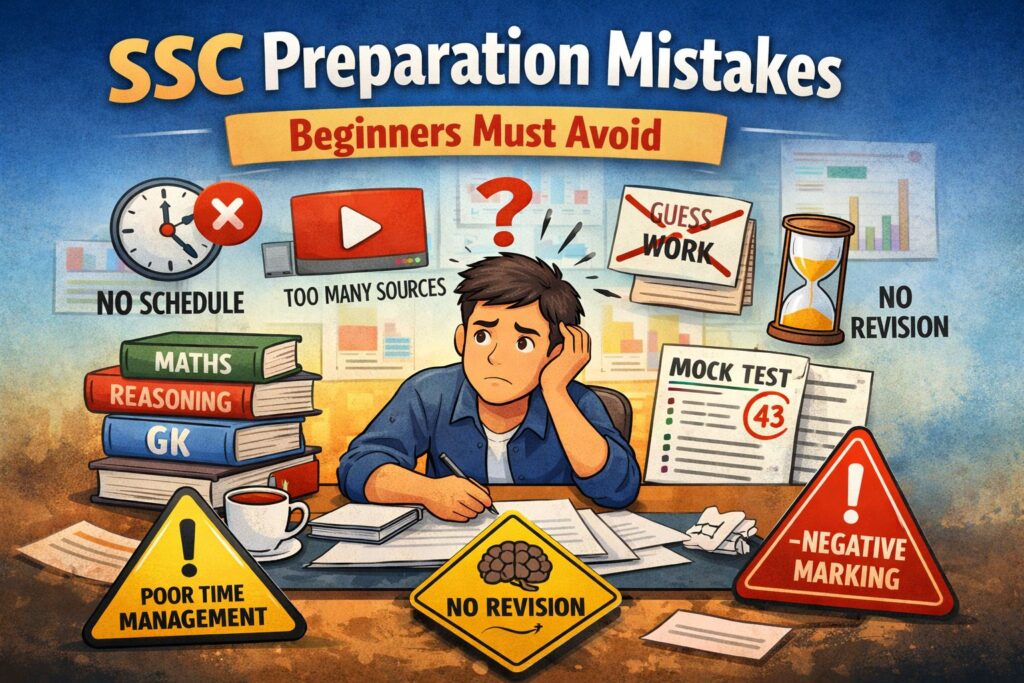
Avoiding common SSC preparation mistakes can save months of effort and significantly improve your chances of clearing the exam on the first attempt.
Many beginners start SSC preparation with full enthusiasm but often make small mistakes that slow down their progress. These mistakes are usually not about lack of hard work, but about following the wrong strategy. Without proper planning, balanced study, and regular practice, even serious aspirants struggle to see improvement in their scores.
In this guide, you will learn the most common SSC preparation mistakes beginners make and how you can avoid them to build a smarter, more effective preparation strategy.
Starting Preparation Without Understanding the Exam
One of the biggest mistakes beginners make is starting their preparation without properly understanding the SSC exam. Many students jump directly into books or online classes without checking the exam pattern or syllabus.
Every SSC exam follows a specific structure. There are fixed subjects, a defined number of questions, and a time limit. If you start studying random topics without knowing this structure, your preparation becomes unorganized and inefficient.
For example, some students spend too much time on advanced topics while ignoring basic concepts that carry more weight in the exam. Others prepare subjects that are not even part of the syllabus.
Before starting preparation, you should always:
- Check the latest exam pattern
- Go through the complete syllabus
- Understand subject-wise weightage
- Look at previous year question papers
This basic understanding helps you focus only on important topics and saves a lot of time during preparation.
Choosing the Wrong SSC Books Can Ruin Your Preparation!
Don’t waste months studying from outdated or ineffective material. Check this expert-recommended list of SSC books before you start your preparation journey.
View Best Books for SSC ExamsNot Following a Proper Study Plan
Another common mistake beginners make is studying without a proper plan. Many aspirants sit down to study but do not have clear daily targets or a fixed schedule. As a result, some subjects are studied too much while others are ignored.
SSC exams require balanced preparation across all subjects such as Quantitative Aptitude, Reasoning, English, and General Awareness. If you study randomly without dividing your time properly, your overall performance will suffer.
For example:
- Spending the entire week only on mathematics
- Ignoring English because it feels difficult
- Not allocating time for revision or practice
Without a study plan, preparation becomes inconsistent, and important topics remain untouched.
A proper study plan should include:
- Daily subject-wise time allocation
- Clear weekly targets
- Regular revision slots
- Time for mock tests and practice
Following a structured routine keeps your preparation organized and reduces stress. If you are unsure how to create a routine, you can follow a simple and practical daily SSC study plan that balances all subjects and includes time for revision and mock tests.
Ignoring Previous Year Question Papers
Many beginners spend most of their time solving new questions from books and online sources, but they ignore previous year question papers. This is a serious mistake because SSC exams often repeat concepts and question patterns.
Previous year papers show you:
- The real exam difficulty level
- Frequently asked topics
- Question types that appear regularly
- The balance between easy, moderate, and difficult questions
Without solving these papers, students often prepare topics that are rarely asked while ignoring the most important areas.
For example, in Quantitative Aptitude and Reasoning, certain question types appear almost every year. If you practice previous year papers, you can easily identify these high-frequency topics and prepare them more effectively.
Benefits of solving previous year papers:
- Better understanding of exam pattern
- Improved speed and accuracy
- Confidence in real exam conditions
- Smart topic selection
A good strategy is to:
- Solve one previous year paper every week
- Analyze your mistakes
- Note down frequently asked topics
- Revise those topics regularly
Previous year question papers act as a roadmap for SSC preparation. Ignoring them means preparing without direction.
Focusing Only on One or Two Subjects
Many SSC beginners make the mistake of spending most of their time on subjects they like, while ignoring the ones they find difficult. This creates an imbalance in preparation and affects the final score.
For example:
- A student good at reasoning may practice it daily but ignore English.
- Another student may focus only on mathematics and skip General Awareness.
- Some aspirants avoid English or quantitative aptitude because they feel weak in those subjects.
SSC exams are based on overall performance, not just one subject. Even if you score very high in one section, low marks in another can reduce your total score and affect your final selection.
This mistake usually happens because:
- Students feel comfortable with certain subjects
- They avoid topics that seem difficult
- They do not follow a balanced study routine
To avoid this mistake:
- Divide your daily study time among all subjects
- Give extra time to weak areas
- Maintain minimum practice in strong subjects
- Track subject-wise progress every week
A balanced preparation strategy ensures that all sections are covered properly and your overall score improves.
Not Practicing Mock Tests Regularly
Many beginners avoid mock tests during the early stages of preparation. Some students feel they are not ready, while others are afraid of getting low scores. As a result, they start giving mock tests only a few weeks before the exam, which is a big mistake.
Mock tests are not just for checking knowledge. They help you:
- Improve speed
- Build accuracy
- Learn time management
- Understand exam pressure
SSC exams are time-bound, and solving questions under a strict time limit requires practice. If you only study concepts and do not attempt full-length mock tests, you may struggle to complete the paper on time.
Common mistakes related to mock tests:
- Starting mocks too late
- Giving only one or two tests per month
- Avoiding tests after getting low scores
- Treating mocks as just a formality
A better approach is:
- Start mock tests after covering basic concepts
- Attempt at least one mock test every week in the beginning
- Increase the frequency closer to the exam
- Focus on improvement, not just scores
Regular mock test practice builds confidence and prepares you for the real exam environment.
Not Analyzing Mistakes After Mock Tests
Giving mock tests is important, but many beginners make the mistake of not analyzing their performance afterward. They attempt a test, check the score, and then move on to the next one without understanding what went wrong.
This habit slows down improvement because the same mistakes keep repeating.
A mock test is useful only when you:
- Review incorrect answers
- Understand why the mistake happened
- Revise the related concept
- Practice similar questions again
Common reasons for mistakes in mock tests:
- Conceptual weakness
- Calculation errors
- Misreading the question
- Poor time management
- Guesswork leading to negative marking
Instead of focusing only on the final score, you should focus on:
- Accuracy percentage
- Time spent per section
- Types of mistakes made
- Topics where errors are frequent
A simple analysis method:
- Note all incorrect questions.
- Identify the reason for each mistake.
- Revise the related concept.
- Solve 10–15 similar questions.
This process ensures that the same mistake does not appear in the next test. Over time, your accuracy and confidence improve significantly.
Collecting Too Many Study Materials
Many beginners believe that using more books, more notes, and more teachers will improve their chances of clearing the SSC exam. In reality, this often creates confusion and slows down progress.
Some common situations:
- Buying multiple books for the same subject
- Switching teachers frequently
- Watching different YouTube channels for the same topic
- Downloading too many PDFs but not studying them properly
When you use too many sources, the same topic is explained in different ways. This creates confusion and makes it harder to remember concepts. Instead of mastering one source, students keep jumping between materials and never complete any of them properly.
This mistake leads to:
- Lack of clarity in concepts
- Slow syllabus completion
- Increased stress and confusion
- Poor revision
A smarter approach is:
- Choose one reliable book or source for each subject
- Follow one teacher or one course at a time
- Complete the syllabus from that source
- Revise the same material multiple times
SSC exams test clarity and speed, not how many books you have studied. Fewer resources with proper revision are always better than too many unfinished materials.
Ignoring Revision
Many SSC aspirants focus only on learning new topics every day and forget the importance of revision. This is a major mistake because without revision, most of the studied content is forgotten within a few weeks.
SSC preparation is not just about covering the syllabus once. It is about remembering concepts, formulas, rules, and patterns until the exam. Without regular revision, even well-studied topics become weak.
Common signs of poor revision:
- Forgetting formulas during mock tests
- Making mistakes in previously studied topics
- Feeling like you have to start from the beginning again
- Low accuracy in familiar questions
A simple revision strategy can solve this problem.
You can follow this basic revision system:
- Daily revision: Spend 20–30 minutes revising what you studied the previous day.
- Weekly revision: Revise all important topics covered during the week.
- Monthly revision: Go through short notes, formulas, and key concepts.
Benefits of regular revision:
- Better memory retention
- Faster problem solving
- Improved accuracy in mock tests
- Higher confidence during the exam
Revision turns average preparation into strong preparation. Without it, even months of hard work may not produce the desired results.
Poor Time Management
Poor time management is one of the most common reasons why SSC aspirants struggle during preparation and in the actual exam. Many beginners either study without a fixed schedule or spend too much time on one subject while ignoring others.
For example:
- Studying only mathematics for several days
- Skipping General Awareness because it seems boring
- Spending hours on a single difficult question
- Not having fixed daily study hours
Without proper time management, preparation becomes unbalanced and stressful. Important topics may remain incomplete, and revision gets ignored.
In the actual SSC exam, time management is even more critical. You have to solve a large number of questions within a limited time. If you are not used to managing time during preparation, you may panic in the exam hall.
Common time management mistakes:
- No daily study schedule
- Long breaks between study sessions
- Procrastination and distractions
- No time allocated for revision and mock tests
To improve time management:
- Set fixed study hours every day
- Divide time equally among subjects
- Use a timer while solving questions
- Follow a weekly study plan
- Track your daily progress
Good time management makes preparation smoother and helps you stay consistent until the exam.
Depending Only on Coaching
Many beginners believe that joining a coaching institute is enough to clear the SSC exam. They attend classes regularly but do very little self-study. This is a major mistake because coaching can only guide you; real improvement comes from personal practice.
In coaching classes, teachers explain concepts and provide strategies, but:
- They cannot practice questions on your behalf.
- They cannot revise topics for you.
- They cannot fix your weak areas unless you work on them yourself.
Students who depend only on coaching often:
- Attend classes passively
- Do not revise after class
- Skip self-practice
- Rely completely on teachers’ notes
SSC exams require strong concepts, speed, and accuracy. These can only be developed through regular self-study and practice.
A better approach is:
- Use coaching for concept clarity and guidance
- Spend more time on self-practice at home
- Revise class notes daily
- Solve extra questions from reliable sources
Many successful candidates clear SSC exams through self study for SSC exams without any coaching. What matters most is consistency, smart practice, and regular revision.
Ignoring Accuracy and Attempt Strategy
Many SSC beginners focus only on attempting more questions, thinking that a higher number of attempts will automatically lead to a better score. However, this approach can backfire because most SSC exams include negative marking.
If you attempt too many questions with low accuracy, your incorrect answers can reduce your total score significantly.
Common mistakes related to accuracy:
- Guessing answers when unsure
- Rushing through questions to increase attempts
- Not checking calculation errors
- Ignoring accuracy during mock tests
For example, if you attempt 90 questions but make many mistakes, your score may be lower than someone who attempts 75 questions with high accuracy.
A smart attempt strategy includes:
- Attempting only the questions you are confident about
- Skipping time-consuming or confusing questions
- Focusing on accuracy first, then increasing attempts
- Practicing section-wise time management
A good target for most SSC exams is:
- Maintain 85–90% accuracy
- Gradually increase attempts as accuracy improves
With the right balance between speed and accuracy, your overall score improves and the risk of negative marking decreases.
Lack of Consistency
Lack of consistency is one of the biggest reasons why many SSC aspirants fail to reach their goals. Some students study with full energy for a few days or weeks, but then lose motivation and take long breaks. This breaks the flow of preparation.
SSC preparation is a long process that requires regular effort. Studying only when you feel motivated is not enough. Success in competitive exams depends more on daily discipline than on temporary motivation.
Common signs of inconsistency:
- Studying seriously for a few days, then skipping for a week
- Changing study plans frequently
- Taking long breaks after mock tests
- Waiting for motivation instead of following a routine
This irregular approach causes:
- Weak concepts
- Poor memory retention
- Slow progress
- Loss of confidence
To build consistency:
- Fix a daily study schedule
- Set small, realistic targets
- Study at the same time every day
- Track your daily progress
- Avoid long gaps in preparation
Even 3–4 hours of daily focused study is better than 10 hours of irregular study. Consistency turns small daily efforts into big results over time.
Choosing the Wrong SSC Books Can Ruin Your Preparation!
Don’t waste months studying from outdated or ineffective material. Check this expert-recommended list of SSC books before you start your preparation journey.
View Best Books for SSC ExamsFinal Tips to Avoid These Mistakes
Avoiding common mistakes is often more important than studying extra hours. A smart and balanced approach can save months of wasted effort and help you reach your goal faster.
Here are some practical tips every beginner should follow:
1. Understand the exam first
Before starting preparation, check the exam pattern, syllabus, and previous year papers. This gives you clear direction.
2. Follow a simple daily routine
Create a study plan that covers all subjects. Even a basic, consistent routine is better than a complicated plan you cannot follow.
3. Focus on concepts and practice
Do not just read theory. Solve questions regularly to build speed and accuracy.
4. Start mock tests at the right time
Once your basic concepts are clear, begin taking mock tests weekly. Increase the frequency as the exam approaches.
5. Always analyze your mistakes
After every mock test, spend time reviewing incorrect answers. This is where real improvement happens.
6. Limit your study resources
Use one good book or source per subject and revise it multiple times instead of collecting too many materials.
7. Make revision a habit
Revise important topics every week. This strengthens memory and improves accuracy.
8. Stay consistent
Study every day, even if for a few hours. Consistency matters more than motivation.
If you avoid these common mistakes and follow a balanced strategy, your SSC preparation will become more effective, less stressful, and much more result-oriented.
FAQs
Q1. What is the biggest mistake in SSC preparation?
The biggest mistake is starting preparation without understanding the exam pattern and syllabus. Many beginners study random topics, which wastes time and leads to unbalanced preparation.
Q2. Can I clear SSC exams with self-study?
Yes, many candidates clear SSC exams through self-study. With the right study plan, regular practice, mock tests, and consistent revision, self-study can be very effective.
Q3. How many hours should a beginner study daily for SSC?
A beginner should aim for 3–5 hours of focused study daily. The key is consistency. Studying regularly every day is more important than studying long hours occasionally.
Q4. When should I start giving mock tests for SSC?
You should start mock tests after completing the basic concepts of all subjects. In the beginning, one mock test per week is enough. Increase the frequency as the exam approaches.
Q5. How can I stay consistent during SSC preparation?
Set a fixed daily schedule, create small achievable targets, track your progress, and avoid long breaks. Consistency comes from discipline, not motivation.