
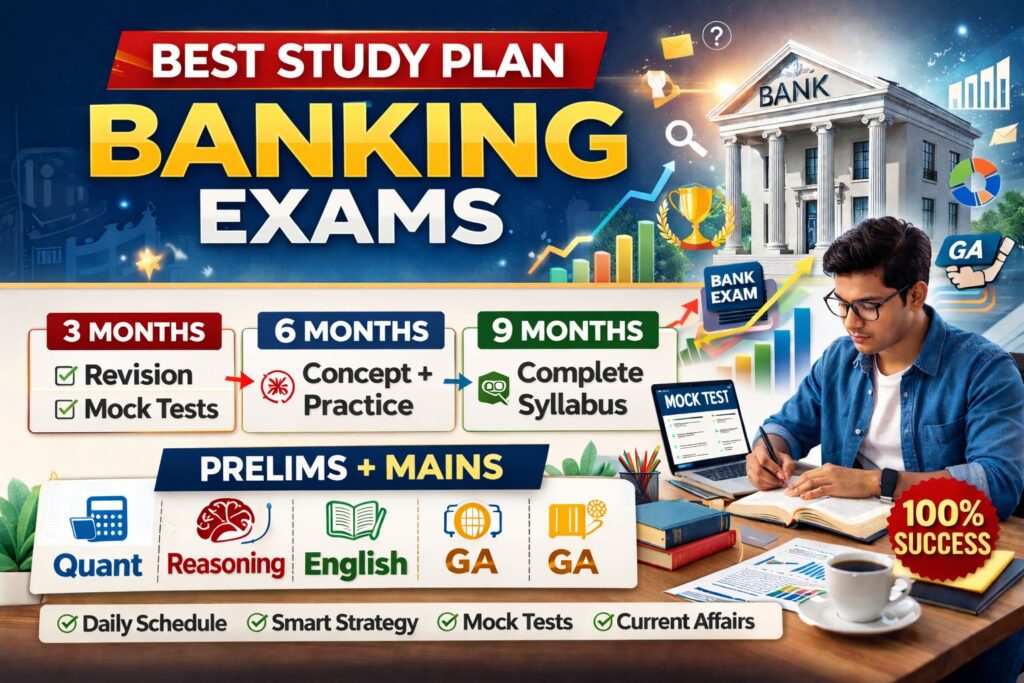
A complete 3, 6, and 9 month banking study plan to help beginners and experienced aspirants prepare effectively for upcoming bank exams.
Introduction – Why You Need a Proper Banking Study Plan
Preparing for competitive banking exams such as IBPS PO, IBPS Clerk, SBI PO, or RBI Assistant requires much more than hard work. The real difference between successful candidates and unsuccessful ones is not the number of hours they study, but how effectively they use their preparation time. This is where a well-structured banking study plan becomes essential.
Many aspirants begin their preparation with enthusiasm but soon find themselves overwhelmed by the vast syllabus, multiple subjects, and time pressure. Without a clear roadmap, students often jump from one topic to another, spend too much time on easy areas, or completely ignore weak subjects. This type of random preparation leads to confusion, low confidence, and poor performance in mock tests.
A timeline-based study plan helps you organize your preparation in a systematic way. Instead of studying everything at once, you divide your journey into manageable phases such as concept building, practice, revision, and mock test analysis. This approach ensures that you not only complete the syllabus on time but also improve your speed and accuracy gradually — which are critical factors in bank exams.
Another important benefit of having a preparation timeline is that it allows you to choose a plan based on your current level of readiness:
- A 3-month study plan is suitable for candidates who already have basic knowledge and want to focus on revision and practice.
- A 6-month study plan works best for average beginners who understand some concepts but need structured preparation.
- A 9-month study plan is ideal for complete beginners who are starting from scratch and need enough time to build strong fundamentals.
Whether you are a student, a working professional, or a full-time aspirant, following a proper banking study plan can significantly improve your chances of clearing both the Prelims and Mains exams in your first attempt.
A disciplined and strategic preparation journey always produces better results than studying without direction. In the next section, we will first understand the banking exam structure so that you can prepare according to the exact requirements of the examination.
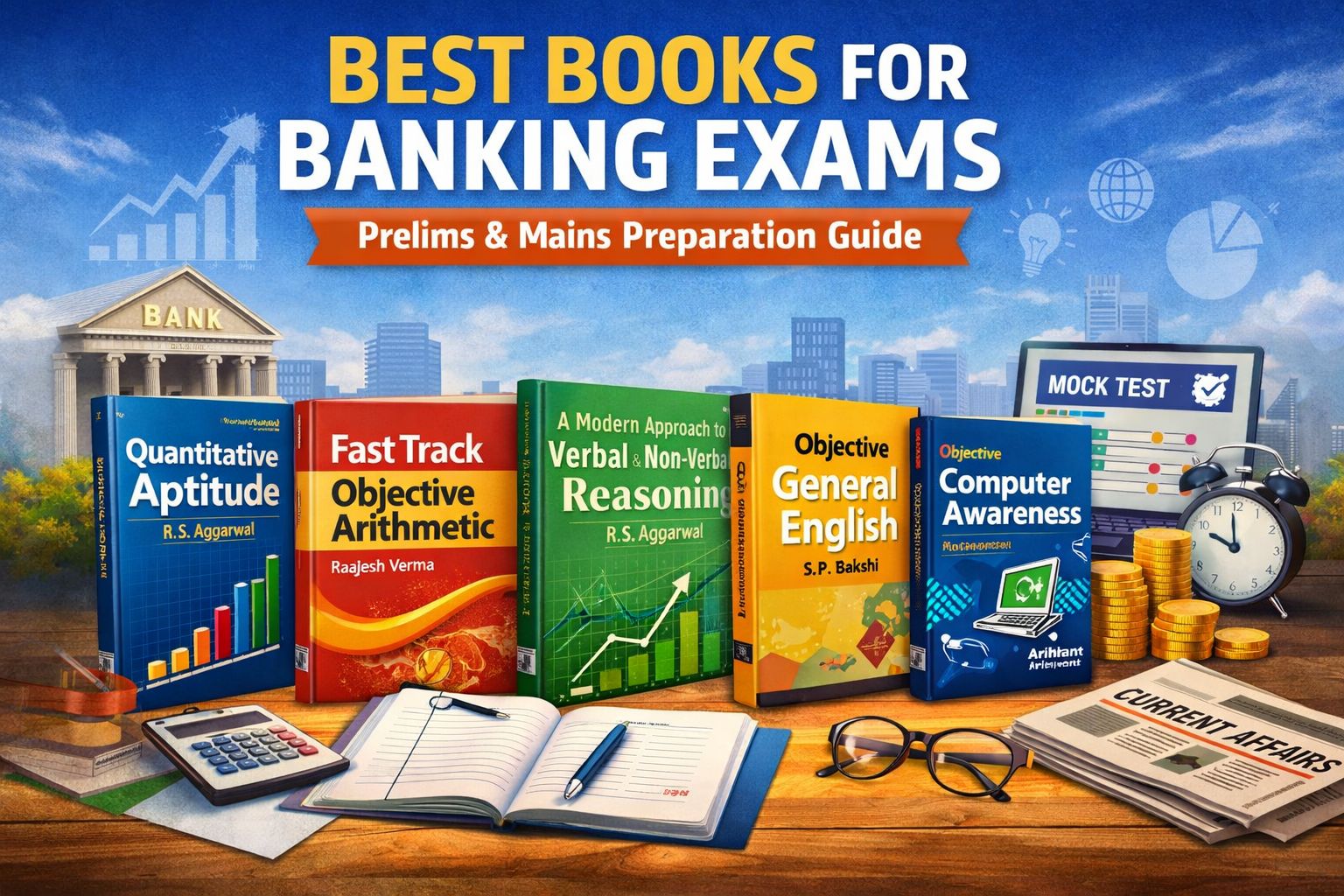
Start Your Banking Exam Preparation with the Right Books
Boost your chances of success with expert-recommended books for SBI, IBPS & RBI exams — Prelims + Mains preparation.
View Best Banking Exam BooksUnderstanding the Banking Exam Structure Before Preparation
Before you begin following any banking study plan, it is extremely important to understand the actual structure of banking exams. Many aspirants start preparing without knowing the exam pattern, marking scheme, or subject-wise weightage. As a result, they spend too much time on less important topics and ignore sections that carry higher marks.
Most major banking exams in India such as IBPS PO, IBPS Clerk, SBI PO, and RBI Assistant are conducted in two main stages:
Preliminary Examination (Prelims)
The Prelims exam is the first stage of the selection process and acts as a screening test. The marks obtained in this stage are usually not counted in the final merit list, but clearing this round is mandatory to qualify for the Mains exam.
The Preliminary exam generally includes the following three sections:
- Quantitative Aptitude
- Reasoning Ability
- English Language
This stage tests your basic numerical ability, logical thinking, and language understanding. The difficulty level is usually easy to moderate, but the biggest challenge is solving questions accurately within a limited time frame.
Speed and accuracy play a crucial role in this stage because there is sectional timing in most bank exams. Candidates must attempt questions quickly without making too many mistakes, as negative marking is applicable for wrong answers.
Main Examination (Mains)
The Mains exam is the most important stage of the banking selection process because the marks obtained here are considered for final selection.
The Mains exam typically includes the following subjects:
- Reasoning Ability
- Quantitative Aptitude / Data Interpretation
- English Language
- General / Banking Awareness
- Computer Knowledge
In some exams like SBI PO, there may also be a Descriptive Test which includes essay writing or letter writing to evaluate your written communication skills.
Compared to the Prelims exam, the Mains exam is more analytical and concept-based. Questions in this stage are often lengthy and require a deeper understanding of topics. Simply memorizing formulas or tricks is not enough — strong conceptual clarity is necessary to solve problems efficiently.
Importance of Knowing the Exam Pattern
Understanding the exam structure helps you in:
- Planning your preparation subject-wise
- Allocating study time effectively
- Identifying high-scoring areas
- Improving time management skills
- Avoiding unnecessary topics
Once you clearly understand what the exam demands, you can design your preparation strategy accordingly.
In the next section, we will learn how to choose the right preparation timeline based on your current level and available time.
How to Choose the Right Preparation Timeline
Not every aspirant starts preparation at the same level. Some candidates already have a strong background in mathematics or reasoning, while others may be preparing after a long academic gap. That is why choosing the correct preparation timeline is very important before starting your banking study plan.
Instead of blindly following someone else’s schedule, you should first evaluate your current level and available time. Let us understand which timeline suits which type of candidate.
3 Month Study Plan – For Experienced Candidates
A 3-month preparation plan is suitable for candidates who:
- Already understand basic concepts of Quantitative Aptitude and Reasoning
- Have previously prepared for banking or other competitive exams
- Need mainly revision, practice, and mock test improvement
- Can dedicate at least 5–6 hours daily for focused study
In this timeline, you do not spend much time on basic concept learning. Instead, the focus is on:
- Speed improvement
- Solving high-level questions
- Practicing full-length mock tests
- Detailed mock analysis
This plan is intense and requires discipline. It is not recommended for complete beginners.
6 Month Study Plan – For Average Beginners
A 6-month plan works best for candidates who:
- Have basic knowledge but lack strong practice
- Are moderately comfortable with mathematics and English
- Need time for both concept building and practice
- Can study 4–5 hours daily consistently
This timeline allows you to:
- Strengthen fundamentals
- Practice topic-wise questions
- Gradually improve speed
- Attempt sectional and full-length mock tests
Most aspirants find the 6-month preparation plan practical and manageable.
9 Month Study Plan – For Complete Beginners
A 9-month study plan is ideal for candidates who:
- Are starting from scratch
- Have weak mathematics or reasoning skills
- Are returning to studies after a long break
- Can dedicate 3–4 hours daily initially
This plan provides enough time to:
- Build strong conceptual foundations
- Understand shortcuts and tricks properly
- Practice regularly without pressure
- Improve accuracy before focusing on speed
If you are unsure about your level, it is always safer to choose a longer timeline and adjust later.
Self-Assessment Checklist
Before selecting your timeline, ask yourself:
- Can I solve basic arithmetic and percentage questions easily?
- Am I comfortable with puzzles and logical reasoning?
- Is my English grammar and comprehension average or above?
- How many hours can I realistically study daily?
- Have I appeared in any banking exam before?
Your honest answers will help you choose between 3, 6, or 9 months preparation.
Remember, consistency matters more than duration. A focused 6-month plan can be more effective than an unorganized 9-month preparation.
In the next section, we will begin with the detailed 9 Month Banking Study Plan for Beginners, step-by-step month-wise guidance.
9 Month Banking Study Plan (For Beginners)
If you are starting your bank exam preparation from the very beginning, a 9-month timeline gives you the perfect opportunity to build strong fundamentals without unnecessary pressure. This plan is designed in three phases so that you move from concept learning to practice and finally to exam-level preparation in a smooth and structured way.
Month 1–3: Concept Building Phase
The first three months should be completely dedicated to understanding the basic concepts of all subjects. At this stage, your main goal is not speed but clarity.
Focus on the following areas:
Quantitative Aptitude
- Number System
- Simplification & Approximation
- Percentage
- Ratio and Proportion
- Profit and Loss
- Simple & Compound Interest
- Time and Work
- Time, Speed and Distance
Try to understand the logic behind each formula instead of memorizing shortcuts.
Reasoning Ability
- Alphabet and Number Series
- Coding-Decoding
- Direction Sense
- Blood Relations
- Inequality
- Basic Seating Arrangement
- Syllogism
Solve easy-level questions to develop logical thinking ability.
English Language
- Basic Grammar Rules
- Parts of Speech
- Tenses
- Articles and Prepositions
- Vocabulary Building
- Reading Comprehension (Basic Level)
Make it a habit to read newspapers or articles daily to improve comprehension skills.
General Awareness
Start following current affairs related to:
- Banking sector
- Financial news
- Government schemes
- Economy updates
Spend at least 20–30 minutes daily on current affairs preparation.
Month 4–6: Practice & Speed Improvement Phase
Once your concepts are clear, the next three months should focus on applying what you have learned.
During this phase:
- Start solving topic-wise practice questions
- Attempt sectional quizzes regularly
- Learn shortcut techniques where applicable
- Practice puzzles and data interpretation sets
- Work on error reduction
You should also begin solving:
- Moderate-level Quant questions
- Seating Arrangement & Puzzle sets
- Cloze Test and Para Jumbles
- Data Interpretation basics
At the end of each week, revise previously studied topics to avoid forgetting concepts.
Month 7–9: Full-Length Mock Test Phase
The final three months are the most crucial stage of your preparation.
Now your focus should shift towards:
- Attempting full-length mock tests
- Improving time management
- Identifying weak areas
- Analyzing mistakes in mock tests
- Increasing accuracy rate
Follow this routine:
- Attempt at least 2–3 mock tests per week
- Analyze each test carefully
- Note down repeated mistakes
- Revise weak topics regularly
Mock test analysis is just as important as attempting the test itself. Without proper analysis, you may continue making the same mistakes in the actual exam.
By the end of this phase, you should be comfortable solving exam-level questions within the given time limit.
In the next section, we will discuss the 6 Month Banking Study Plan for candidates who already have some basic knowledge.
6 Month Banking Study Plan (For Intermediate Candidates)
A 6-month preparation timeline is suitable for candidates who already have basic knowledge of subjects like Quantitative Aptitude, Reasoning, and English but need a structured plan to improve performance. This study plan focuses on strengthening concepts, improving speed, and developing exam-level problem-solving skills within a limited timeframe.
This timeline can also be useful for working professionals or students who can dedicate around 4–5 hours daily for preparation.
Month 1–2: Concept Revision Phase
The first two months should be used to revise all fundamental concepts. Even if you are familiar with basic topics, revisiting them helps improve accuracy and builds confidence.
During this phase, focus on:
- Arithmetic topics in Quantitative Aptitude
- Basic and moderate reasoning concepts
- English grammar rules and vocabulary
- Reading comprehension practice
- Basic Data Interpretation concepts
Avoid jumping directly to high-level questions. Instead, strengthen your foundation so that you can solve questions quickly during practice sessions.
You should also begin preparing daily current affairs for the General Awareness section from the very beginning.
Month 3–4: Practice Phase
After revising the fundamentals, the next two months should be dedicated to practice and application.
In this phase:
- Solve topic-wise practice questions daily
- Attempt sectional tests for each subject
- Practice puzzles and seating arrangement regularly
- Work on Data Interpretation sets
- Improve reading speed for English comprehension
Try to identify your weak areas and devote extra time to them. Consistent practice during this period will help you improve both speed and accuracy.
Weekly revision is extremely important at this stage to retain what you have studied.
Month 5–6: Mock Test & Analysis Phase
The final two months should be focused on exam-oriented preparation through mock tests.
Follow this approach:
- Attempt at least 3 full-length mock tests every week
- Analyze each mock test in detail
- Track your performance subject-wise
- Identify time-consuming question types
- Revise frequently asked topics
Mock test analysis helps you understand your mistakes and avoid repeating them in future attempts. Try to simulate real exam conditions while attempting tests.
By the end of this phase, your goal should be to:
- Improve time management
- Reduce negative marking
- Increase accuracy
- Gain confidence before the actual exam
In the next section, we will discuss the 3 Month Banking Study Plan for experienced candidates who need quick preparation.
3 Month Banking Study Plan (For Experienced Candidates)
A 3-month preparation timeline is ideal for candidates who already have a strong understanding of the basic concepts and have possibly appeared in banking or other competitive exams before. This short-term plan focuses mainly on revision, intensive practice, and performance improvement through mock tests.
If you can dedicate at least 5–6 hours daily for preparation, this study plan can help you prepare effectively within a limited time.
Month 1: Revision + Practice Phase
The first month should be dedicated to revising all important concepts across subjects.
Focus on:
- Arithmetic formulas and shortcut techniques
- Important reasoning concepts
- English grammar rules
- Frequently asked question types
- Basic to moderate level Data Interpretation
Start solving topic-wise practice questions immediately after revision. This will help reinforce concepts and improve accuracy.
You should also continue preparing daily current affairs related to banking, economy, and finance.
Month 2: Mock Test Phase
In the second month, your preparation should become more exam-oriented.
During this period:
- Attempt sectional tests regularly
- Practice puzzles and DI sets
- Improve reading comprehension speed
- Solve previous year questions
- Begin attempting full-length mock tests
Try to attempt at least 2–3 mock tests per week under real exam conditions.
Month 3: Final Preparation Phase
The last month is the most important part of your preparation journey.
Your focus should now be on:
- Attempting 4–5 mock tests per week
- Analyzing mock test performance
- Identifying weak areas
- Revising important topics
- Improving time management skills
Avoid learning completely new topics during this phase. Instead, strengthen what you have already prepared.
Mock test analysis plays a crucial role in this stage. Carefully review incorrect answers and understand the reason behind each mistake.
By the end of this plan, you should be confident in attempting the actual exam without panic or confusion.
In the next section, we will discuss the Subject-Wise Daily Study Plan for Bank Exams to help you manage your day-to-day preparation effectively.
Subject-Wise Daily Study Plan for Bank Exams
No matter whether you are following a 3, 6, or 9 month banking study plan, your daily routine plays the most important role in determining your success. A proper subject-wise distribution of time ensures balanced preparation and prevents neglecting any section.
Below is a structured daily study model that you can adjust according to your available time.
Ideal Daily Study Hours
- Full-time aspirants: 5–6 hours per day
- Students: 4–5 hours per day
- Working professionals: 2–4 hours per day
The key is consistency. Studying 4 hours daily for six months is more effective than studying 10 hours irregularly.
Daily Time Distribution (Example: 5 Hours Study Plan)
1. Quantitative Aptitude – 1.5 Hours
Focus on:
- Arithmetic topics
- Data Interpretation sets
- Simplification & Approximation
- Practice 20–30 questions daily
Make sure you revise formulas regularly and practice calculation speed.
2. Reasoning Ability – 1.5 Hours
Focus on:
- Puzzles and Seating Arrangement
- Syllogism
- Inequality
- Coding-Decoding
- Logical Reasoning sets
Reasoning requires daily practice. Try to solve at least 2 puzzle sets every day.
3. English Language – 1 Hour
Focus on:
- Reading Comprehension
- Cloze Test
- Error Detection
- Vocabulary building
Read an editorial or article daily to improve reading speed and comprehension skills.
4. General Awareness – 30 Minutes
Focus on:
- Current affairs (last 6 months before exam)
- Banking awareness
- Important government schemes
- Financial news
Make short notes to revise quickly before the exam.
5. Revision & Mock Analysis – 30 Minutes
Daily revision is essential to avoid forgetting previously studied topics. If you attempt a mock test, spend time analyzing mistakes carefully.
Weekly Study Structure
- Attempt at least 1 full-length mock test per week (increase frequency as exam approaches)
- Revise weak topics every Sunday
- Track your performance subject-wise
- Improve time management gradually
Following a disciplined daily routine will strengthen your preparation and build exam confidence.
In the next section, we will discuss a Weekly Study Plan for Working Candidates, especially for those who cannot study full-time.
Weekly Study Plan for Working Candidates
Preparing for banking exams while managing a full-time job can be challenging, but with a proper weekly study plan, it is absolutely possible to crack the exam. The key is to utilize your available time efficiently and maintain consistency throughout your preparation journey.
Working professionals may not get enough time to study during weekdays, so planning your weekly routine in advance becomes essential.
Weekday Study Plan (Monday to Friday)
On working days, try to dedicate at least 2–3 hours daily for preparation.
You can follow this structure:
Morning (Before Work) – 1 Hour
- Revise formulas or grammar rules
- Solve 10–15 Quant questions
- Practice vocabulary or reading comprehension
Evening (After Work) – 1 to 2 Hours
- Practice Reasoning questions
- Solve puzzles or seating arrangement
- Study current affairs for 20–30 minutes
Avoid attempting difficult topics when you are mentally tired. Focus on moderate practice and revision during weekdays.
Weekend Study Plan (Saturday & Sunday)
Weekends are the best time to cover major portions of your syllabus.
Try to dedicate 4–6 hours daily on weekends.
Focus on:
- Learning new topics
- Practicing Data Interpretation sets
- Solving full puzzle sets
- Attempting sectional tests
- Revising weak areas
You should also attempt:
- At least 1 full-length mock test every weekend
- Detailed mock test analysis
Mock test analysis helps you understand where you are losing marks and which sections need improvement.
Weekly Revision Strategy
At the end of each week:
- Revise all important formulas
- Review current affairs notes
- Identify weak topics
- Plan the next week’s study schedule
Consistency and proper planning are the most important factors for working candidates.
In the next section, we will discuss the Best Study Resources & Materials required for bank exam preparation.
Best Study Resources & Materials for Bank Exam Preparation
Choosing the right study material is just as important as following a structured banking study plan. Many aspirants waste valuable time switching between multiple books and online resources. Instead of collecting too many materials, focus on a few reliable sources and revise them multiple times.
Below is a practical guide to selecting quality resources for each subject.
Quantitative Aptitude
For Quant preparation, focus on books that explain concepts clearly and provide sufficient practice questions. Your goal should be to strengthen arithmetic and data interpretation.
While selecting the best books for banking exams, look for:
- Clear explanation of formulas
- Step-by-step solved examples
- Practice questions with varying difficulty levels
- Previous year question patterns
Do not rely only on shortcut tricks. First understand the concept, then apply faster methods.
Reasoning Ability
Reasoning requires continuous practice. Choose resources that include:
- Topic-wise practice questions
- High-level puzzles and seating arrangement
- Logical reasoning sets
- Previous year pattern questions
Practice different types of puzzles regularly to improve speed and pattern recognition skills.
English Language
For English preparation:
- Use a grammar-focused book for concept clarity
- Practice reading comprehension daily
- Improve vocabulary through editorials and articles
- Solve cloze tests and para jumbles regularly
Consistency is very important in this section because improvement happens gradually.
General Awareness
For General Awareness:
- Follow daily current affairs from reliable sources
- Prepare monthly current affairs notes
- Focus on banking and financial awareness
- Revise at least last 6 months before exam
Make concise notes for quick revision before the Mains exam.
Online Resources & Mock Tests
Mock tests are an essential part of your preparation. Choose a reliable test series that:
- Follows the latest exam pattern
- Provides detailed performance analysis
- Offers sectional and full-length tests
- Includes previous year question simulations
Remember, mock test analysis is more important than the number of tests you attempt.
How to Avoid Resource Overload
- Do not buy too many books.
- Stick to one main book per subject.
- Revise the same material multiple times.
- Focus on practice rather than collecting new resources.
Quality preparation always beats quantity.
In the next section, we will discuss important self-study techniques from a practical banking self study guide perspective that can help you prepare effectively without coaching.
Self Study Tips for Bank Exam Aspirants
Many candidates believe that joining a coaching institute is necessary to crack banking exams. However, with the right approach and discipline, self-study can be equally effective. A well-planned preparation routine based on a practical banking self study guide can help you complete the syllabus on time and perform confidently in the exam.
Below are some proven self-study tips that every bank exam aspirant should follow.
Create a Realistic Study Schedule
Avoid making overly ambitious study plans that are difficult to follow consistently. Instead:
- Set daily and weekly study targets
- Allocate time for each subject
- Include revision and practice sessions
- Track your progress regularly
A realistic schedule helps you stay motivated and prevents burnout.
Focus on Concept Clarity First
Do not rush into solving advanced-level questions before understanding the basics.
- Learn the fundamental concepts
- Understand formulas and rules
- Practice basic-level questions
- Gradually move to moderate difficulty
Strong fundamentals make it easier to solve complex questions during the exam.
Practice Regularly
Daily practice improves both speed and accuracy.
- Solve Quant questions every day
- Practice reasoning puzzles regularly
- Attempt English comprehension exercises
- Revise current affairs notes
Consistent practice reduces exam fear and increases confidence.
Attempt Mock Tests Periodically
Mock tests help you:
- Understand exam-level difficulty
- Improve time management
- Identify weak areas
- Reduce negative marking
Always analyze your performance after attempting a mock test. Note down mistakes and revise related topics.
Maintain Short Notes
Prepare concise notes for:
- Important formulas
- Shortcut techniques
- Vocabulary words
- Current affairs
Short notes are extremely useful for quick revision before the exam.
Stay Consistent and Avoid Distractions
Avoid unnecessary breaks from preparation.
- Limit social media usage
- Follow a fixed study routine
- Stay focused on your goal
- Maintain a positive mindset
Consistency is the key to success in any competitive exam.
In the next section, we will discuss smart preparation techniques based on an effective banking preparation strategy to help you crack the exam faster.
Smart Preparation Techniques to Crack Exams Faster
Following a well-defined banking preparation strategy can make a significant difference in your overall performance. Smart preparation is not about studying more hours — it is about studying efficiently and focusing on the right areas.
Below are some effective techniques that can help you improve your performance in less time.
Focus on High-Scoring Topics
Some topics are frequently asked in banking exams and carry higher weightage.
For example:
- Simplification and Approximation
- Number Series
- Seating Arrangement
- Syllogism
- Data Interpretation
- Reading Comprehension
Prioritizing these topics can help you score more marks with less effort.
Improve Calculation Speed
Fast calculation skills are essential for Quantitative Aptitude.
You should:
- Memorize squares and cubes
- Practice multiplication shortcuts
- Learn percentage-to-fraction conversions
- Improve mental math ability
Better calculation speed helps you save time during the exam.
Use Elimination Technique
In multiple-choice questions:
- Eliminate clearly wrong options first
- Narrow down possible answers
- Make logical guesses when required
This technique increases your chances of selecting the correct answer even if you are unsure.
Practice Previous Year Questions
Previous year questions help you:
- Understand exam trends
- Identify important topics
- Learn frequently asked question types
- Improve problem-solving approach
Try solving them in a time-bound manner.
Analyze Mock Tests Properly
After attempting a mock test:
- Check incorrect answers
- Understand the reason behind mistakes
- Identify weak topics
- Revise those topics again
Without analysis, mock tests will not improve your performance significantly.
Avoid Spending Too Much Time on One Question
If you are stuck:
- Skip the question
- Move to the next one
- Return later if time permits
Time management is one of the most important skills required to clear banking exams.
In the next section, we will discuss some common mistakes that aspirants should avoid during their preparation journey.
Common Mistakes to Avoid During Bank Exam Preparation
Many banking aspirants work hard but still fail to clear the exam due to avoidable mistakes in their preparation strategy. Being aware of these common errors can help you stay on the right track and improve your chances of success.
Studying Without a Proper Plan
Starting preparation without a structured banking study plan often leads to:
- Incomplete syllabus coverage
- Poor time management
- Lack of revision
- Low mock test performance
Always follow a timeline-based study plan to ensure balanced preparation.
Ignoring Weak Subjects
Most candidates prefer studying subjects they are comfortable with and avoid weaker areas such as Quantitative Aptitude or English.
This results in:
- Sectional cut-off failure
- Unbalanced preparation
- Low overall score
Make sure you devote extra time to improve weak subjects.
Attempting Too Many Resources
Using multiple books and online materials creates confusion and wastes time.
Instead:
- Stick to limited study resources
- Revise the same material repeatedly
- Focus on practice rather than collecting new content
Quality preparation is more important than quantity.
Not Practicing Mock Tests Regularly
Some aspirants focus only on theory and avoid attempting mock tests.
This leads to:
- Poor time management
- Exam anxiety
- Lack of familiarity with exam pattern
Mock tests help simulate real exam conditions and improve performance.
Skipping Mock Test Analysis
Attempting mock tests without analyzing performance is a common mistake.
Always:
- Review incorrect answers
- Identify time-consuming questions
- Revise weak topics
Mock test analysis helps you avoid repeating mistakes in the actual exam.
Ignoring Current Affairs Preparation
General Awareness is an important scoring section in the Mains exam. Ignoring current affairs can cost you valuable marks.
Make sure you:
- Follow daily current affairs
- Revise monthly updates
- Focus on banking and financial news
Avoiding these mistakes can significantly improve your preparation efficiency and exam performance.
In the next section, we will conclude this banking study plan with some final preparation advice.
Start Your Banking Exam Preparation with the Right Books
Boost your chances of success with expert-recommended books for SBI, IBPS & RBI exams — Prelims + Mains preparation.
View Best Banking Exam BooksConclusion – Final Preparation Advice
Cracking a banking exam is not about luck or last-minute preparation. It is the result of consistent effort, smart planning, and disciplined execution over several months. Whether you choose a 3, 6, or 9 month banking study plan, the key factor is how sincerely you follow it.
Always remember:
- Build strong fundamentals before focusing on speed.
- Practice daily to improve accuracy.
- Attempt mock tests regularly and analyze them carefully.
- Revise frequently to retain concepts.
- Stay consistent, even on days when motivation is low.
Do not compare your preparation journey with others. Every aspirant has a different starting point and learning pace. Focus on steady improvement rather than instant results.
Banking exams test not only your knowledge but also your time management, decision-making ability, and mental stability under pressure. If you prepare with discipline and follow a structured timeline, you can confidently clear both Prelims and Mains in your first attempt.
Stay patient, trust your preparation process, and keep moving forward with determination.
FAQs
Q1. Can I crack a banking exam in 3 months preparation?
Yes, you can crack a banking exam in 3 months if you already have a basic understanding of subjects like Quantitative Aptitude, Reasoning, and English. In such cases, your preparation should focus mainly on revision, regular practice, and mock test analysis.
Q2. Is 6 months enough for bank exam preparation?
Yes, a 6-month preparation timeline is generally sufficient for candidates who have average knowledge of the syllabus and can dedicate 4–5 hours daily for study. With consistent practice and mock tests, many aspirants clear bank exams within this timeframe.
Q3. How many hours should I study daily for bank exams?
Ideally, full-time aspirants should study 5–6 hours daily, while working professionals should aim for at least 2–4 hours of focused study every day.
Q4. Which subjects are most important for banking exams?
Quantitative Aptitude, Reasoning Ability, English Language, and General Awareness are the core subjects for most banking exams. A balanced preparation approach is required to clear sectional cut-offs in all subjects.
Q5. Are mock tests necessary for bank exam preparation?
Yes, mock tests are extremely important because they help you understand the exam pattern, improve time management skills, and identify weak areas in your preparation.